subjects · 9 min read
Renaissance Dog Portraits: Your Dog as a Duke, Admiral or General
How a Renaissance dog painting is made from a phone photograph: which costume suits which breed, the photo detail that matters, sizes and prices from £220.
By Thomas Mark
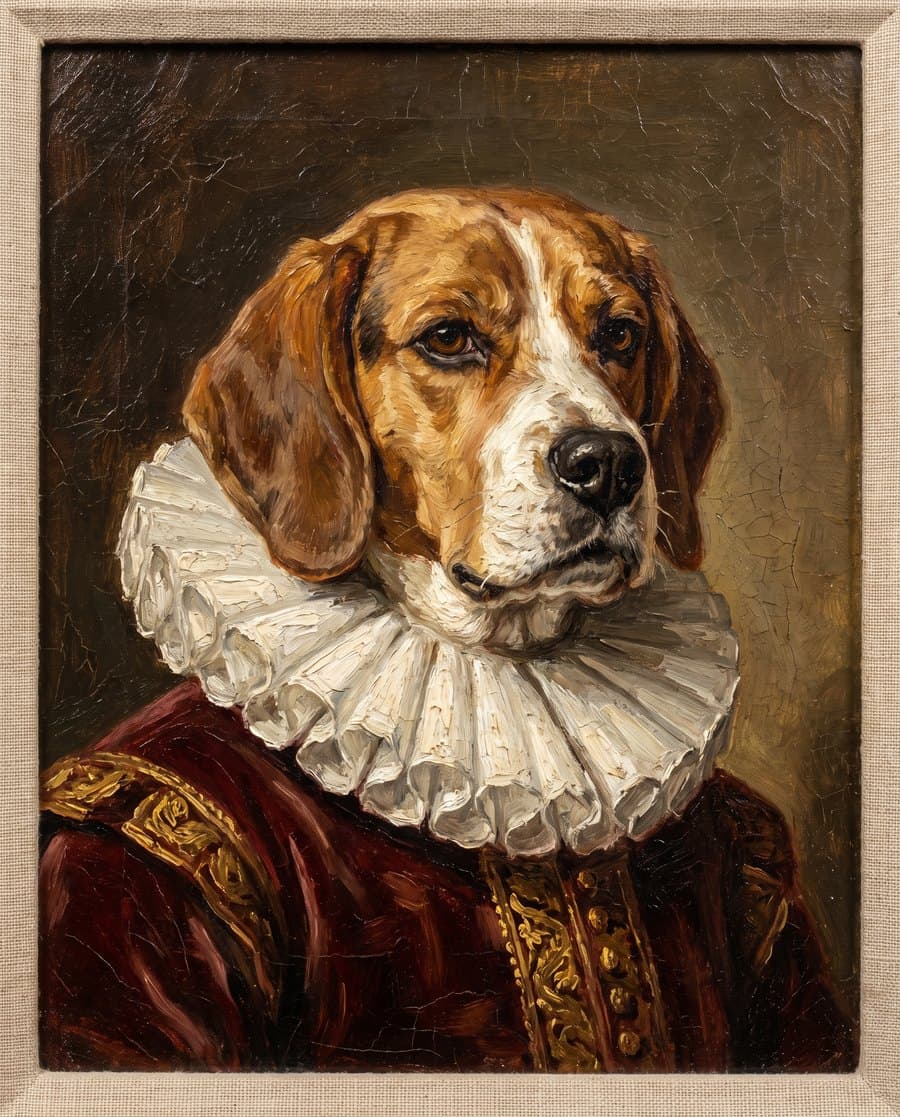
A Renaissance dog painting is a hand-painted oil in which your dog's head is painted from your photograph and set onto the body, costume and background of a period aristocratic portrait: an admiral's dress uniform, a duke's black velvet, a cardinal's red silk. The costume is a painting decision rather than an upgrade, so it costs nothing on top of the size price of £220 to £549.
Two things decide whether one works: which costume suits the dog's face, and whether your photograph was taken at the right height.
What a Renaissance dog painting is, and is not
Searches for dog renaissance painting turn up three quite different products, and it is worth knowing which you are looking at before comparing prices.
The first is a digital composite printed on canvas: your dog's head masked out of the photo onto a stock costume, or the whole thing generated by an image model. Usually £20 to £60, arrives within a week, a perfectly good joke gift — though up close you see the seam at the neck, the wrong lighting on the fur and the flat printed surface. The second is a print of a painting the studio made once and sells to everyone with a name added at the bottom: cheap, competent, not of your dog. (We sell the first kind ourselves, and label it: the Sitting Room paints your dog into a Tudor, Regency, Dutch or Napoleonic portrait in a few minutes, by computer — the first one free, £9 for the full-size file, a picture for the phone rather than a painting for the wall.)
The third is what we do: an oil on canvas, painted by hand by a professional artist from your photograph. It takes three to four weeks to paint, plus delivery, and ships rolled in a tube, unframed, for you to frame locally. It costs more, and it is the only one of the three where your dog's face was painted by a person looking at your dog. If you want the joke for a birthday next Tuesday, buy the print. If you want the thing still on a wall in twenty years, this is it.
Costume by breed and temperament
The costume is chosen against the shape of the head, the set of the ears and the dog's expression, not off a menu. A few pairings do most of the work.
| Costume | What the face needs | Dogs it tends to suit |
|---|---|---|
| Admiral's dress uniform, gold braid and medals | A small, alert head above a broad chest of decoration | Pomeranians, spaniels, dachshunds, terriers, anything self-important |
| General or cavalry officer, sash and high collar | A long muzzle and an upright neck to rise out of the collar | German shepherds, collies, huskies, greyhounds |
| Duke in black velvet with a lace collar | A calm, level gaze — the costume is quiet, the face carries it | Labradors, retrievers, weimaraners, greying older dogs |
| Cardinal in red silk | A serious face and a coat that holds up against a field of red | Black labradors, dobermans, rottweilers, black cats |
| Tudor gentleman, flat cap and fur-trimmed gown | A wide, square head that fills the cap's line | Bulldogs, boxers, staffies, mastiffs |
| Elizabethan ruff | A flat or short muzzle, framed as a plate frames a meal | Pugs, French bulldogs, cavaliers, Persian cats |
| Victorian frock coat and cravat | Long drop ears reading as side-whiskers or a wig | Cocker spaniels, bassets, bloodhounds, setters |
Two rules sit underneath that table. Erect ears want a hat or a plume, because the headwear has something to sit against; drop ears look better bare, since a hat pushes them flat and the dog stops looking like itself. And the funnier result comes from a serious dog in serious dress rather than a goofy dog in a goofy costume — a dog that already looks faintly disappointed in you is the ideal sitter for an admiral.
If none of that lands, describe the dog's character when you order and we will suggest two. Costume is one of fourteen directions a dog portrait can take — dog portrait ideas covers the rest.
The photo requirement that matters most
It is not resolution. A modern phone photo has more detail than a painter can use. What decides whether a Renaissance dog painting works is the height it was taken from, and where the dog is looking.
Period portraits put the sitter's head at or just above the viewer's eye line, turned three-quarters. Almost every photo of a dog is taken from standing height, looking down, and on a uniformed body that angle reads as a dog peering over a wall: the neck vanishes, the chest foreshortens, and the costume has nothing to attach to.
The fix takes thirty seconds. Kneel so the lens is level with the dog's eyes, have someone behind you make a noise so the ears go up and the eyes come to the camera, then take twenty photos and send three. Ears up matters: flattened ears make a dog look apologetic in a costume built for swagger. Daylight beats flash, which puts a white disc in each eye.
How to photograph your dog for a portrait goes through coats, light and getting a dog to sit still. If your only photo is from above, send it anyway: we reply with an honest read within hours, 9am to 5pm Monday to Saturday (UK time), and will say if a five-minute reshoot would make a materially better painting.
What changes and what stays
The face is painted exactly as your photograph has it. The white patch that is off-centre, the ear that has never sat right, the grey coming through a black muzzle at eleven — those stay, because they are why the painting is of your dog rather than of a dog.
Everything below the collar is invented. Body, costume, drapery and background come from the conventions of period portraiture rather than from your photo, which is why you do not need a full-body shot, and why a photo of a dog on a sofa can become a general in the field.
Two things are worth naming in the order notes. One is costume colour against coat colour: a black dog in black velvet needs a lace collar and a lighter ground. The other is anything real you want carried over — the collar, the tag, a scar.
Cats as duchesses and cardinals
Cats suit this better than most owners expect. The half-closed, faintly withering expression that makes them hard to photograph is more or less the standard expression of sixteenth-century court portraiture, so a cat in a ruff needs no acting. Tuxedo cats arrive already dressed for it.
The costume choices differ. Cats carry a ruff, a lace collar or a cardinal's silk better than a uniform, because the shoulders are narrow and epaulettes look borrowed. A duchess in brocade, a cardinal, or a Dutch merchant's wife in black and white come back best. Cats also blink at cameras, so you want the frame taken just after something got their attention. Cat portraits from a photo covers coat colours and the shots that work. Dogs and cats are both ordered through pet portraits.
Two dogs, or dog and owner, in one composition
Each additional subject starts at £35, and separate photographs are better than a group shot: we paint each face from its own best reference and compose them together, so you are not limited to the one afternoon everybody sat still.
Two dogs work as a matched pair of officers, or as a senior and a junior rank; the composition reads better when they are not identical in scale. Three or more moves towards a court group. Give two subjects at least 20 × 24″ and three at least 24 × 36″, or the faces shrink and the costume detail eats the picture.
Dog and owner splits two ways. Both in period costume is the handsome, straight version. The owner in ordinary clothes with the dog in full ceremonial dress is stranger and usually funnier, because the joke sits in the contrast rather than the costume.
Sizes, prices, and how to ask for the costume
Costume adds nothing to the price. There is no style picker and no surcharge: you order a size, and the treatment goes in the notes field on the order form.
| Size | Price | Best for |
|---|---|---|
| 12 × 16″ | £220 | One pet, desk or shelf. Costume detail is compressed at this size. |
| 16 × 20″ | £275 | One pet, the smallest size we would use for a focal piece. |
| 20 × 24″ | £330 | One pet with room for braid and medals, or two pets. |
| 24 × 36″ | £449 | Two or three pets, or one dog commanding a hallway. |
| 30 × 40″ | £489 | Statement scale, group compositions. |
| 36 × 48″ | £549 | Grand rooms. Rarely right for a single pet. |
For a costumed painting, 20 × 24″ is the size we point most people at: braid, lace and brocade are small marks, and below 16 × 20″ they begin to merge.
Send the photograph, the subject and the size, and write the costume in the notes — "admiral, gold braid, dark background" is enough — then pay at checkout. We check the photograph within hours, 9am to 5pm Monday to Saturday (UK time); if it will not make a good painting, you can send another or have a full refund. Full prices sit on the pricing page, and pet portrait prices breaks down what moves the number.
Before it ships you are sent a photograph of the finished painting, and if something is wrong we carry on until it is right.
Memorial Renaissance portraits
A costumed portrait of a dog that has died can be exactly right or completely wrong, and only you know which. For some people the ceremony is the point, and a dog who lived to fifteen painted as a decorated general is a moving thing to walk past. For others the costume puts a joke between them and the animal, and a plain dark-ground portrait is what they wanted.
If you are unsure, order the plain version: it is the one people less often regret. Keeping a dog's memory alive is worth reading first if the loss is recent, and saying in the notes that it is a memorial changes how we handle the correspondence.
Frequently asked questions
Can you do a deliberately funny one?
Yes, and the funniest are the straightest. A chihuahua painted with complete seriousness as a field marshal beats any winking detail we could add. Tell us the tone in the notes, and we will say if an idea will read as a novelty item rather than a painting.
Can you paint my dog's real collar into it?
Yes. Send a photo where the collar is visible, or describe it, and it goes over or under the costume as you prefer. The same applies to a tag or a bandana, at no extra cost.
How long does a Renaissance dog painting take?
Three to four weeks of painting, plus delivery. Costume adds no time. If you are working to a date, put it in the notes when you order; if we cannot make it, we tell you within hours, 9am to 5pm Monday to Saturday (UK time), and refund you in full.
Can you paint a horse in cavalry uniform?
Yes, and horses carry a uniform better than anything else — a horse in cavalry dress, head turned three-quarters, is the most convincing version of this idea. Horses, rabbits and every animal that is not a dog or cat go through animal portraits.
Does the costume make it more expensive?
No. You pay for the size. Renaissance costume, a changed background or a specific colour scheme are painting decisions described in the notes field. The only price variable other than size is additional subjects, from £35 each.