styles · 9 min read
Portrait Painting Styles: Which One to Choose for Your Commission
Portrait painting styles compared: classical realism, Sargent, Renoir, Vermeer, Rembrandt, Klimt and Renaissance. Which one suits your photo and your room.
By Thomas Mark
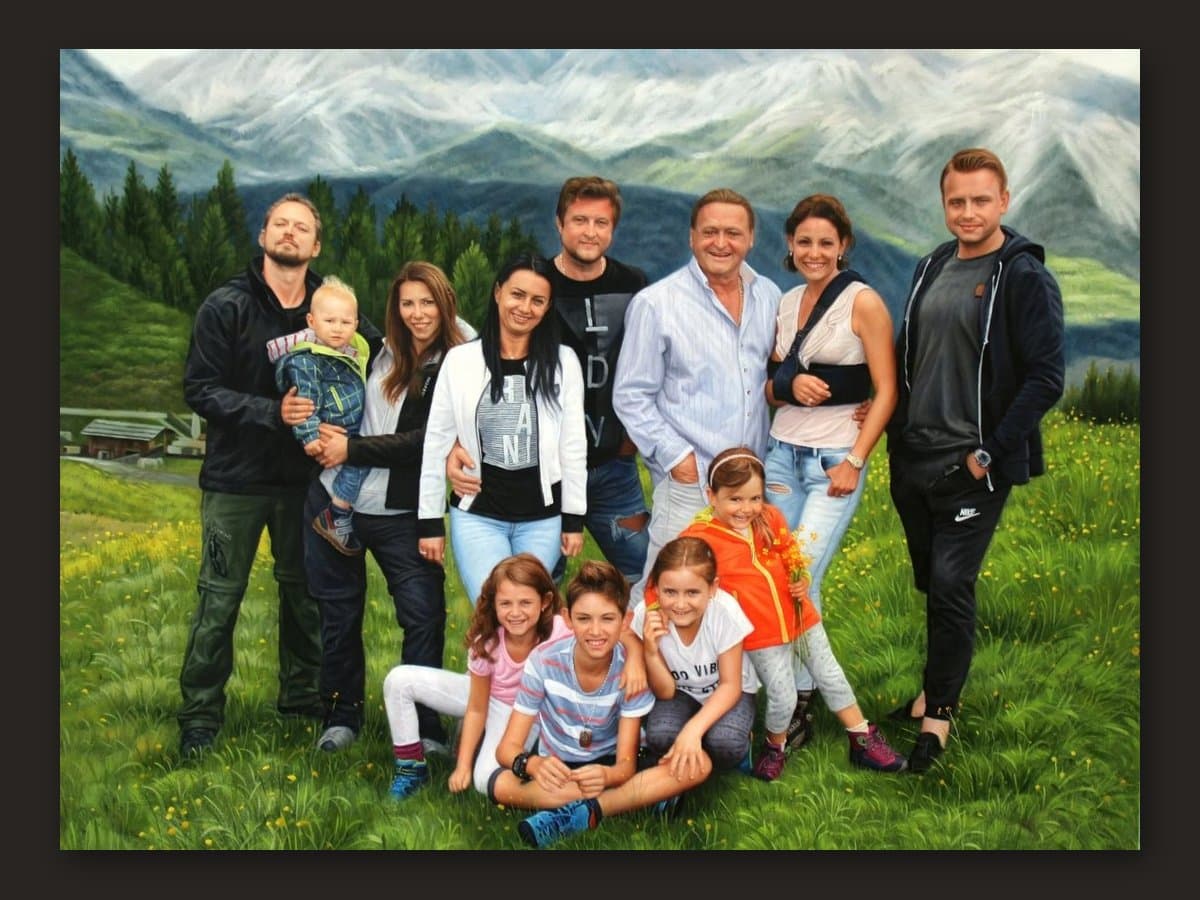
Portrait painting styles change the brushwork, the light, the palette and the background of a painting. They do not change the likeness. If you are stuck between a Sargent treatment and a plain traditional one for a family photograph, the short answer is that classical realism is the safest choice for a group of four or more, and the looser or more decorative styles pay off most on one or two faces.
This is the long answer: seven portrait painting styles compared master by master, then sorted by subject and by room. Our own house options are summarised in oil portrait styles explained; this page is the wider reference.
What style changes and what it does not
Style is not a filter laid over a photograph. Every one of these paintings is made the same way: a professional artist works in oil from the photograph you send, and the face has to look like the person in it. Four things move:
- Brushwork — smooth and blended, or visible marks readable from a metre away.
- Light — one hard source from the side, an even studio light, or a warm glow with the corners in shadow.
- Palette — cool greys and clean whites, or warm ochres, reds and browns.
- Background — rendered, suggested in a few strokes, or replaced with a wall, a curtain, gold pattern or a landscape.
Two things do not move. The likeness, which is the whole job. And the price: commissions are priced by size, £220 for 12 × 16″ up to £549 for 36 × 48″, plus from £35 per additional person or pet. A gold-leaf Klimt background costs what a plain grey one costs.
What style cannot do is invent information the photograph does not contain. Loose brushwork carries a soft photo better than smooth rendering does, because a confident stroke can stand in for detail. But if the eyes are not sharp, no style rescues them.
The same photograph painted five ways
Take a photograph most people have somewhere: four family members outdoors in late-afternoon light, a hedge and some sky behind them. Here is what five treatments do to it.
| Style | What changes | What you end up looking at | Where it can go wrong |
|---|---|---|---|
| Classical realism | Almost nothing. Even light, accurate colour, background tidied | Four faces, clearly rendered, near-photographic from two metres | Flat photo in, flat painting out |
| Sargent | Background cut to a few strokes, clothing painted fast, light pushed brighter | Faces finished, everything else confidently unfinished | On four people looseness can read as rushed |
| Renoir | Warmer palette, softened edges, skin lit from within | A warm, idealised family, hedge dissolved into green light | Sweetness. Often too soft for adult men |
| Vermeer | Light rebuilt as if from one window, background replaced with plain wall | Stillness, one or two faces carrying the whole picture | Four people in a Vermeer setting is not a Vermeer |
| Renaissance | Outdoor setting replaced by costume, drapery and a dark interior | A family recast as a noble household, faces still yours | Nothing subtle survives; a deliberate, theatrical choice |
Master by master
Each entry below covers the photo, the room and the recipient it suits. None costs extra.
Classical realism
Photo: almost any decent one, groups included — the most forgiving of ordinary snapshots. Room: anywhere; it does not fight the decor. Recipient: older relatives, memorial pieces, anyone who wants a traditional portrait without evoking a particular painter.
John Singer Sargent
Photo: strong daylight, one or two adults, white shirts and pale dresses. Room: bright, pale walls, where looseness reads as air rather than absence. Recipient: someone who will enjoy the brushwork as brushwork.
Pierre-Auguste Renoir
Photo: children, a parent with a child, outdoor light. Room: warm rooms and wooden furniture; a sitting room rather than a hallway. Recipient: grandparents and new parents — anyone who wants tender rather than formal.
Johannes Vermeer
Photo: a quiet solo shot with side light. Room: one with real daylight, hung where the painted light and the real light agree. Recipient: someone who does not want to be shown smiling.
Rembrandt
Deep shadow, warm gold light, faces emerging out of near-black.
Photo: a single adult face with some age and character in it. Room: darker interiors, a study, a dining room with low lighting. It dies on a bright white wall. Recipient: fathers, grandfathers, retirements — a portrait that should carry weight.
Gustav Klimt
The face realistic, set into a gold, patterned, jewel-like field.
Photo: head-and-shoulders of one person, or a couple close together; everything else gets replaced anyway. Room: modern interiors, plain walls, space around the frame — of the modern portrait paintings people commission, this is the one hung as a room's single statement. Recipient: anniversaries, weddings, anyone bold enough to enjoy a gold panel.
Renaissance noble portrait
Your subject's face painted into the body of a 17th-century noble — armour, a ruff, a naval uniform, a brocade gown. Covered fully in our guide to renaissance portraits, and the animal version in renaissance pet portraits.
Photo: any clear head-and-shoulders shot; the body and setting come from a historical reference. Room: hallways, studies, anywhere a conversation piece earns its place. Recipient: someone with a sense of humour about themselves, or a dog with more dignity than sense.
Styles by subject
The subject narrows the choice more reliably than anything else.
| Subject | First choice | Also works | Usually wrong |
|---|---|---|---|
| Family group of 3+ | Classical realism | Renoir, Renaissance | Vermeer, Rembrandt |
| Couple | Sargent | Klimt, classical realism | Rembrandt |
| Single adult | Rembrandt or Sargent | Vermeer, Klimt | Renoir |
| Child | Renoir | Classical realism | Rembrandt |
| Dog or cat | Renaissance noble | Classical realism | Vermeer |
| Horse | Classical realism | Renaissance cavalry | Klimt |
| Memorial | Classical realism | Vermeer | Klimt, Renaissance |
The best style for a family portrait is nearly always the plain one: with four or five faces the painting already has plenty to hold your attention, and a strong style competes with the people in it. Rembrandt on a child looks like a small adult in mourning.
Memorials are the one case where we will actively steer you. A memorial portrait gets looked at by people who are grieving, and every stylistic flourish is the painter putting a hand up in front of the face. Classical realism gets out of the way. For pets, dog and cat portraits take the Renaissance costume treatment best: a cat in a lace ruff is funnier than a cat on plain grey.
Styles by room
Portrait painting styles behave differently under different light, so the wall matters more than people expect. A dark warm painting in a cold north-facing room turns to mud; a pale high-key painting in a dim hallway disappears.
| Room | The problem | What to pick |
|---|---|---|
| North-facing | Cool, flat, steady light. Warm dark paintings go grey | Sargent, classical realism, Renoir — anything with a bright key |
| Small flat | No viewing distance, and a big dark painting closes the room in | Classical realism or Sargent at 16 × 20″ or 20 × 24″ |
| Over a fireplace | Seen from below and across the room; fine detail is wasted | Rembrandt, Sargent, Klimt — strong value contrast reads at four metres |
| Hallway | Seen in passing, close up, usually in poor light | One or two faces, simple composition, high contrast |
Two minutes looking at a real Rembrandt reproduction in our masterworks wing will settle this faster than another paragraph from us.
How to decide if you cannot pick
Work down this list and stop at the first line that fits your photograph.
- Classical realism if there are three or more faces, or the painting is a memorial.
- Sargent if there are one or two adults and the light in the photo is good.
- Vermeer if it is a single quiet figure lit from one side.
- Renoir if the subject is a child, or a parent with a child.
- Rembrandt if it is one adult face with age and character in it.
- Klimt for a statement wall or an anniversary.
- Renaissance if the point is to delight someone rather than to be sober.
What to write on the order form
The order form asks for your photograph, the subject and the size. There is no style picker: a dropdown of portrait painting styles cannot capture what you actually want, and since style costs nothing extra there is nothing to price.
Whatever treatment you have in mind goes in the notes field, in your own words. Three things are worth putting there: a painter or period if you have one ("Rembrandt-ish, dark background" is enough to work from), the feeling you want, and anything you want changed — the background replaced, a jacket swapped for a suit, a pet added from a second photograph. Or write "you choose", and we will tell you which styles the photograph will carry.
You pay when you submit the form, and we check the photograph within hours, 9am to 5pm Monday to Saturday (UK time); if it will not make a good painting, you can send another or have a full refund. The painting then takes about three to four weeks, plus delivery. Before it ships you receive a photograph of the finished painting, and if anything is not right we keep painting until it is. It arrives rolled in a tube, unframed, to frame locally for the room you chose the style for.
Start a commission, see how each style looks finished in the gallery, or read the family portrait page if that is what brought you here.
Frequently asked questions
Can you mix two styles in one painting?
Sometimes, and it is worth asking. A Sargent figure against a Klimt patterned ground works because the two do different jobs. Rembrandt lighting with a Renoir palette does not — they compete for the same decision. Describe it in the notes and we will say honestly whether it holds together.
Can I send a painting I like as a reference?
Yes, and it is the most useful thing you can send. A named painting removes the ambiguity words like "warm" or "classic" leave behind. Tell us whether you mean the light, the brushwork or the background.
Which style hides a weak photograph best?
A loose one, but only up to a point. Sargent-style brushwork tolerates softness better than classical realism, and impressionist warmth covers poor white balance and dull flash. What no style survives is unsharp eyes, or a face too small in the frame to hold detail. Send the photo and we will tell you which end of that scale you are on.
Does a more elaborate style cost more?
No. Commissions are priced by size only, £220 to £549, plus from £35 for each additional person or pet. A gold-leaf background, painted armour or a rebuilt setting are all included. Only size and subject count change the number.
Can I change my mind about the style after ordering?
Before painting starts, yes, easily, and at no charge. Once it is well under way a fundamental change means starting again, so tell us early. Most people settle it in the reply we send after seeing the photograph.