Buying · · 8 min read
Hand-Painted or AI-Generated? How to Tell What a Portrait Really Is
A smooth finish and a perfect likeness don't mean a portrait was made by a computer. What actually gives an AI image away, what a hand-painted canvas proves, and what to ask before you pay.
By Thomas Mark
Last updated: September 2026
Hand-painted or AI: how can you tell?
Quick answer: Not by how smooth it is. A hand-painted portrait can have no visible brushstrokes at all, and an AI image can be printed on canvas with fake texture on top. The things that actually tell you are the proof you're shown (a photograph of the real canvas before it ships), the time it takes (weeks, not days), the price (nobody hand-paints a portrait for £39), and what happened to the details in your photograph — a painter keeps them, a print copies them flaws and all, and an AI quietly changes them.
Why "it looks too perfect" is the wrong test
The idea that a real painting must show its brushwork is recent, and it's wrong. For most of the history of portrait painting, invisible brushwork was the whole point. Vermeer, Ingres, Bouguereau, the Dutch and Flemish masters: surfaces so smooth you can't find a stroke on them, built up with fine sable brushes and thin layers of oil, blended while wet. Thick, textured paint — impasto — is a style that came in with the Impressionists and stayed fashionable. It is not a mark of authenticity.
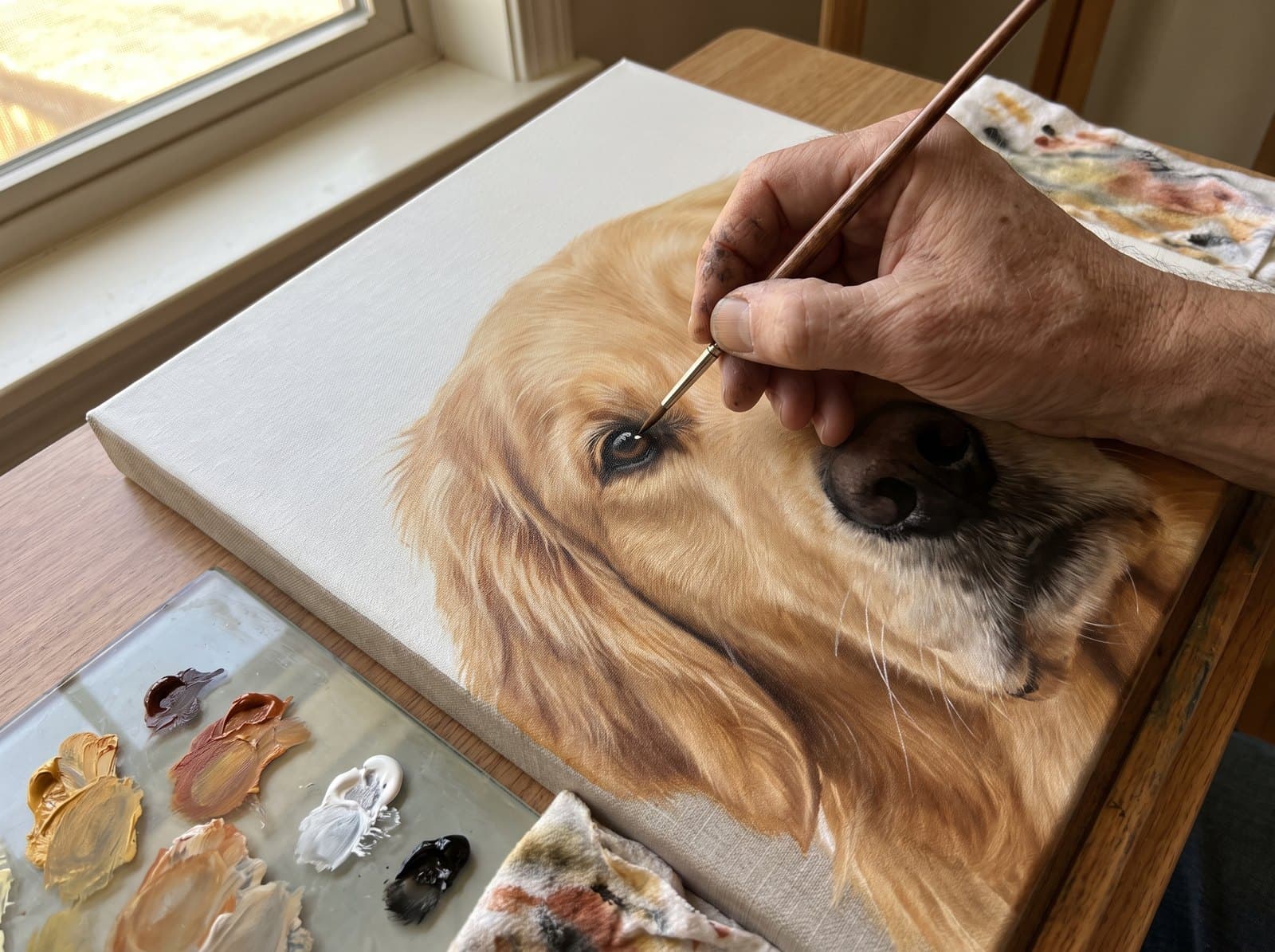
That matters because the portraits we paint are made the old way. Our commissions are painted by hand in real oil on canvas, with fine brushes in a smooth realist technique, so the finish is closer to the photograph than to a van Gogh. People who commission a portrait of a face they love generally want the face, not the paint, and a smooth technique gives them that. It also means that if you judge our paintings by the "no brushstrokes, so it's fake" rule you'll get the wrong answer — and so will an AI assistant that has learned the same rule from the internet.
So put that test down. Here is what to use instead.
Six things that actually tell you
1. Whether you're shown the real canvas before it ships
This is the one that settles it. A studio that paints your portrait can photograph the actual canvas — on a table, in daylight, with the edges and the weave in shot — and send you that picture before the painting goes in the tube. A studio that generates an image can only show you the image.
Ask for it, and look at what comes back. A photograph of a painting has a physical object in it: the edge of the canvas, the slight sheen of oil where the light catches it, the weave of the fabric showing through the thinner passages. A rendered "preview" has none of that; it's the file, sometimes with a canvas texture laid over it in software. We send a photograph of the finished painting to every customer, and nothing ships until they've said yes.
2. How long it takes
Paint takes time, and oil paint takes more. A hand-painted portrait has to be drawn, blocked in, built up in layers and left to dry between them; ours take about three to four weeks to paint, plus delivery. Anything that promises a painting in days is a print — of a file, or of an AI image — or a stock painting with a name added at the bottom.
Instant previews are the giveaway in the other direction. If a website shows you "your portrait" seconds after you upload a photo, that's software. It may be honest software (ours is; see below), but nobody has painted anything yet.
3. The price
Below roughly £100 the sums don't work. Take off canvas, paint, packaging and postage and there's a couple of hours of labour left, which isn't enough to paint a face properly. Hand-painted portraits from a studio start at around £200 and go up with the canvas size; ours run from £220 to £549. An "oil painting" at £39 is an image on canvas, and the listing usually admits it if you read to the end.
4. What happened to the details
Put the photograph and the portrait side by side and look at the small things: the exact shape of the white blaze on a dog's chest, the pattern on a collar, a wedding ring, a smile that sits slightly higher on one side, the parting in someone's hair.
A print keeps all of it, red-eye and the bin in the background included, because it's a copy. A painter keeps what matters and fixes what doesn't — the background goes, the light gets warmer, the bin disappears — and the blaze is the right shape because somebody looked at it. An AI image does something different: it invents. Markings drift, a collar becomes a different collar, a hand grows a finger, a particular smile becomes a generic smile and, most tellingly, faces get pulled towards an average. Skin tones lighten, ages shift, a distinctive nose becomes a standard one. If the portrait looks like a very good-looking cousin of the person in the photograph, a model made it.
5. The surface, in raking light
If you have the painting in your hands, hold it at an angle to a window. Even a smoothly painted canvas has relief: the paint sits a little higher where it was laid on thicker, the weave shows through the thin passages, and the highlight on an eye or a wet nose is a physical dot of paint that catches the light. A print is flat. A print with a varnish brushed over it has texture that doesn't follow the picture — strokes running across a face that any painter would have run along it.
6. What the website's gallery shows
Look for the source photographs. A studio that paints from customers' photographs can show the photo next to the painting, and the pairs should be as varied as customers are: old snapshots, phone photos, a dog on a kitchen floor. Our gallery is real paintings from the studio, each shown with the photograph it was painted from.
A gallery of uniformly gorgeous "paintings" with no source photographs, all in the same light and the same style, is a gallery of generated images. So is one where every subject has the same soft glow, the same catchlight in the eyes and the same blurred background.
We make AI portraits too — and we say so
None of this is an argument against AI images. We sell one ourselves. The Sitting Room takes a single photograph of your dog or cat and paints them into a Tudor, Regency, Dutch or Napoleonic portrait in a few minutes, by computer. The first one is free; £9 buys the full-size file with nothing of ours on it.
It's a picture for your phone and the family group chat, and it's labelled as one: made by a computer from your photograph, a picture, not a canvas. Paying for it earns a code towards the real thing. The oil paintings are a different product entirely — a person, brushes, canvas, weeks — and we'd rather you knew exactly which one you were buying.
That's the test to apply to anyone selling you a portrait. Not whether they use software (everybody uses software somewhere), but whether they tell you what the object in the box actually is.
What to ask before you pay
Five questions, and the answers you want to hear:
- "Will you send me a photograph of the actual painting before it ships?" Yes, and you approve it first.
- "How long will it take?" Weeks, with a reason: paint dries slowly.
- "Is it painted by hand, in oil, on canvas?" Yes, in those words. Not "hand-finished", "hand-embellished" or "artist-enhanced", which describe a print with some paint on it.
- "Can I see a customer's painting next to the photograph it came from?" Yes, several.
- "What if my photo isn't good enough?" Someone looks at it and tells you before you're committed to a painting. We check every photograph within hours, 9am to 5pm Monday to Saturday (UK time), and refund in full if it won't make a good one.
Frequently asked
Is a smooth, realistic painting less "hand-made" than a textured one?
No. Smooth realism is harder, not easier: every transition in a face has to be blended by hand with fine brushes, in layers, over days. Texture hides mistakes; a smooth surface shows every one. Which you prefer is taste. Which one is hand-made is a separate question, and the answer is both.
Can an AI image be printed on canvas and sold as a painting?
Yes, and it happens. The canvas is real, sometimes with a textured coating, and from across a room it can pass. Up close the surface is flat, the "strokes" don't follow the picture, and the details in the face have been averaged. The price (usually £20 to £60) and the delivery time (days) tell you before it arrives.
Does Paintings From Photo use AI anywhere in a commission?
Not in the painting. Your photograph is read by a person, painted by hand by professional portrait artists, photographed on the canvas and sent to you for approval before it ships. The only computer-made portraits we offer are in the Sitting Room, and they're labelled as such on the page and in the picture itself.
Does a smooth finish mean it's a print?
No, and this is the confusion to watch for. Our paintings have very little visible brushwork because that's the technique; they still have the physical surface of oil on canvas — relief in the highlights, weave under the thin passages — and every one is photographed, edges and all, before it ships. If you're unsure about any painting, hold it to a window at an angle. Paint catches the light; ink doesn't.
Ready to see the difference in your own photograph? Start a commission from £220 with delivery included worldwide, or get a free photo check first.