Subjects · · 8 min read
What to Say When Someone's Pet Dies (And What Not To)
What to say when someone's pet dies: the words that genuinely help, the phrases that land badly, and what to do weeks later when everyone else moves on.
By Thomas Mark
Last updated: September 2026
What to Say When Someone's Pet Dies
Quick answer: Three sentences is usually enough — say the animal's name, say you are sorry, and say one specific thing you remember about them. Avoid anything that begins with "at least", anything that compares losses, and any suggestion that another pet would fix it. If you want to do something as well as say something, wait two or three weeks; most people cannot face choosing a photograph in the first fortnight, and a hand-painted memorial portrait starts at £220 and takes three to four weeks to paint, so there is genuinely no rush.
Why people freeze
Most people asking what to say when someone's pet dies are not short of feeling — they are unsure how much reaction is allowed. It was a dog. There is no funeral, no card aisle, no week off work. Psychologists call this disenfranchised grief — a real loss that the world around it doesn't fully licence — and it is why so many people end up crying in a car park about a cat and feeling ridiculous for it.
Under-reacting is far more common than over-reacting. Almost nobody has ever been upset because a friend took their dog's death too seriously. Plenty of people are still quietly hurt, years later, that someone said nothing at all. If you are stuck between an imperfect message and no message, send the imperfect one.
The four things worth saying
Use the animal's name. "I'm so sorry about Bramble" does something that "sorry about your dog" doesn't. It says you thought of them as somebody rather than a category.
Offer one memory, however small. You do not need a story. "He used to sit on the wall waiting for the school run" is plenty. It tells the person that their animal existed in someone else's life too, which is the thing they are most afraid of losing.
Give them permission. "You're allowed to be completely wrecked by this" is often the most useful sentence in the whole conversation, because a lot of people are grieving and privately embarrassed about it at the same time.
Make one specific offer. Not "let me know if you need anything" — that hands them a task. Say "I'm dropping food round on Sunday, you don't have to answer the door" or "I'll come and walk with you Thursday morning if you want the company."
What not to say, and what to say instead
Almost every phrase in the left-hand column below is said kindly. That is the problem with them — they sound like comfort and function like a full stop.
| Common phrase | Why it lands badly | Try instead |
|---|---|---|
| "At least he had a good life" | Argues with the grief instead of sitting beside it | "Sixteen years is a long time to have someone. Of course this hurts." |
| "You can always get another" | Treats the animal as a role that can be refilled | "There'll never be another one like her." |
| "It was just a dog" | The single most damaging thing on this list | Say nothing at all rather than this |
| "At least it wasn't a person" | Ranks their loss against someone else's | "This is a proper loss. I'm sorry." |
| "Everything happens for a reason" | Asks them to justify the death to you | "There's no sense in it. I'm just sorry." |
| "I know exactly how you feel" | Moves the subject to you | "I don't know what this feels like for you, but I'm here." |
| "Let me know if you need anything" | Puts the work on the grieving person | "I'll be outside at six with dinner. No need to talk." |
Saying it in a text, a card, or at work
In a text
Short is better. Forty words or fewer, no questions they have to answer, and make it clear no reply is needed: "Just heard about Milo. I'm so sorry. He was a brilliant, ridiculous dog and I loved that he barked at the postman for eleven years. Don't reply to this — I'm just thinking of you."
In a card
Three or four handwritten lines beat a printed verse. Name the animal, one memory, one line of warmth. If the Rainbow Bridge poem means something to them, it is a kind thing to include; if you don't know them well, skip the poetry and write plainly.
At work
Most UK employers offer no formal compassionate leave for a pet, so a colleague may be at their desk within hours of the vet's appointment. Say one quiet line to them directly — not to the room — and do not make them explain it to anyone. "I saw about Nell. I'm sorry. Tell me if you'd rather I took the two o'clock" is enough.
When they had to make the decision
Euthanasia guilt is its own thing, and it is usually the sharpest part. People replay whether they went too early or waited too long, sometimes for months. Vague reassurance bounces off. Specific reassurance does not.
What helps: "You made the last decision for him, and you made it for his sake rather than yours. That is the hardest kind of love there is." What doesn't help: asking how it happened, or how much it cost, or whether they were there. Let them tell you if they want to.
The quiet fortnight
Everyone messages in the first three days, which is why what to say when someone's pet dies matters far more in week three than in week one. Almost nobody messages on day eighteen, which is roughly when the house has stopped feeling temporarily wrong and starts feeling permanently different.
| When | What actually helps | What to avoid |
|---|---|---|
| First 48 hours | One short message using the pet's name. Food on the doorstep. | Repeated phone calls that must be answered |
| Days 3–7 | Practical offers: returning unopened food or medication to the vet, moving the bed out of the hallway if they ask | Tidying the animal's things away without being asked |
| Weeks 2–4 | Check in once. Say the name again. | "Are you feeling better yet?" |
| 6–12 weeks | Ashes usually come back around now. A good moment to offer something lasting. | Surprising them with a new puppy |
| One year on | A single text on the date. It is remembered for years. | Assuming it is long forgotten |
If you want to give something
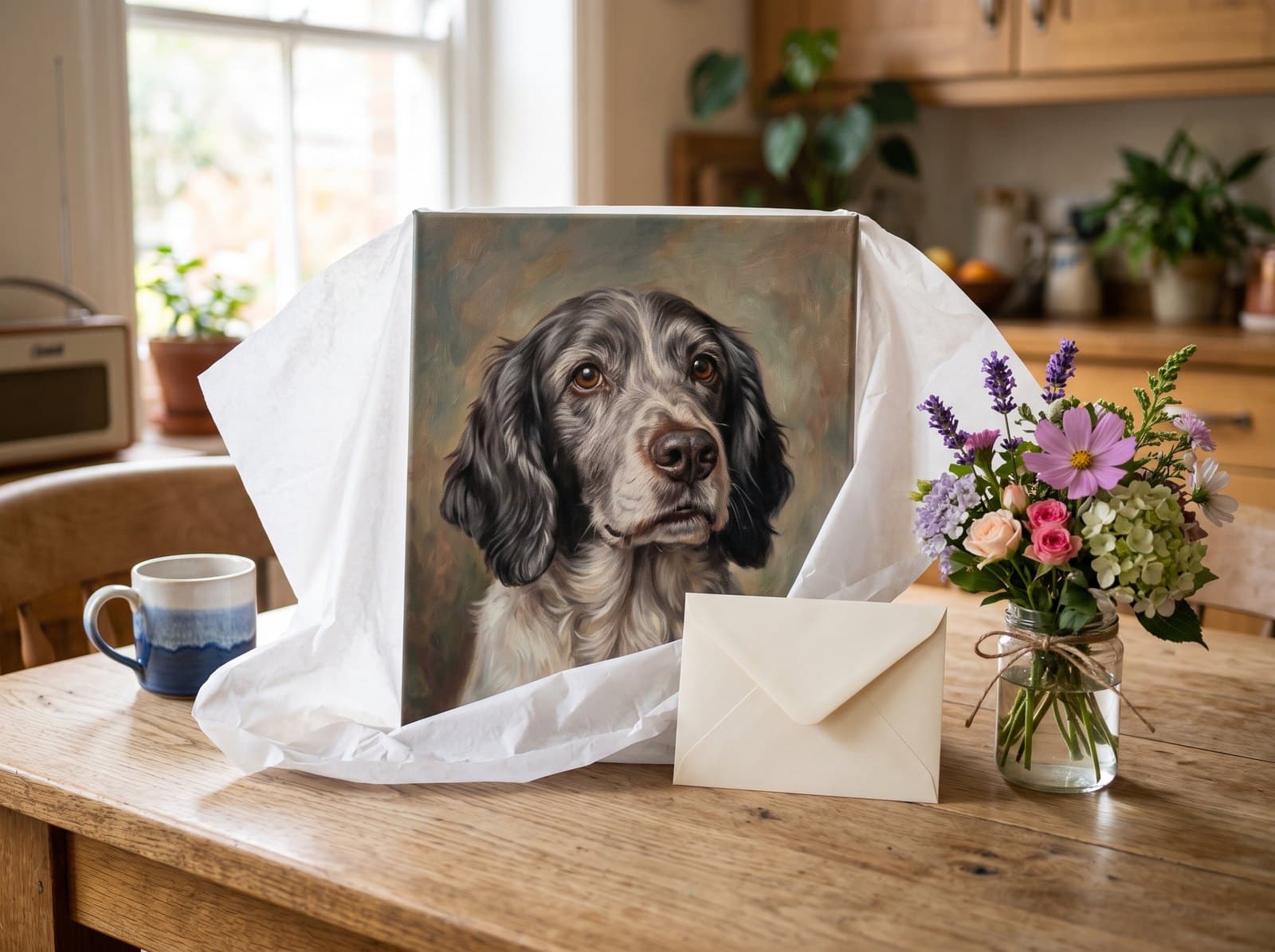
There is no obligation to give anything — presence beats parcels. But if you want to, the things that tend to land well are the ones that keep the animal present rather than tidy them away: a framed print of a photograph they love, a donation to the rehoming charity the dog came from, a paw print cast, or a painting.
If you are considering a portrait for someone else, ask them for their favourite photograph rather than surprising them with a finished one. That conversation is usually welcome in itself — people who are grieving often want an excuse to talk about their animal — and it means the painting is of the photo that matters to them, not the one that happened to be on Facebook.
The practical side, if it helps: our pet portraits are painted by hand in oil, from £220 for 12 × 16″ up to £549 for 36 × 48″, with a second animal or a person in the same painting from £35. They take three to four weeks to paint, plus delivery. Before anything ships you're sent a photograph of the finished painting, and we keep painting until it looks like your dog. Paintings arrive rolled in a tube, unframed, so they can be framed locally to fit the room.
Photographs are almost never the obstacle. Phone snaps, old prints, slightly blurry pictures taken in a bad kitchen light — a painter works from what you have, and can work around a closed eye or a distracting background. If you want to pick the strongest photo before you ask, our guides cover what makes an image easy to paint from.
Frequently asked
What do you say when someone's pet dies and you're not a pet person?
Say so, briefly and without apology: "I've never had a dog, so I won't pretend to know what this feels like — but I know Bramble was family and I'm sorry." Honesty is far better than a borrowed sentiment. What you must not do is fill the gap with "it was only an animal."
Is it wrong to say "at least they're not in pain any more"?
It is not wrong, but it is better as a second thing than a first thing. Lead with sorrow, not silver linings. If they say it themselves, agreeing is kind; saying it before they do can sound like you are hurrying them along.
How long should I wait before checking in again?
Around two weeks. The first messages arrive in a rush and then stop dead, so a note at day fourteen or eighteen lands in the silence. Keep using the animal's name — most people are relieved rather than upset to hear it.
What do you write in a pet sympathy card?
Name, memory, warmth, offer. For example: "So sorry about Nell. I'll always remember her stealing chips at the barbecue. Fifteen years is a huge thing to lose. I'll ring you Sunday — no need to pick up."
Should I send flowers?
Flowers are fine, with one caveat worth knowing: lilies are lethally toxic to cats, so never send them to a household with other cats. Food, a plant, or a donation in the animal's name is often more use than a bouquet in the first week.
The hardest part of knowing what to say when someone's pet dies is accepting that nothing you say will fix it. It isn't meant to. You are only there to make the loss slightly less lonely, and saying the animal's name out loud does more of that than any perfect sentence ever could.