Subjects · · 8 min read
Grieving a Pet Is Not Silly. Here's Why It Hurts.
Pet grief is real grief, not an overreaction. Why losing a dog or cat hurts as much as it does, why others don't always understand, and what truly helps.
By Thomas Mark
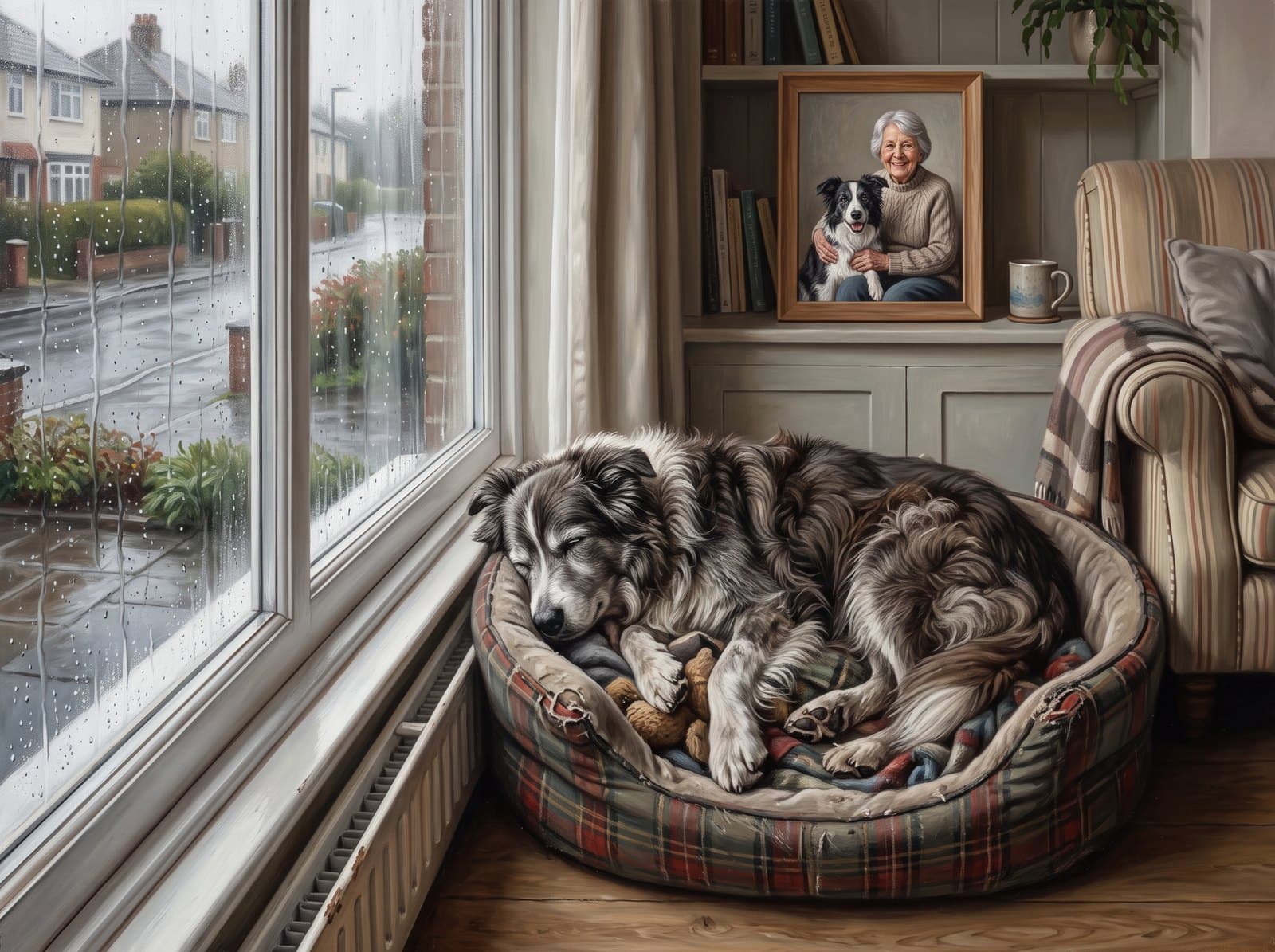
Last updated: September 2026
Pet grief: why it hurts so much
Quick answer: Pet grief hurts because it is grief — the same process, not a lesser version of it. A dog you had for twelve years was in roughly 4,380 of your mornings and knew the sound of your car; losing that removes a relationship and a daily structure at the same time. It is also what psychologists since Kenneth Doka in 1989 have called disenfranchised grief: real loss that society doesn't formally recognise, so there's no funeral, no bereavement leave and no obvious permission to fall apart. Nothing about that is silly, and the fact that people quietly commission a portrait of a pet months or years later says a great deal about how long it stays with them.
You are not overreacting
If you're reading this at 2am because you feel ridiculous for crying over a cat, here is the useful bit first: the intensity you're feeling is a normal response to what actually happened, not evidence that something is wrong with you.
People are often surprised by the size of it. They expected sadness. They did not expect to be unable to eat, or to sit in the car outside work for ten minutes, or to feel physically wrong-footed every time they walk past an empty bed. That gap between expected grief and actual grief is where the "am I being silly?" thought lives.
You're not. There are specific, unremarkable reasons why this particular loss lands hard.
Four reasons it hits harder than people expect
1. The relationship had no friction in it
Most human relationships carry history — arguments, disappointments, things unsaid. Grief for a person is usually tangled with all of that. A dog or cat gave you an uncomplicated version: pleased to see you every single time, no conditions, no record kept. Losing something uncomplicated produces uncomplicated pain, and uncomplicated pain is loud.
2. It was woven into the shape of your day
This is the part almost nobody predicts. Pets don't only occupy your affection, they occupy your timetable. The 7am walk. The bowl going down at six. The particular noise at the door. When they die you don't lose one thing once — you lose a small thing repeatedly, at the same times, every day, for weeks.
That's why the second week is so often worse than the first. In the first week you're busy. In the second, the routine comes round and finds nothing in it.
3. Nobody gave you anywhere to put it
There is no funeral to organise, usually no time off, and no cultural script. When a grandparent dies, everyone knows roughly what to say and do. When a fourteen-year-old spaniel dies, colleagues say "sorry to hear that" and move on, and you are left carrying a full-sized grief in a space designed for a small one. Support does exist — the Blue Cross runs a free UK Pet Bereavement Support Service by phone and email, and The Ralph Site hosts a free online community — but you generally have to go and find it yourself.
4. You probably had to make the decision
This is the difference that separates it from most human bereavement. You chose the day. You may have held them while it happened. Almost everyone then spends weeks turning over whether it was a week too early or a fortnight too late, which is a form of grief with guilt sewn into the lining.
For what it's worth, vets will tell you the same thing repeatedly: the regret runs in both directions, which is usually a sign the timing was about right. Someone who agonises over whether they acted too soon was, by definition, not someone acting carelessly.
"It was just a dog"
Some of the worst moments come from other people. Not cruelty, usually — clumsiness. Someone asks whether you'll get another one, on day three. Someone mentions how much a new puppy costs. Someone means well and says "at least it wasn't a person."
Two things help here.
The first is to stop explaining yourself to people who don't get it and spend the energy on the people who do. Almost everyone has one friend who lost a dog and still can't talk about it. That's your person for this.
The second is to be direct with the well-meaning: "I know it sounds like a lot, but I'm finding it really hard." Most people adjust immediately when told. If you want the other side of this conversation — the words that actually land when it's someone else grieving — we've written about what to say when someone's pet dies as well.
How long pet grief lasts
Honestly: longer than most people expect and less consistently than they fear.
The pattern most people describe is sharpest for the first two to four weeks, noticeably lighter by around three months, and then unpredictable — largely fine, punctuated by things that ambush you. A lead in the boot. The vet's automated vaccination reminder. The anniversary. That the ambushes keep happening two years later isn't a sign you're stuck; it's just what a long relationship leaves behind.
What isn't normal, and is worth a GP appointment rather than waiting out: not sleeping or eating for weeks, being unable to work, or feeling that nothing is worth doing. Grief that stops moving at all deserves proper help, and asking for it over a pet is not an embarrassing thing to do.
What actually helps
Nothing on this list fixes it. They're just the things people reliably say made the weeks easier.
| What helps | Cost | When it tends to help | What it asks of you |
|---|---|---|---|
| Blue Cross Pet Bereavement Support Service | Free | First days and weeks | One phone call or an email |
| The Ralph Site online community | Free | Any stage, especially at 3am | Nothing |
| Telling one friend properly | Free | Immediately | Saying it out loud once |
| Bereavement counselling (UK private) | £50–£80 per session | Still flattened after 3–4 months | Weekly, for several weeks |
| GP appointment | Free | Sleep, appetite or work affected for weeks | Ten minutes |
| Photo book or printed album | £25–£60, 1–2 weeks | Once photos don't sting | An evening of sorting |
| Hand-painted portrait | £220–£549, 3–4 weeks | Weeks to years afterwards | Choosing one photograph |
| Donating to the rescue you got them from | Any amount | When you want the loss to do something | Nothing |
| Another pet | Varies | When you want a pet, not a replacement | Honesty about which it is |
The last row is the one people get anxious about. There is no rule and no respectable waiting period. The only question worth asking is whether you want a dog or you want that dog back, and you generally know the answer.
Why people end up wanting something to look at
A lot of pet portraits are commissioned three, six, eighteen months after a death rather than in the first fortnight, and the reason is fairly consistent: photographs live on a phone, and a phone is where you go to be distracted. Grief tends to want something you can look at deliberately.
That's the practical case for a memorial portrait — it turns remembering into something you do on purpose in a particular spot in the house, instead of something that happens to you when you're scrolling. Ours are hand-painted in oils from your own photograph, £220–£549 depending on size, and take three to four weeks plus delivery. Before it ships you get a photograph of the finished piece to approve, so nothing arrives as a surprise on a bad day — it comes rolled in a tube, unframed, ready to take to a framer. Sizes and prices are set out on the pricing page.
If the photograph you love is old, small, slightly blurred or a screenshot from a video, that's usually workable — see how to turn a photo into a painting for what an artist can and can't rescue.
Frequently asked
Is it normal for pet grief to feel worse than losing a relative?
It's common, and it doesn't mean you loved the relative less. You lived with the pet, saw them every day, and had a relationship with no conflict in it. Daily contact and simplicity are what make grief sharp — that's an accident of circumstances, not a ranking of who mattered.
How long does pet grief last?
Usually sharpest for two to four weeks, much lighter by around three months, then occasional waves for years. If it hasn't shifted at all after several months, or you're not sleeping or eating, speak to your GP.
Should I feel guilty about having my pet put to sleep?
Nearly everyone does, and nearly everyone is wrong to. Euthanasia is a decision made from a position of responsibility, usually on a vet's advice, to end suffering you could otherwise only extend. The guilt is the price of having been the one trusted to decide.
What do I say to someone who tells me it was just a dog?
Little, if you can manage it. People say it because they've never had one, not because they're judging you. "He was with me for twelve years" is usually enough to end the conversation kindly.
Is it too soon to get another pet?
Only if you'd be getting one to stop feeling this. There's no correct interval — some people need a house that isn't silent within a month, others need a year. The test is whether you're looking forward to a new animal or trying to undo the loss of the old one.
The short version
Pet grief is grief. It has all the same machinery — the disbelief, the routine that won't stop reminding you, the guilt, the waves that come back at odd times — with less social permission attached. Give it the same seriousness you'd give any other loss, take the free support if you want it, and don't rush the decisions about ashes, photographs or another pet. None of them have deadlines, and the things worth doing to remember an animal properly, from a bench to a family portrait with them back in it, work just as well in a year's time as they do this week.