Care · · 8 min read
How to Clean an Oil Painting Without Ruining It
How to clean an oil painting safely at home: what a dry brush can do, what water and household cleaners wreck, and when a UK conservator is worth the money.
By Thomas Mark
Last updated: October 2026
How to Clean an Oil Painting
Quick answer: Do less than you think. For a painting that is simply dusty, a soft, dry, natural-bristle brush drawn lightly across the surface every few months is the whole job, and it is as far as anyone without training should go. Water, sprays, wipes, bread, potato and every other kitchen remedy will do more harm than the dirt did. Anything beyond dust — nicotine, soot, a yellowed varnish, mould — is a conservator's job, and in the UK a light professional surface clean on a small painting starts at roughly £150. If you are looking after a new commission painted from a photograph, the same rules apply from the day it arrives, with one extra: don't touch the surface at all for its first six months while the paint cures.
Why oil paint is not like anything else you clean
An oil painting is a stack of layers, each fragile in its own way. The canvas stretches and slackens with humidity. The paint — pigment held in linseed or a similar oil — takes six to twelve months to dry through and keeps hardening, and becoming more brittle, for decades. Some paintings then carry a varnish, a thin clear coat that takes the dirt so the paint doesn't have to; some don't.
Most of what damages a painting is invisible until it is done. Water gets under the paint film and lifts it. Solvents in household cleaners dissolve varnish, and then the paint beneath, without any warning at the point of contact. A cloth that feels soft to your hand catches on the ridges of thick brushwork and pulls flakes away.
That is why how to clean an oil painting is a harder question than how to clean anything else in the house. The margin between "did nothing" and "did damage" is narrow, and you cannot see where it is.
The one method that is safe: a dry brush
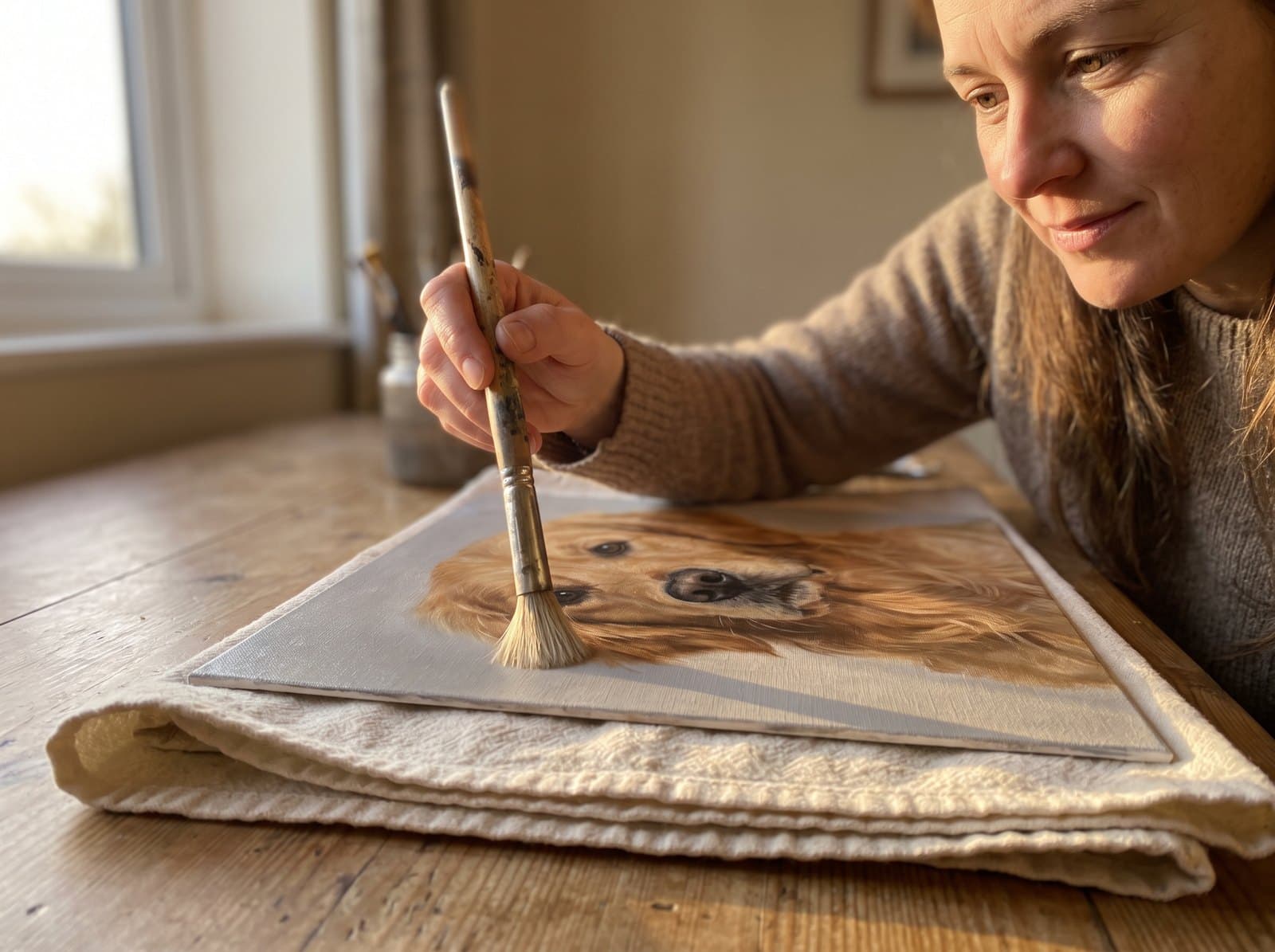
If you take one thing from this guide to how to clean an oil painting, take this. Buy a soft natural-bristle brush — a squirrel-hair watercolour mop, a clean hog-hair brush, or an unused make-up brush; £8 to £20 buys something perfectly good. Avoid feather dusters, which shed and snag, and microfibre cloths, which are excellent on glass and terrible on textured paint.
Then:
- Take the painting off the wall and lay it flat, face up, on a clean table with a towel underneath.
- Look at it in raking light from a window or a torch held at a low angle. If you see lifting flakes, cracks with raised edges, or paint that has already come away, stop. The painting needs a conservator, not a clean.
- Work from the top down in short, light strokes, letting the bristles do the work. No pressure at all.
- Do the frame separately, with a different cloth, and never let the frame cleaner near the canvas.
Ten minutes, every three to six months, is enough for a painting in an ordinary room.
What not to do, and why the old tricks persist
Every family has a relative who cleaned a painting with a cut potato, a slice of bread or a spit-dampened hankie and says it came up lovely. There is a grain of history in each — conservators do use saliva on swabs, under magnification, on a tested corner — but done at the kitchen table they leave starch, crumbs and moisture behind and take paint with them.
Specifically:
- No water, and no damp cloths. Water swells the ground layer and lifts paint; on an unvarnished painting it can leave blanched, milky patches that do not come out.
- No household sprays, glass cleaner, baby wipes or washing-up liquid. All contain solvents or surfactants that attack varnish and then paint.
- No white spirit, turpentine, alcohol or acetone. These are exactly what a conservator uses to remove varnish deliberately. On a painting you want to keep, they strip it.
- No compressed-air cans. The propellant leaves a cold residue and can blow at pressure into cracks.
- No olive oil, linseed oil or furniture polish to "bring back the colours". They darken, go tacky, attract dust and can never be fully removed. A dull painting almost always has a dirty varnish, and the fix is to replace the varnish, not to feed it.
The one half-step that does get mentioned — a cotton bud barely dampened with distilled water, on a varnished painting with a firm, uncracked surface — is the most you will ever see recommended for an amateur, and further than we would go, because you cannot reliably tell a varnished painting from an unvarnished one by eye. If you try it, test on a corner a frame would cover and stop at any sign of lifted colour on the bud.
Cleaning options compared
| Option | Typical cost (UK) | Time | Pick it when |
|---|---|---|---|
| Dry soft-brush dusting at home | £8–£20 for the brush, once | 10 minutes | The painting is simply dusty and the surface is sound. This is routine care. |
| Damp distilled-water swab, corner-tested | Nothing | An hour, plus a day to check | Varnished, uncracked, low-value, and you accept the risk. Most people shouldn't. |
| Conservator surface clean | From about £150 for a small painting | 2–6 weeks | Grime, nicotine, kitchen film, fly specks or a dullness that dusting doesn't shift. |
| Conservator varnish removal and revarnish | Several hundred pounds upwards, by size and condition | 1–3 months | A yellow or grey cast over the whole picture, or an old varnish that has gone cloudy. |
| Structural conservation | Quoted case by case; often £500 and up | Months | Flaking, tears, mould, water damage, a slack or torn canvas. |
| Commission a fresh painting from the original photo | £220–£549 | 3–4 weeks | The painting was made from a photograph you still have, and repair would cost more than it did. |
The last row surprises people, but it is worth stating plainly. A modern portrait painted from a family photo is not a Victorian heirloom, and if it has been through a flood, a fire or a decade above a gas hob, sending the same photograph off again to be painted from scratch is often cheaper than restoring the damaged one.
When to call a conservator
Some kinds of dirt announce themselves as beyond home cleaning. Nicotine leaves a sticky amber film that a brush only smears. Soot from an open fire or candles settles as a fine grey layer that bonds to varnish. Mould shows as fuzzy grey-green spots, usually on the back first, and is a sign the room is too damp for the painting to live in at all.
None of these come off safely without solvents chosen for that particular paint and varnish, applied under magnification. In the UK, the Institute of Conservation keeps a register of accredited conservators; most will give a written condition report and a fixed quote before touching anything, and a good one will tell you honestly when a painting is not worth the fee.
A new painting needs different care for its first year
Oil paint feels dry to the touch in days but is not cured for six to twelve months, and in that period the surface is soft enough to hold a fingerprint or a dust particle permanently. Don't dust it with anything at all for the first six months; a puff of breath from arm's length is as far as you should go. Don't varnish it yourself, and don't let a framer varnish it either — a final varnish over uncured oil traps solvents and can crack or cloud later.
It arrives rolled in a tube, unframed. A framer stretches it onto bars and fits a frame as one job, handling the canvas by its edges rather than the painted surface, so there's no need to wait out the curing period above before booking that in. Once it's framed and hung, out of direct sun, away from radiators and anywhere steamy, leave it alone — framing covers the options.
Keeping it clean in the first place
Most questions about how to clean an oil painting are really questions about where it hangs. Kitchens are the worst place for one in an ordinary house, followed by rooms with an open fire or wood burner, then bathrooms and conservatories. Steady, moderate conditions — somewhere between 40 and 60 per cent humidity, no direct sunlight, no wall that gets cold and damp in winter — do more to keep a painting clean than any amount of brushing. Where you hang a portrait is a cleaning decision as much as a decorative one.
FAQ
Can you clean an oil painting with water?
Not safely, and not at home. Water swells the ground and lifts paint, and on an unvarnished painting it leaves milky blanched patches. A barely damp distilled-water swab on a varnished, uncracked, low-value painting is the most that is ever recommended for an amateur, and most conservators would still advise against it.
Can you use bread or a potato to clean an oil painting?
No. Both are old tricks with a grain of history behind them, but at the kitchen table they leave starch, crumbs and moisture on the surface and take paint away with the dirt. If the painting is grimy enough that dusting doesn't help, it needs a conservator, not a vegetable.
How much does it cost to have an oil painting professionally cleaned in the UK?
A surface clean of a small, sound painting starts at roughly £150. Removing and replacing a yellowed varnish runs into the several hundreds depending on size, and structural work such as tear repair or relining is quoted individually. Ask for a written condition report and a fixed price before any work starts.
Should I varnish a new oil painting?
Not for at least six months, and ideally a year, while the paint cures. Varnish over uncured oil can crack or cloud. When the time comes it is a job best given to a conservator or an experienced painter, not a framer.
The short version of how to clean an oil painting: a soft dry brush for dust, nothing wet, nothing from the kitchen, nothing from under the sink. Leave a new painting untouched for its first six months. Anything the brush cannot shift is a conservator's job, and if the painting was made from a photograph you still have, a fresh commission is sometimes the more sensible fix than a repair. Questions about looking after a portrait are welcome through the contact page.
More onCommissioning a painting