Commissioning · · 8 min read
What Size Portrait Do You Actually Need?
A portrait size guide for real UK walls: which canvas fits above a sofa or fireplace, what each size costs, and how many faces will fit on it comfortably.
By Thomas Mark
Last updated: September 2026
Portrait size guide: which size do you actually need?
Quick answer: Measure the wall, not the photograph. A painting should be roughly two-thirds the width of whatever sits beneath it, which puts most living-room commissions at 24 × 36in and most single-face portraits at 16 × 20in. Sizes run from 12 × 16in at £220 to 36 × 48in at £549, and the number of people matters as much as the wall — a family portrait of five needs 24 × 36in as a floor, or the faces end up too small to read.
The one measurement that decides it
Almost everyone starts from the photo. They look at a close-up of the dog and think small, or a group shot on a beach and think big. That instinct is usually wrong, because the photo gets reframed and recomposed anyway. What cannot be changed after the fact is the wall.
So get a tape measure out and write down two numbers: the width of the furniture the painting will hang above, and the width of clear wall if there is no furniture.
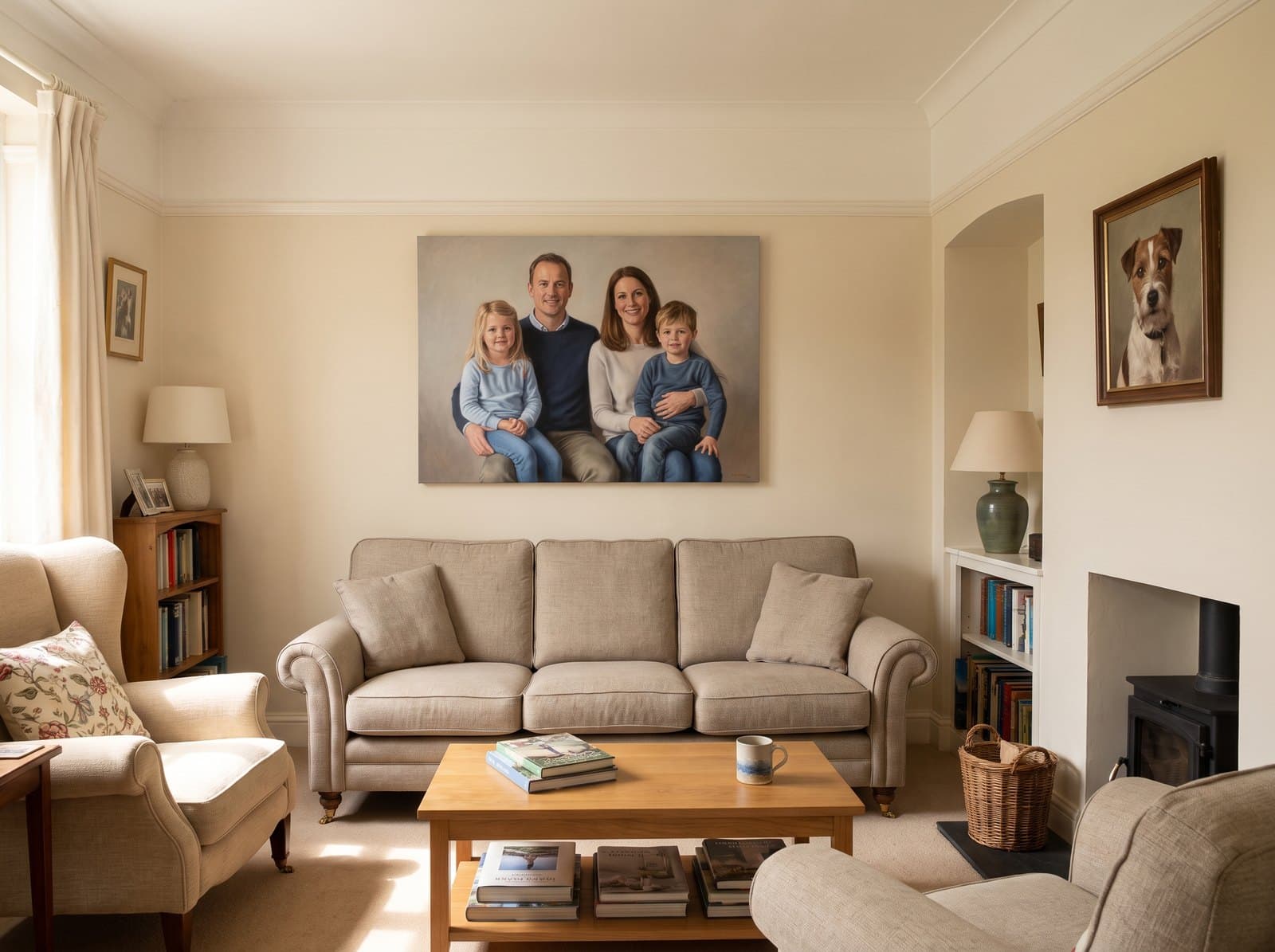
Then apply the rule professional hangers use: the artwork should be about two-thirds to three-quarters the width of the furniture below it. A standard UK three-seater sofa is 200–210cm wide, which calls for something 130–155cm across. A two-seater at 150–160cm wants 100–120cm. A 90cm chimney breast wants around 60cm.
Hold those against the actual canvases and the shortlist gets short very quickly. Most of this portrait size guide is really that sum, done properly.
Sizes, prices and what each one is for
Sizes are listed short side first — a 24 × 36in hung landscape is the same canvas as one hung portrait, so the group shot and the standing full-length cost the same.
| Canvas | Metric | Price | Wall or furniture it suits | Subjects it holds comfortably |
|---|---|---|---|---|
| 12 × 16in | 30 × 41cm | £220 | Under 60cm — a shelf, an alcove, a narrow hallway | One face, close crop |
| 16 × 20in | 41 × 51cm | £275 | 60–90cm — above a bedside table, a radiator, a desk | One person or one pet, head and shoulders |
| 20 × 24in | 51 × 61cm | £330 | 90–120cm — a standard chimney breast | Two subjects, or one full-length |
| 24 × 36in | 61 × 91cm | £449 | 1.2–1.6m — above a two-seater, a sideboard, a bed | Three or four subjects |
| 30 × 40in | 76 × 102cm | £489 | 1.6–2m — above a three-seater sofa | Four or five, with real background |
| 36 × 48in | 91 × 122cm | £549 | Over 2m — stairwell, knocked-through room, big chimney breast | A full family group |
Each subject after the first adds from £35, and the charge rises with the canvas, so the headcount matters as much as the size once you scale up. The full list is on the pricing page.
The gap that catches people out is between 20 × 24in and 24 × 36in — 61cm to 91cm on the long side, and £119 in price. If you are hovering between them, the wall almost always wants the bigger one.
How far away will you be standing?
Width is only half the problem. A rough working rule: a portrait reads properly when its longest side is at least a quarter of the distance you normally view it from. Stand three metres back and a 12 × 16in canvas stops being a painting and starts being a photo frame.
| Where you'll usually be | Typical distance | Smallest size that still reads |
|---|---|---|
| Walking past it in a hallway | 1–1.5m | 12 × 16in |
| Across a bedroom | 2.5–3m | 16 × 20in |
| From the sofa opposite | 3–4m | 20 × 24in |
| Down a knocked-through living-dining room | 5–7m | 24 × 36in |
| From the bottom of a stairwell | 6m+ | 30 × 40in |
Hallways are the exception. You pass within a metre of the wall, so a small canvas works there and a large one is genuinely awkward — you can never stand far enough back to see all of it at once.
How many faces are going on it
Here size stops being decorative and becomes structural. A face has to be big enough to carry an expression, and roughly 12–15cm from chin to crown is the point below which it stops looking like a person and starts looking like a detail.
- One subject. 16 × 20in is what most people end up wanting. 12 × 16in works for a tight head-and-shoulders crop on a small wall.
- Two subjects. 20 × 24in minimum. A couple, or a person with a pet portrait beside them, needs the width or the two heads crowd each other.
- Three or four. 24 × 36in. Below that every head has to shrink to fit, and everyone loses.
- Five or more. 30 × 40in or 36 × 48in. A group of six on a small canvas is a row of thumbnails.
If the group is large and the budget is not, paint fewer people bigger rather than everyone small. Two grandparents at 20 × 24in read better than the whole family at the same size.
Hanging height changes what you buy
Galleries hang the centre of a picture at about 145cm from the floor — average standing eye level. In a room where you are mostly sitting, drop that to around 135cm. Above furniture, leave 15–25cm between the top of the sofa back and the bottom of the canvas; less and the two read as one lump.
Now do the arithmetic in a standard UK room with a 2.4m ceiling. Sofa back at 85cm plus a 20cm gap leaves 1.35m of wall. A 36 × 48in hung portrait is 122cm tall and will very nearly touch the coving. Hung landscape it is 91cm and sits comfortably. Same canvas, completely different outcome.
Test it before you order
Cut a rectangle of newspaper to the exact dimensions, tape it to the wall at the height you plan to hang it, and leave it there for two days. Walk past it. Sit down opposite it. Look at it from the doorway.
Nine times out of ten people go up a size afterwards, not down. Undersizing is by far the most common mistake — a canvas that looked big propped against the skirting board looks modest on a two-metre wall with air around it.
Allow for the frame
Paintings ship rolled in a tube, unframed. A local framer stretches the canvas onto wooden bars and fits a frame around it, and that is worth building into your plan rather than treating as an afterthought: it means the frame is chosen for the room the painting will actually hang in, not for a studio it will never see, and it adds a step and a cost on top of the painting itself. Budget time for the framer's own turnaround as well as ours.
When you are checking a size against the wall, add the moulding width twice once it is framed. A modest 5cm frame turns a 24 × 36in painting into a 71 × 101cm object on the wall, which can be the difference between fitting an alcove and not.
Will the photo stand up to the size?
Bigger canvases do not need bigger files the way prints do, because a painter is interpreting the photo rather than enlarging it. A soft or small reference is workable; the guides cover what can and cannot be recovered from a poor original.
What matters is how much of the frame the faces occupy. If your subject is a small figure in a wide landscape shot, painting it at 36 × 48in will not invent detail that was never captured — it will only make the guesswork larger. Crop tighter and go smaller, or send a second, closer photo.
Every commission gets a photograph of the finished painting before anything ships, so you can check the composition at the size and crop you chose and ask for changes if it is not quite right. Nothing leaves the studio until you approve it, and the whole process runs three to four weeks, plus delivery. If you are unsure between two sizes, say so when you send the photo through the photo-to-painting page, and the gallery shows finished canvases at each size.
Frequently asked
What size portrait is best above a sofa?
For a three-seater, 30 × 40in. For a two-seater, 24 × 36in. Both land in the two-thirds-of-the-furniture-width band and leave enough wall showing either side that the painting looks placed rather than wedged in.
Is 12 × 16in too small for a portrait?
Not for the right spot. On a shelf, in a narrow hallway or in a cluster of pictures it works well, and it is the £220 entry point. On a main living-room wall it will look lost. The test is distance: if you are usually more than about two metres away, go up.
Does a bigger canvas cost more per extra person?
A little, yes. Additional subjects are £35 each on the three smaller canvases, rising to £79 on a 36 × 48in, because a bigger face is more work to paint. Going up a size to give four faces room costs the size difference plus that. A portrait of two people is the most common commission we paint.
What if my wall is an unusual shape?
Stairwells, chimney breasts and alcoves are better served by choosing orientation before size. A tall narrow space wants a portrait-orientation canvas even if the photograph is landscape — the composition gets adapted to fit. Send the wall measurements along with the photo.
How do I know if I've gone too big?
You very rarely have. The genuine limits are physical: a canvas taller than the wall space between furniture and coving, or wider than an alcove. Beyond those, large reads as confident and small reads as tentative.
The short version
Measure the furniture, take two-thirds of its width, and check how far back you normally stand. That gets you to a size in about a minute. Then check the faces fit — one or two subjects at 16 × 20in or 20 × 24in, three or four at 24 × 36in, five or more at 30 × 40in and up. Tape a paper rectangle to the wall for two days before you commit, and if you are torn between two sizes, take the larger one.
More onCommissioning a painting