Commissioning · · 9 min read
What Makes a Good Photo for a Portrait Painting
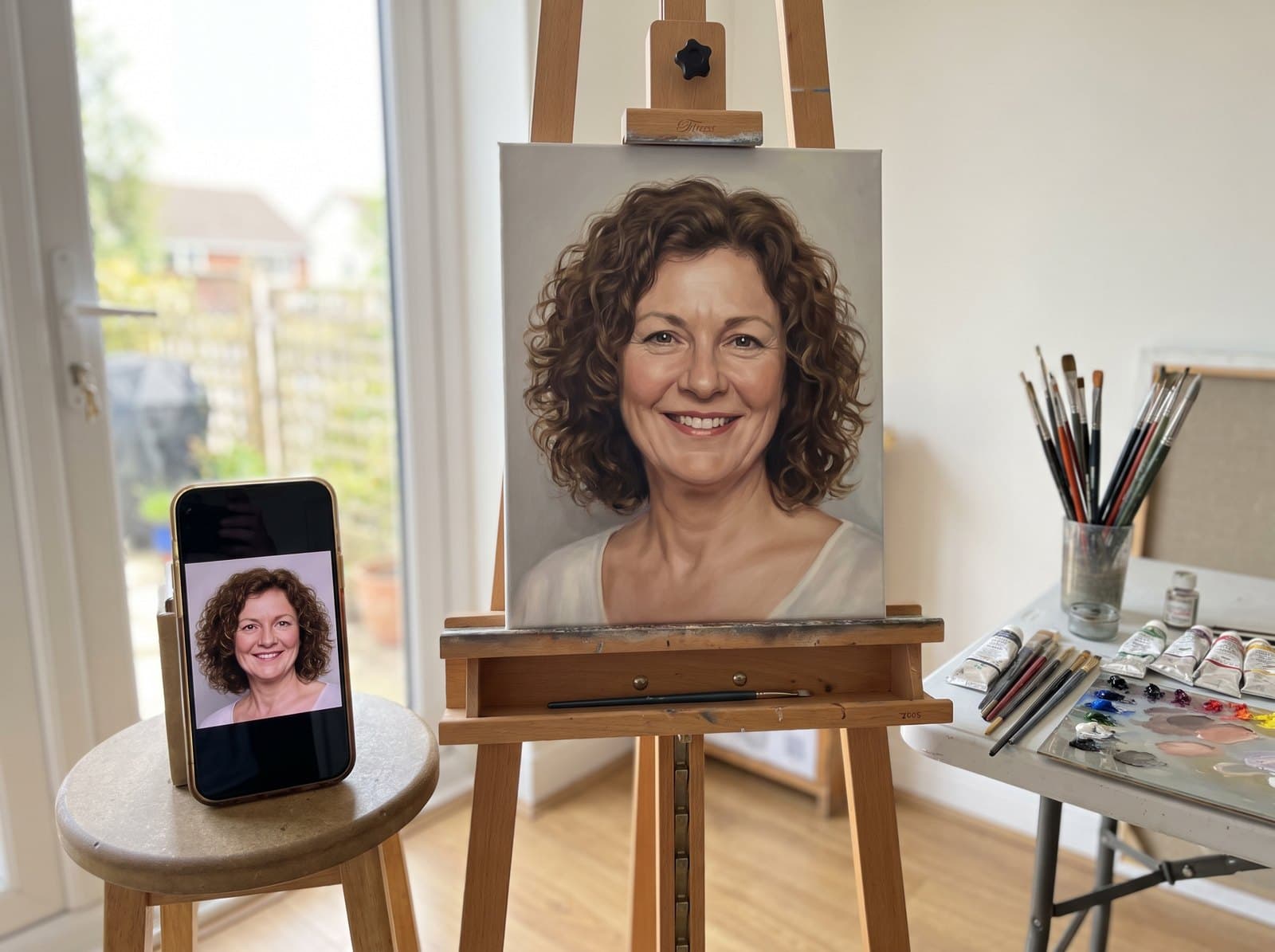
The best photo for portrait painting has five things: eyes in focus, daylight, eye-level angle, real expression and the original file. Here's how to choose.
By Thomas Mark
Last updated: September 2026
What makes the best photo for portrait painting?
Quick answer: The best photo for portrait painting is one where the eyes are sharp, the light is ordinary daylight rather than flash, and the camera was roughly level with the subject's face. Resolution matters far less than people expect — around 2,000 pixels on the short side is comfortable for any size we paint, and plenty of portraits painted from photos start from less than that. Expression beats technical quality every time: a slightly soft picture where someone looks like themselves is a better starting point than a crisp one where they don't.
The five things a painter actually looks at
Every photo that reaches us gets weighed against the same five things, and they are what separates the best photo for portrait painting from a merely nice picture. In order of how much they matter:
- Are the eyes in focus? Everything else can be rebuilt. A face is recognised through its eyes, and if they're a soft grey smudge there's nothing to build from.
- Where is the light coming from? Soft light from the side or slightly in front gives the shape of a face. Direct flash flattens it.
- What height was the camera at? Level with the face, or a fraction below, reads as a portrait. Looking down from standing reads as a snapshot.
- Is the expression theirs? The tilt of a head, one ear slightly out, a particular half-smile. This is the whole job.
- Is it the original file? Not a screenshot, not a WhatsApp forward, not a photo of a phone screen.
Notice what isn't on that list: megapixels, professional equipment, or a tidy background.
Light is the single biggest factor
Most photos that don't work are lighting problems in disguise.
Overcast daylight is the best light there is. A grey British afternoon is an enormous softbox. No squinting, no hard-edged shadows, nothing blown out. If you're taking a photo specifically to be painted, go outside on a dull day and you've won most of the battle.
Indoors, use a window and turn the ceiling lights off. Sit the person or pet side-on to a large window, about a metre from the glass, with you between them and the light. Household bulbs mixed with daylight produce a colour cast that has to be corrected rather than copied.
Bright direct sun is harder than it looks. It blows out white shirts and golden fur, and turns a black coat into a shape with no detail inside it. Move into open shade instead.
Flash is the one to avoid. It removes shadow, which removes the shape of a face, and it throws back red or green eye reflections that have to be invented from scratch. If flash is all you have, send it anyway — but send a second photo alongside it if one exists.
Angle, distance and height
Stand up and point down at a dog and you get a back and a lot of carpet. It is fixable to a point, but you are asking the painter to guess at geometry that was never photographed.
Get the lens level with the subject's eyes — for a child or a dog that means kneeling, and for an adult it means holding the phone at their eye height rather than yours.
Stand about 1.5 metres back and use the standard 1x lens. The 0.5x ultrawide bends noses forward and pushes ears back, which looks wrong at full painting size because the eye reads a painting more slowly than a snapshot. Don't pinch to zoom either; that's a crop, not a zoom. Step closer.
Resolution, and why it matters less than you think
A painter works from the shape of a face, not from pixels. There is a floor, though, and most people cross it by accident rather than by using an old camera. Three things quietly destroy a good photo:
- Sending it through WhatsApp. Images are compressed heavily — a 4MB photo can arrive as 200KB. If someone else has the photo you want, ask them to AirDrop it, email it as an original, or share it through a photo-album link rather than as a chat image.
- Screenshotting it. A screenshot is capped at your screen resolution and picks up whatever compression the app applied.
- Photographing a phone screen with another phone. It adds moiré patterning and a colour cast on top of everything else.
Roughly 2,000 pixels on the short side is comfortable. Here's how that maps to what you can actually order, with our full price list covering the rest:
| Canvas size | Price | Comfortable reference size | Notes |
|---|---|---|---|
| 12 × 16″ | £220 | ~1,200px short side | Forgiving; fine from most phone photos |
| 16 × 20″ | £275 | ~1,600px short side | The most popular single-subject size |
| 20 × 24″ | £330 | ~2,000px short side | Two or three subjects sit comfortably |
| 24 × 36″ | £449 | ~2,500px short side | Detail in clothing and background starts to show |
| 36 × 48″ | £549 | ~3,000px, or several photos combined | Large group work; usually built from more than one photo |
Those are comfort levels, not hard rules. We've painted 20 × 24″ canvases from single scanned prints, and each extra person or pet in the painting adds from £35, depending on the canvas size.
Which photos work, and what to do about the ones that don't
| The photo you have | Will it work? | What to do |
|---|---|---|
| Sharp phone photo, daylight, eye level | Yes — ideal | Send the original file, not a chat copy |
| Slightly soft, but the expression is right | Yes | Send it. Soft fur and hair are rebuilt by hand anyway |
| Taken from standing, looking down at a dog | Usually | Fine for head and shoulders; a full-body pose is harder |
| Flash indoors, red or green eye | Usually | Send a daylight photo of the same subject too, if one exists |
| Portrait mode / artificial background blur | Yes, with care | Retake with it off if the subject is still around — it eats whiskers and stray hair |
| Heavy filter, or a black-and-white conversion | Yes | Send the unfiltered original as well so colours are real |
| WhatsApp forward, around 800px | Sometimes | Ask the sender for the original from their camera roll |
| Scanned print from the 1970s–90s | Yes | Scan flat at 600dpi, or photograph it near a window without flash |
| Group shot where one face is 100px across | Not on its own | Pair it with a closer photo of that person |
| Subject in sunglasses | No | Choose another photo — the eyes carry the whole portrait |
Combining more than one photo
Group portraits are often built from several photos, and that's normal rather than a compromise. A family portrait might use one photo for the composition, two more for individual faces, and a fourth for a dog that has never once sat still in the same room as everybody else — and the same applies when the only good photo of each person was taken years apart. There are merged groups in the gallery, each next to the photographs it came from.
What we need is one photo that sets the arrangement and lighting, and then clear faces for anyone the main photo doesn't do justice to. Say which is which when you send them.
Old photos, and photos of people who have gone
This is the situation most people are actually in. There is one photograph, it isn't ideal, and there won't be another.
Old, faded, small and slightly blurred photographs are the ordinary case on memorial commissions, not the exception. Colour that has drifted orange over thirty years is corrected on the way through, not copied, and creases and dust are painted out. A print that's soft because it came from a 1985 compact camera still holds the structure of a face.
If you're photographing an old print yourself: take it out of the frame or sleeve, lay it flat near a window on an overcast day, and shoot straight down without flash. That gets you further than most home scanners.
And if the photo really is too far gone, you'll find out before any paint goes on: we check every photograph within hours, 9am to 5pm Monday to Saturday (UK time), and if it won't make a good painting you can send another or have a full refund. Our guides go through reference photos in more depth, including what can be rescued when the only picture you have is the only picture there will ever be.
Frequently asked
Does the photo need to be high resolution?
Not especially. Around 2,000 pixels on the short side is comfortable for any size we paint, and smaller works regularly. What ruins a file isn't age or camera quality — it's compression from messaging apps and screenshots. Always send the original from the camera roll.
Can you paint from a photo taken on an old phone?
Yes. A 2014 phone photo in decent daylight is a better reference than a 2024 phone photo taken in a dim pub. Light and focus decide it, not the year on the handset.
Should I use Portrait mode?
No, if you have the choice. The artificial background blur removes exactly the fine detail that makes a subject recognisable — whiskers, flyaway hair, the soft edge of an ear. If Portrait mode is already baked into the only photo you have, it's still workable.
What if the best photo I have is a group shot?
Send it, and send a closer picture of the person or pet you want painted alongside it. The group photo can set the pose while the closer one carries the face. This is routine on wedding commissions, where the sharpest shot of a couple is often a wide one from the back of the room.
How do I know the photo works before I pay for a painting?
You pay when you order, and we check the photograph within hours, 9am to 5pm Monday to Saturday (UK time) — if it won't make a good painting, you can send another or have a full refund. Painting itself takes three to four weeks, and before it ships you get a photograph of the finished piece; we keep painting until it's right. It then ships rolled in a tube, unframed, so you can choose a frame — and a framer — that suits the room.
The short version: the best photo for portrait painting is rarely the technically perfect one. It is the one where they look like themselves. Daylight, eyes in focus, camera at their height, original file. That's the whole checklist.
More onCommissioning a painting