Commissioning · · 9 min read
Can You Paint From a Blurry or Old Photo?
A painting from old photo references is routine, not a special request. What we can work with, what we genuinely can't, and how to send a faded print well.
By Thomas Mark
Last updated: September 2026
Painting from old photos: can it be done?
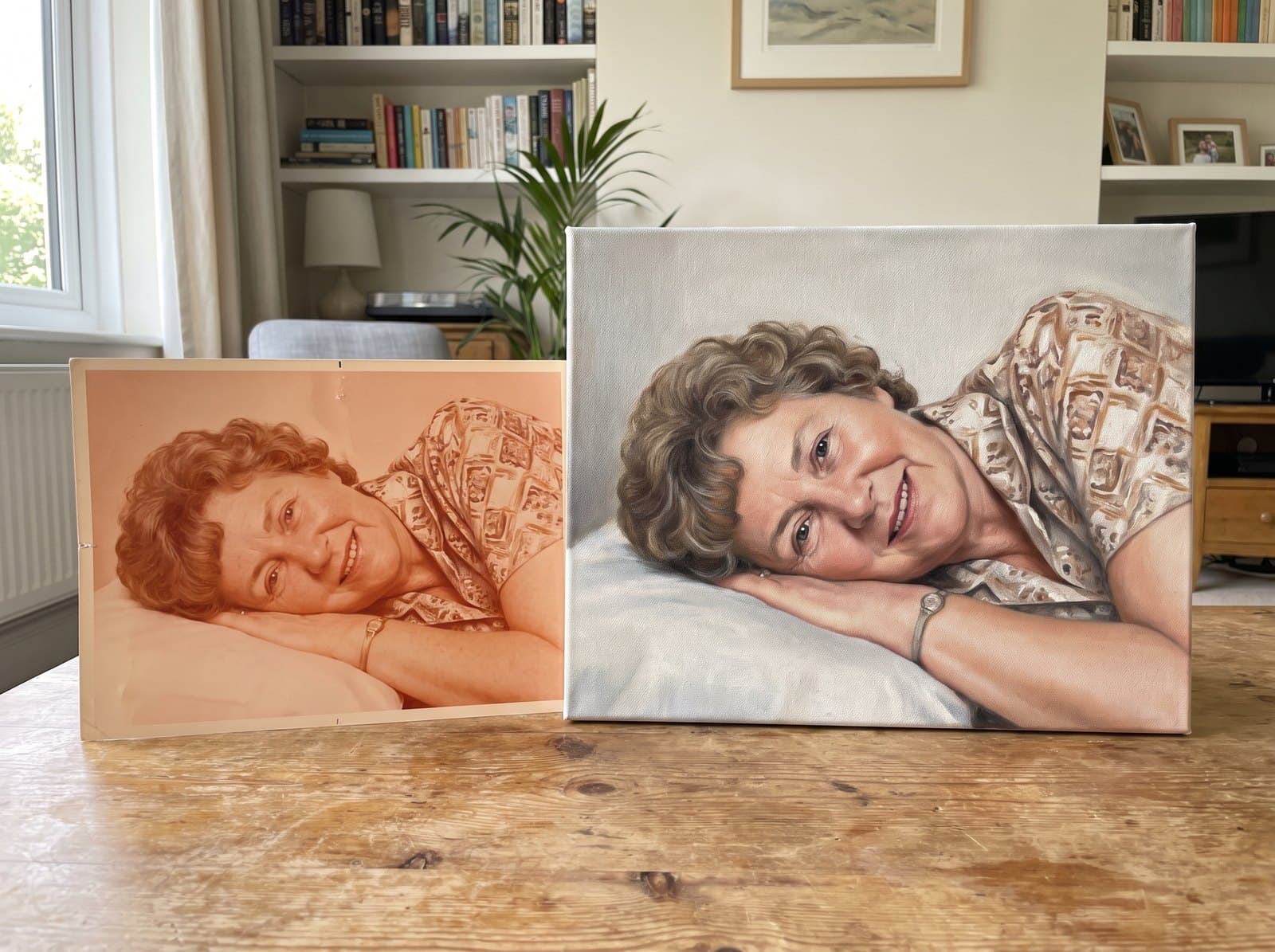
Quick answer: Usually yes. A painting from old photos is one of the most common jobs in the studio — roughly a third of the references we're sent are soft, faded, cropped out of a group shot, or photographed off a mantelpiece with a phone. Sharpness matters far less than people expect. What an artist needs is information: if the eyes, the shape of the face and the direction of the light are readable to you, they're usually readable to a painter too. Working from an existing photo is the normal case here, not the exception, and before anything ships you get a photograph of the finished painting to approve.
Why "is it too blurry" is the wrong question
A camera records pixels. A painter doesn't. Nobody copies a photograph square millimetre by square millimetre — they work out what the shapes are, where the light is coming from, and how the face is put together, then paint that. So a photo can be technically poor and still carry everything needed.
The useful test isn't sharpness. It's whether the photo answers three questions:
- Where are the eyes and how are they set? Eye position and spacing carry most of what makes someone recognisable.
- What direction is the light coming from? This decides the structure of the whole face, and it can't be invented convincingly.
- How big is the face in the frame? A soft photo with a large face beats a crisp photo where the head is the size of a five pence piece.
A warm, slightly out-of-focus photo of your grandmother from 1974 will nearly always be the better reference.
The four things people mean by "a bad photo"
Softness. General blur from a slow shutter, a smeared lens or an old camera. The most forgiving problem there is — paintings made from soft references routinely look sharper than the photo they came from.
Size. A face cropped down to 150 pixels across has genuinely lost information. This is the one problem that can stop a commission outright.
Age and colour. Prints from the 1970s to the 1990s drift orange or magenta as the dyes break down. Colour shift is fixable — it's a decision about what the true colours were, and we'll ask you.
Light. Direct flash, deep shadow, a black dog on a dark sofa. Recoverable up to the point where there's no detail left in the shadows at all.
Is your photo usable? A quick reference
| What's wrong with it | A real example | Can we paint from it? | What we do |
|---|---|---|---|
| Soft or slightly out of focus | Indoor phone photo, edges mushy | Yes | Artist resolves the detail; result looks sharper than the source |
| Motion blur across the face | Dog mid-shake, toddler running | Not on its own | Used for pose; we ask for a second photo for the face |
| Small crop from a group shot | Face roughly 200px wide | Usually — under 150px, no | We ask for any other photo of them, however poor |
| Faded or colour-shifted print | 1980s print gone orange | Yes | Colours reconstructed; we ask what the dress and eyes really were |
| Black and white only | A 1940s studio portrait | Yes | Painted in colour from your description, or kept monochrome |
| Creased, torn or water-marked | Print kept folded in a wallet | Yes | The damage simply isn't painted |
| Direct flash, red-eye, flat face | Party photo, 35mm compact | Yes | Flash flattening corrected; we confirm eye colour with you |
| Very dark or heavily backlit | Black cat against a window | Sometimes | If there's no fur detail at all, we'll need another photo |
| Frame grabbed from a video | Still from a 1080p clip | Often | A steady frame gives a workable face; a moving one rarely does |
Getting the most out of an old print
If what you have is a physical photograph, how you copy it matters more than its age.
Scan it if you can. A flatbed scanner at 600 dpi, saved as PNG or maximum-quality JPEG, pulls more out of a small print than any phone. Turn off "auto enhance" and any restoration setting — they smooth away exactly the fine detail we want. Scan the whole print, borders included.
No scanner? Photograph it flat. Take the print out of the frame if there's glass over it, lay it on a table near a window on an overcast day, hold the phone parallel to it, flash off, filling the frame with the print.
Send the original file. Don't send photos through WhatsApp or a messaging app — they compress heavily, and you can arrive with a fraction of the file you started with.
Never "enhance" it first. AI upscalers invent detail that was never there. We would much rather have your unedited 900-pixel scan.
More than one photo is allowed
People often assume a commission means one perfect photograph. It doesn't. It's completely normal to send three or four: the best one for the face, another for the pose, a third showing the true colour of someone's hair or a dog's markings in daylight.
That's also how we handle photos that can't co-exist — a grandparent from a 1960s print and a grandchild from last summer. Combined family portraits are built exactly this way, and it's the same technique that rescues a weak reference: one photo supplies what another one lost.
What we genuinely can't do
We'd rather say so before you order than after.
- A face with no features. If the head is 60 pixels across, or so dark there's nothing but a shape, painting it would mean inventing a person.
- A photo already run through an AI enhancer. These tools hallucinate eyes, teeth and hairlines. The result looks sharp and is wrong, and the wrongness can't be undone. Always send the original.
- A photo that doesn't look like them to you. If you think "that's not really her", the painting will have the same problem. Trust that and find another one.
- Extreme JPEG damage. A file forwarded, screenshotted and re-saved a dozen times develops blocky artefacts around the eyes and mouth that read as facial features.
Old photos of someone who has died
This is a large part of what we do, and the photographs are almost never good ones. They're whatever happened to exist — a snapshot at a birthday, a passport photo, a print from a wallet. That's normal, and it doesn't limit what the painting can be.
Two things are worth saying. A memorial portrait doesn't have to come from the most flattering photo, and often shouldn't — the one people live with for twenty years is usually the one where the expression is right, not the lighting. And we won't quietly "improve" someone: smoothing lines, making them look younger or well. If you want something changed, you tell us when we send the photograph of the finished piece, and we keep painting until it's right.
If you can't choose between five photos, send all five. Picking the reference is part of the job, and it's easier for us than it is for you.
Old photos of pets
Anything before about 2012 tends to be genuinely bad: a small sensor, a dark room and a moving animal. Add a black or brindle coat and there's often almost nothing in the shadows.
Still usually workable, because dogs and cats are recognisable by structure — muzzle shape, ear set, the pattern of markings — more than by fine detail. What helps enormously is a second photo taken in daylight, even a poor one, purely to establish true coat colour. If you've got one blurry indoor favourite and one rubbish garden snap, send both; pet portraits are commissioned from exactly that pairing all the time.
Wedding photos from the seventies and eighties
Faded albums are their own category. Prints from that era have usually gone warm or pink, the whites of the dress have turned cream, and the whole thing has softened. All recoverable — but the colours have to be decided rather than read, so we'll ask you directly: was the dress white or ivory, were the flowers cream or yellow, what colour were his eyes.
If anyone in the family still has the negatives, they hold considerably more detail than any print. Worth one phone call. Wedding portraits made from decades-old references are often the strongest anniversary gift going, precisely because no digital copy of that day exists anywhere.
Cost and timing
None of this changes the price. Paintings are £220–£549 depending on size, hand-painted in oils, and take three to four weeks plus delivery. Before it ships you get a photograph of the finished piece, and we keep painting until it's right. It arrives rolled in a tube, unframed, ready to take to a framer — sizes and prices are on the pricing page.
There's no surcharge for a difficult reference. What we will do is tell you honestly if a photo won't produce a painting you'll be happy with, before you've committed to anything.
Frequently asked
Will the painting look blurry if the photo is blurry?
No. The artist works out the underlying structure and paints that, so soft references generally produce sharper-looking results than the photo itself. The exception is motion blur across the face, where the information about where the features sit has gone.
How old is too old?
There's no upper limit — we've worked from photographs taken in the 1930s. For a painting from old photos, the print's condition, its physical size and how well it's been copied matter far more than the decade.
Can you paint a black and white photo in colour?
Yes, and it's a common request. The colour information genuinely isn't in the file, so we'll ask you: hair colour, eye colour, skin tone, what they were wearing. Family recollection is usually enough. If nobody remembers, keeping it monochrome is a good choice rather than a compromise.
Should I run it through an AI photo enhancer first?
Please don't. Those tools guess at detail, and the guesses land on eyes, teeth and hairlines — the features that decide whether a portrait looks like the person. Send the original, however small.
I only have one photo and it isn't great. Is it worth it?
Very often, yes. A great many paintings start from a reference the customer apologised for. Ask us first if you like, or simply order: we check every photograph within hours, 9am to 5pm Monday to Saturday (UK time), and refund you in full if it won't make a good painting — and you still see a photograph of the finished piece before it ships.
In short
Old, faded, small, creased and slightly blurry are all normal. The two things that stop a painting are a face with no detail left in it, and a photo already "restored" by software into someone else. Everything else is interpretation — which is what an artist is for.