Subjects · · 8 min read
How to Photograph an Old Dog, Before You Need To
A gentle, practical guide to photographing old dogs — light, angles, phone settings and the seven shots people wish they had taken while there was still time.
By Thomas Mark
Last updated: October 2026
Photographing old dogs
Quick answer: Photographing old dogs is mostly about light and height, not equipment. Take them outside on an overcast day or sit them by a north-facing window, kneel until your phone is level with their eyes, use the standard 1x lens from about a metre and a half away, turn the flash off, and shoot thirty or forty frames in bursts so you can keep five. Sharp eyes and daylight are the two things that matter — they're also the two things that decide whether a photo can later become a hand-painted pet portrait. Twenty minutes on an ordinary afternoon will get you better pictures than you've taken in the last three years.
Why this is worth doing today
Almost everyone photographs their dog constantly and still ends up with nothing usable — a black shape on a dark sofa, a blur mid-shake, the back of a head. That's fine while they're here; the dog is the real thing and the photos are just overspill. It stops being fine later. The most common thing we hear from people commissioning a memorial portrait is that they have four thousand photos and not one is quite right.
So the argument for photographing old dogs deliberately isn't morbid. You are not marking the end of anything. You're taking twenty minutes, on a Tuesday, while it's still easy.
Pick an ordinary day, not a special one
Mid-morning after a short walk is usually the sweet spot for an older dog — not straight after a long one, when they're flat out, and not in the evening, when stiffness and confusion tend to be worse. Keep it to fifteen or twenty minutes. A dog that's had enough looks like a dog that's had enough in every frame.
Light: the one thing that changes everything
Ninety per cent of bad dog photos are lighting problems wearing a costume.
- Overcast outdoors is the best light there is. A grey British afternoon is a giant softbox. No squinting, no hard shadows, and it flatters a greying muzzle.
- Bright sun is the worst. It blows out white and gold coats and turns black coats into a silhouette with no detail. If it's sunny, move into open shade — the shadow side of the house, under a tree, a doorway.
- Indoors, use a window and turn the lights off. Sit the dog side-on to a large window, about a metre from it, with you between them and the glass. Household bulbs mixed with daylight give a colour cast that's a nuisance to correct.
- Never use flash. It flattens the fur, throws back a green-blue eye reflection, and startles a dog whose hearing and sight are already going.
Golden hour is lovely, but the light is low and moving fast. Overcast is easier and more forgiving.
Get down to their height
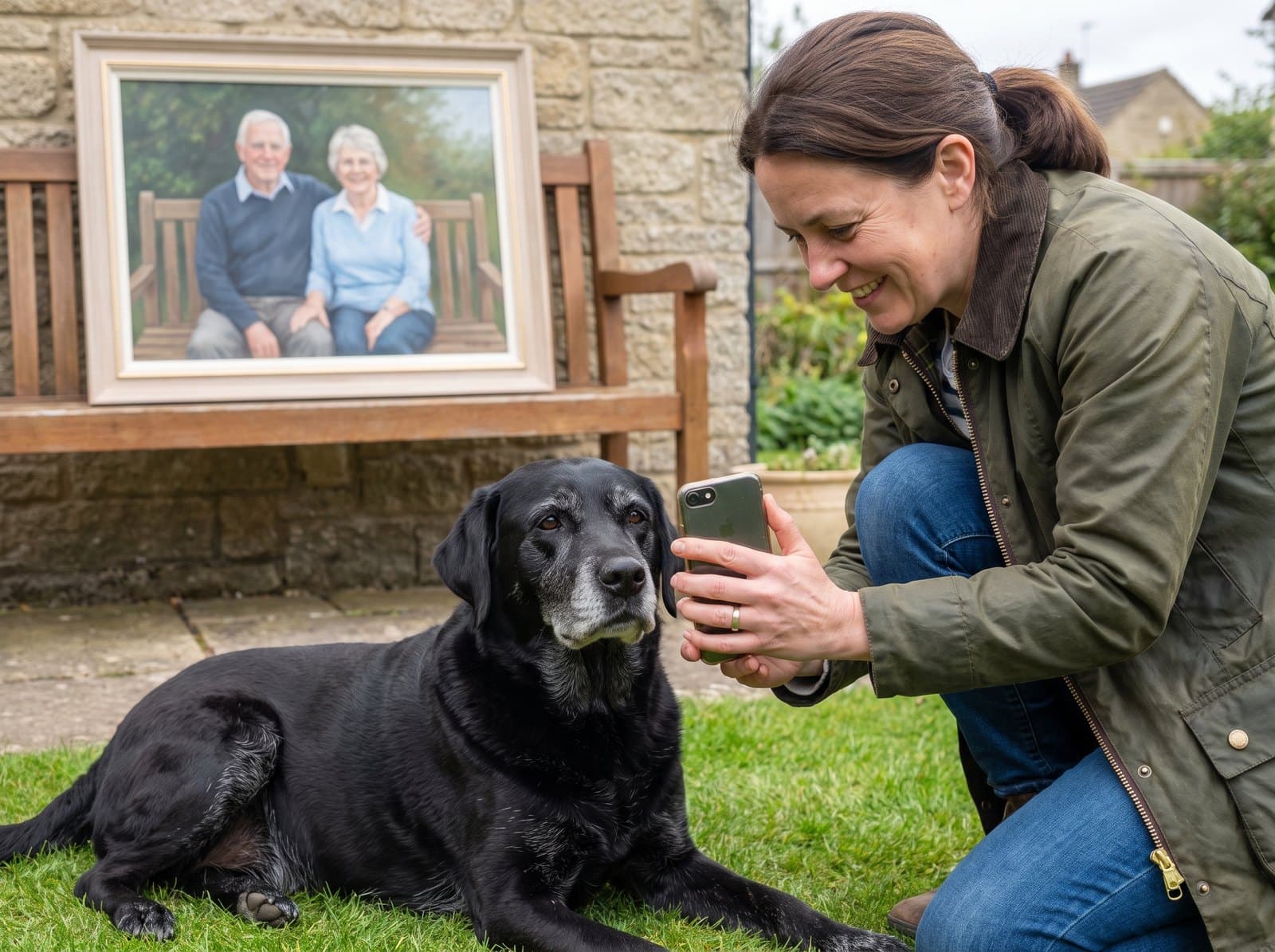
Stand up and point the phone downwards and you get a dog's back and a lot of carpet. Kneel, sit or lie down so the lens is level with the dog's eyes, or a fraction below — it's the biggest improvement available for free. With an old dog who can't stand for long this is easy: let them lie down, then get down there with them.
Phone settings that actually matter
You don't need a camera. A phone from the last five or six years is more than enough, but a few settings make a real difference:
- Use the main 1x lens from about 1.5 metres back. The 0.5x ultrawide distorts noses into snouts, and pinching to zoom is a crop, not a zoom — step closer instead.
- Tap the eye to focus, then hold your finger there for a second to lock it. If only one eye is toward you, focus on that one.
- Turn off Portrait mode for anything you might want painted. The artificial background blur eats whiskers, ear fluff and the fine hair on the muzzle — precisely the bits that make an old dog look like themselves.
- Hold the shutter for a burst and keep the frame where the ears are up.
- Wipe the lens first. A smeared lens is the most common cause of soft, hazy photos.
The seven shots worth having
Get these and you've covered everything you might want later — a frame for the hall, a photo book, or a painting.
| Shot | How to take it | Why it matters | Good enough to paint from? |
|---|---|---|---|
| Head and shoulders, eye level | 1.5m away, 1x lens, focus on the near eye | The classic portrait shot; carries expression | Yes — this is the one artists ask for |
| Full body, standing | Side-on, from a crouch, whole dog in frame | Records size, stance and proportions | Yes, for a full-body painting |
| Curled up asleep | Window light, don't wake them | Often the truest picture of an old dog | Usually — if the face is visible |
| Close-up of the face | 60–80cm, no zoom, steady hands | Greying muzzle, eyebrows, the small stuff | Yes, as a reference alongside the main shot |
| Paws and feet | Overhead, from a crouch | The detail people miss most afterwards | Not alone, but a valuable extra |
| The dog with you in it | Ask someone else, or a timer on a shelf | Almost nobody has one. Everyone wants one | Yes — this becomes a family portrait |
| Something they do | Head on your knee, sunny spot, favourite chair | Character, not just appearance | Sometimes — depends on light and sharpness |
If you only take two, take the first and the sixth. The photo of the two of you together doesn't exist in most households, and it's the one that becomes irreplaceable.
Photographing an older dog specifically
A few things change when the dog is thirteen rather than three.
Cloudy eyes are normal and you shouldn't hide them. Most older dogs develop a bluish haze called nuclear sclerosis, which isn't cataracts and isn't painful. A good artist paints the eyes as they are now — an old dog given young eyes looks like a different dog, and people notice immediately even when they can't say why.
Work around stiffness. Don't ask an arthritic dog to hold a pose or come to you repeatedly — go to them. A dog lying in their bed by a window makes a better portrait than the same dog made to stand.
Deaf and blind dogs need warning. Let them smell your hand before you loom over them with a phone — sudden movement overhead is alarming to a dog who can't track it.
Photograph the grey. The white muzzle, the pale eyebrows, the ears that have gone soft. People often try to find the photo where the dog looks youngest. Years later, it's usually the honest late-life picture they reach for.
Save them somewhere that isn't just your phone
Phones get lost and dropped, and cloud accounts fill up and quietly stop backing up. Copy the keepers to a laptop or memory stick at their original resolution, in a folder with the dog's name on it. Don't send yourself the good ones through WhatsApp and keep only that copy — it compresses images heavily, leaving a fraction of the file you started with. For a painting, the original is ideally at least 2000 pixels on the short side.
If a painting is somewhere in your thinking
You don't have to decide now. But if a portrait is a possibility one day, the photos you take this month are the ones it will be made from — so it's worth knowing what an artist needs. Sharp eyes, daylight, taken at the dog's level. That's the whole list. Our guides go through it in more detail, including what can be worked around: a slightly soft photo, an old print, a background that needs changing, or several photos combined into one. Painting from an existing photo is the normal case, not the exception, and older or imperfect pictures are more workable than people assume.
Ours are painted by hand in oils, £220–£549 depending on size, taking three to four weeks plus delivery. You're sent a photograph of the finished painting to approve before anything ships, and we keep painting until it's right; it then arrives rolled in a tube, unframed, ready for a framer to stretch onto bars. Sizes and prices are on the pricing page. None of that needs deciding while the dog is asleep on the rug next to you. The photographs do.
Frequently asked
What's the best photo for a portrait of an old dog?
Head and shoulders, taken outdoors on an overcast day or beside a window, at the dog's eye level, from about 1.5 metres, with both eyes sharp and no flash. Daylight and focus matter far more than the phone you used.
Should I use Portrait mode?
Not if the photo might be painted. Portrait mode fakes the background blur by guessing where the dog ends, and it consistently gets whiskers, ear fluff and flyaway muzzle hair wrong. For a photo you'll only ever look at on a screen, it's fine.
My dog won't look at the camera. Does it matter?
Less than you'd think — a dog looking slightly off-camera often makes a calmer portrait than one staring down the lens. If you do want their attention, have someone behind you make a small noise once. Squeaks work exactly one time per session, so have the camera ready first.
Is it strange to plan photos for a memorial while the dog is still alive?
No, and it's much kinder to yourself. Taking photographs now is an ordinary afternoon with your dog. Trying to find a usable photo afterwards is a bad hour spent scrolling through a camera roll while grieving. Plenty of people take the pictures years early and never think about it again until they need them — and a memorial portrait made from a photo taken in good light is a completely different object from one rescued out of a blurred snapshot.
How many photos do I need?
Thirty or forty in one session, from which you'll keep five or six. For a painting, one strong main photo plus two or three extras showing colouring and markings is plenty.
One last thing
You will not regret the twenty minutes. Walk to the end of the garden on a grey afternoon, kneel down in the wet grass, and take some proper pictures of your old dog while they're still standing in front of you looking slightly puzzled about it. That's the whole job, and it's a nicer afternoon than it sounds.
More onDogs, cats and horses