Commissioning · · 9 min read
How to Turn a Photo Into a Painting (UK, 2026)
How to turn a photo into a painting in the UK: the four options compared, what a hand-painted oil commission costs, how long it takes and what to send.
By Thomas Mark
Last updated: September 2026
How to turn a photo into a painting
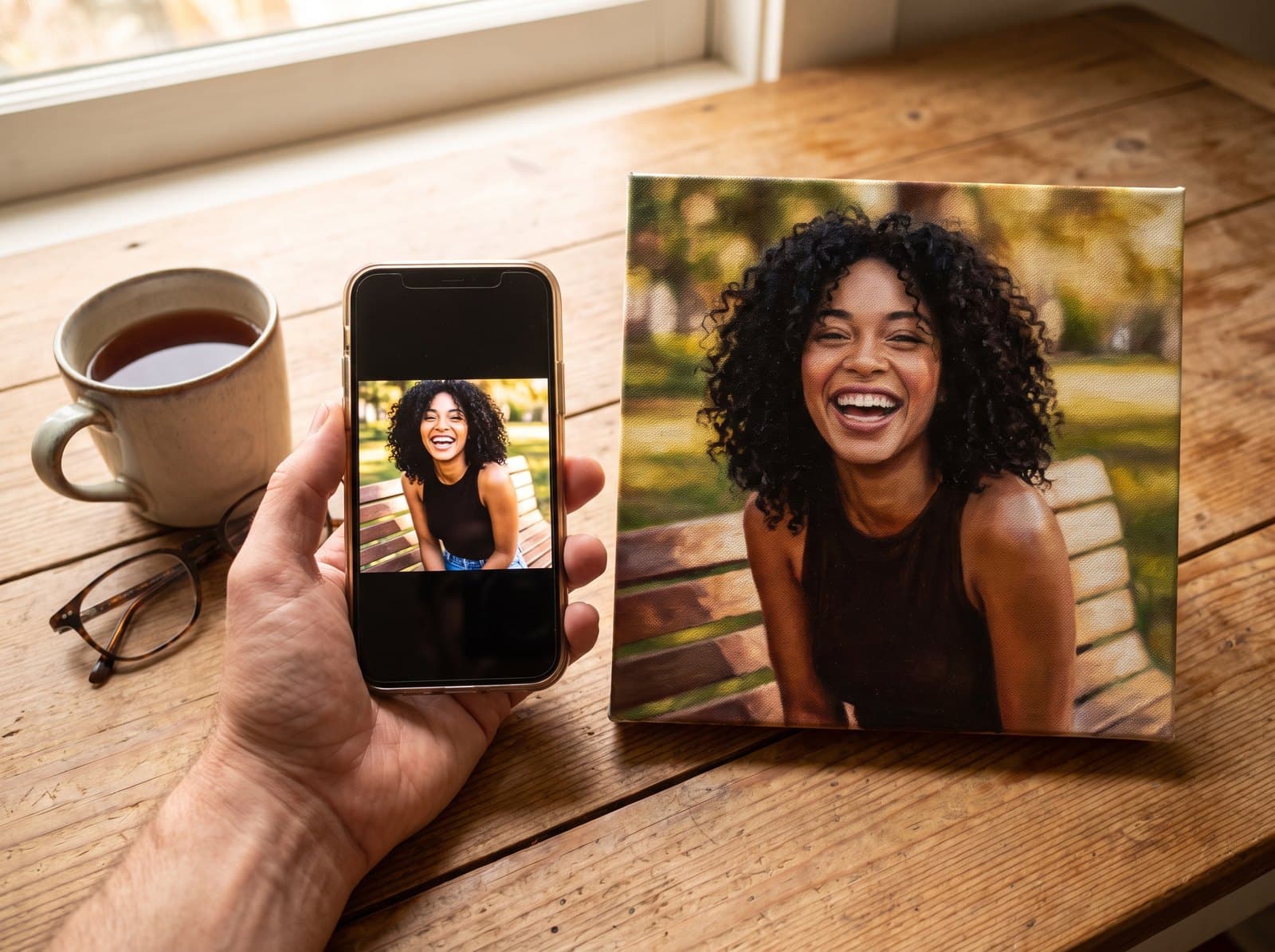
Quick answer: Send the photograph to a studio that paints by hand, approve a photograph of the finished painting, and it ships to you rolled in a tube for a local framer to stretch and frame. In the UK a hand-painted oil portrait made from your photo starts at £220 for a 12 × 16″ canvas and takes three to four weeks plus delivery, most of that being the painting itself. Nothing is posted until you have seen it and said yes. If you only want the look of a painting rather than an actual one, a filter app costs nothing and takes ten seconds — the rest of this page is about the difference.
The four ways to do it, honestly compared
People arrive at this wanting quite different things. Some want a nice profile picture; some want the last photo of their dog to exist as an object. The price gap between those two answers is enormous.
| Option | What you get | Typical UK cost | Time | Worth it when |
|---|---|---|---|---|
| Filter app or AI generator | A digital file with a painting effect | Free–£10 | Seconds | You want a profile picture or a screen background |
| Printed "canvas art" | Your photo, or a filtered version, inkjet-printed onto canvas | £25–£70 | 3–5 days | You need something on the wall this week and budget is tight |
| Digital painting by an artist | A hand-drawn digital file, sometimes printed | £80–£250 | 1–3 weeks | You want a real artist's interpretation but not a physical original |
| Hand-painted oil on canvas | A one-off painting in real oil paint, no print process | £220–£549 | 3–4 weeks plus delivery | It's a gift, a memorial, or something you expect to keep for decades |
The honest summary: the first two are copies of a photograph, the last two are interpretations of it. A print reproduces every flaw in the original file at exactly the size you ask for — a slightly soft photo becomes a very soft print. A painter looks at the photo, works out what the person actually looks like, and paints that instead. That distinction is the whole decision.
What actually happens when you commission one
There is less mystery here than most studios let on. The process is five steps.
- You pick a size and send the photo. Phone photos are fine. Screenshots, scans of old prints and slightly blurry pictures are all workable — more on that below.
- You say what you want changed. Remove a lead, drop an ex out of the frame, change a background to plain colour, put two people who were never photographed together into one painting. This is the part a print shop cannot do and it costs nothing extra.
- A painter works on the canvas. Oil on cotton canvas, by hand. This is the three-to-four-week bit.
- You see the finished painting. A properly lit photograph of it, before it leaves the studio. If the expression is wrong, the skin tone has drifted, or the background isn't what you pictured, you say so and it goes back on the easel until it's right.
- It ships rolled in a tube, unframed. A local framer stretches the canvas over wooden bars and frames it, and then it goes on the wall.
That approval step is the one that matters. The usual fear with commissioning anything is that a lot of money arrives looking wrong, three days before the birthday, with nothing to be done about it. Approval before dispatch removes that.
Choosing the photograph
This is the single biggest lever on how good the painting turns out — far more than price or size.
What makes a photo work
- Light on the face from one clear direction. Window light beats flash. Flash flattens features and a painter then has to invent the shape of the face.
- Reasonable resolution, but less than you think. Enough that you can zoom to the eyes and still see a defined edge. That's the bar. A 12-year-old 8-megapixel phone photo usually clears it.
- The right expression. A painting holds one expression forever. Pick the picture where they look like themselves, not the one that is technically sharpest.
- Eyes at or near your own eye level. Photos taken looking down at a dog or a child tend to read oddly when enlarged.
What a painter can fix
Quite a lot, and this surprises people. Closed eyes from another photo in the set, a dated haircut, a cluttered kitchen behind the subject, a lead or harness, colour casts from bad indoor lighting, a person who needs to be added from a separate picture, a small photo cropped to a different shape. Damage on old prints — creases, foxing, a torn corner — is routine.
What they cannot fix
If the face is genuinely out of focus or too small in frame to make out, no amount of skill invents features that were never recorded. If it's a very low-resolution screenshot of a video call, expect a likeness that is close rather than exact, and say up front that the reference is weak. Our guides go through this in more detail with examples of what "good enough" actually looks like, and the gallery shows finished paintings beside the photographs they were painted from.
Sizes and prices
All prices are for a finished hand-painted oil on canvas, shipped rolled in a tube and unframed.
| Size | Price | Best for | Where it usually ends up |
|---|---|---|---|
| 12 × 16″ | £220 | One person or one pet | Shelf, hallway, small alcove |
| 16 × 20″ | £275 | A couple, or a dog full length | Bedroom, landing, home office |
| 20 × 24″ | £330 | Two or three subjects | Living room, above a sideboard |
| 24 × 36″ | £449 | A family group | Above a sofa or fireplace |
| 30 × 40″ | £489 | A group with background detail | A large main wall |
| 36 × 48″ | £549 | A statement family portrait | Stairwell or double-height wall |
Each additional person or pet in the composition adds from £35. Full detail is on the pricing page.
Two practical notes. Most people under-order on size — a 12 × 16″ canvas is smaller in a room than it sounds, so if it's going above furniture, go one step up. And everything ships rolled on purpose: a canvas in a tube travels better and costs far less to send than a rigid framed one, and a frame chosen in your own room will suit it better than one chosen by us. Budget for the framer at your end — stretching the canvas over bars runs about £30 to £80, and they will do it as part of the framing job.
Which kind of commission you're after
The process is the same; the reference photos and the things worth asking for differ.
- Pet portraits — the most common request. Get down to the animal's eye level if you're taking the photo now, and send four or five options rather than one.
- Family groups — often assembled from more than one photograph, because the picture where everyone looks good does not exist.
- Weddings, couples and anniversaries — usually a photographer's file, or an old print repainted at a size it could never have been enlarged to.
- Memorial portraits — for a person or an animal who has died. The reference is whatever exists, and that is fine; we work with what there is.
How long it really takes
Three to four weeks in the studio, then the courier: a few days to agree the reference and any changes, around two weeks of painting and drying, then the photograph for approval, any reworking, and shipping. If it has to be framed by the date, add one to three weeks for a framer at the other end.
If you're aiming at a fixed date, order eight weeks ahead and you'll never think about it again — that covers the painting, the delivery and the framing. Six is comfortable. Four is possible but leaves no slack if the painting needs a second pass, and none at all for a frame. If you've left it late, say so when you order rather than hoping.
Frequently asked
Can an app turn a photo into a painting for free?
Yes, and if you want a filtered image for a screen, use one. What it cannot do is produce a physical object with paint on it, make judgements about a likeness, remove a person, or fix a bad reference. Those are the reasons people pay for a hand-painted commission, and they're not things software is close to replacing.
Is a hand-painted portrait worth it over a printed canvas?
It depends entirely on what you want. If the picture is decoration, a £40 print is the sensible answer. If it's a gift, a memorial, or something you expect on a wall in thirty years, the difference is real: a print is a reproduction that fades and can be reordered, an oil painting is a single object made by a person from your photograph. Only one of them gets passed on.
Can you paint from an old, damaged or blurry photo?
Usually, yes. Creased prints, faded colour, small photos and slightly soft focus are all standard. The limit is whether the face is legible at all — if you can see the shape of the features when you zoom in, a painter can work from it. Send it and ask before assuming it's too poor.
What if I don't like the painting when I see it?
You see a photograph of the finished painting before anything ships, and reworking at that stage is part of the service, not an extra — it stays on the easel until it's right. Say specifically what's wrong — "the smile is too wide", "her hair is too dark" — rather than "it doesn't look right", and it gets fixed faster.
Does it arrive framed?
No. It ships rolled in a tube, unframed and unstretched, so the first stop is a local framer: they stretch the canvas over wooden bars, usually £30 to £80, and frame it in the same job. Standard sizes mean off-the-shelf mouldings fit, so the frame itself is usually £40–£120 rather than a custom one.
The short version
To turn a photo into a painting properly: choose the photo where the person or animal looks most like themselves, pick a size one step larger than feels obvious, send it, ask for the changes you want, and check the photograph of the finished painting carefully before approving. Three to four weeks and a courier, £220 upwards, and the thing that arrives is not a copy of your photograph — it's someone's reading of it, which is the whole point.
More onCommissioning a painting