Commissioning · · 8 min read
Oil Painting vs Print vs Canvas: What You're Actually Buying
Oil painting vs print vs canvas: what you get for £220 rather than £40, how each one ages on a wall, and how to tell a painting from a print.
By Thomas Mark
Last updated: September 2026
Oil painting vs print: what's the actual difference?
Quick answer: A print is a machine copy of your photograph; an oil painting is a person looking at your photograph and painting it by hand. That is the whole difference, and it explains the price — a canvas print of your dog is roughly £30 to £90 and arrives this week, while a hand-painted oil portrait from the same photo is £220 to £549 and takes about three to four weeks, plus delivery. The confusing part is the word "canvas", which in most shops means a photo printed onto canvas fabric, not a painting on one.
The three things are really only two things
Shops list oil paintings, prints and canvases as three options, which makes it sound like three different crafts. It isn't. There are two categories:
Reproductions. A photo print on paper, a giclée, a canvas print, an acrylic block, a photo mug. A machine reads your image file and lays ink down to match it. The output is a copy of the photograph, at whatever quality the file and the printer allow.
Original paintings. Someone stands at an easel and paints your subject in oil, over days. Nothing is copied mechanically. What ends up on the canvas is one person's reading of your photo — where the light falls, which details matter, what to leave out.
"Canvas" sits in the first group despite its name. A canvas print is an inkjet print on primed cotton, stretched over a wooden frame so it looks like a painting from across the room. Up close it doesn't, because it is ink with no paint on it and the weave is machine-regular. That's not a criticism — it's a good, cheap way to get a photo onto a wall. But it's worth knowing that when a listing says "canvas art from £29", you are buying a printer's output, not a painter's.
Side by side, at the same size
Everything below is for a 16 × 20″ piece, which is the most commonly ordered portrait size.
| What you're buying | Typical UK price | Time | Surface up close | Realistic lifespan |
|---|---|---|---|---|
| Photo print on paper | £15–£40 | 2–5 days | Flat ink; needs glass and a frame | 20–50 years framed and out of sun |
| Canvas print | £30–£90 | 3–7 days | Flat ink on cotton, even machine weave | 30–75 years with a UV coating |
| Hand-painted oil on canvas | £275 | 3–4 weeks | Real oil paint, blended smooth by hand | Centuries, no glass needed |
The lifespan column is where most of the money actually goes. Oil paint dries into a solid film of pigment; the National Gallery is full of 400-year-old examples still doing fine. Modern archival inks are genuinely good, but they are dyes and pigments sitting on a surface, and they fade — slowly in a hallway, quickly on a wall that gets afternoon sun.
What a painter can do that a printer cannot
This is the part people underestimate, and it matters more than surface texture.
A print can only ever be as good as your photo. Blow up a slightly soft phone snap to 20 × 24″ and you get a large, soft photo. Every bit of noise, every blown-out highlight, every bit of motion blur gets bigger with it. A painter working from the same file makes decisions instead: they know what a spaniel's ear does, so a blurred ear becomes a painted ear rather than a smear.
A painter can remove things. The lead and collar tag. The wheelie bin. The ex-boyfriend at the edge of the group. The kitchen units behind your grandmother's head, swapped for a plain warm background. A print gives you the room the photo was taken in, whether you want it or not. The gallery pairs each painting with its original photograph, so you can see what was taken out.
A painter can combine photos. Two dogs who never overlapped in life can share one canvas. So can a photo of your parents from 1974 and one of them from last summer — a common request on our anniversary commissions.
A painter can work from a bad original. Faded 1960s prints, creased photographs, a scanned newspaper cutting. This comes up constantly with memorial portraits, where the only picture that exists is often the worst one anybody owns. A printer would simply reproduce the damage, larger.
If your photo is technically excellent and you like it exactly as it is, a print is an honest answer and you should take it. The oil painting vs print calculation changes the moment the photo needs help, or the moment the thing on the wall is meant to outlive you.
How to tell them apart in a shop or a listing
- Look for the word "reproduction", "giclée", "print" or "canvas print". Sellers must say it, but it is often in the small print under a heading that just says "oil canvas".
- Look at the edges. A print has a clean, mechanical edge, often with the image wrapped round the sides. If in doubt, ask for a photograph of the actual canvas.
- Check the delivery time. Nothing hand-painted in oil ships in three days. Oil needs days to become touch-dry before it can be handled, let alone packed. A "hand-painted" listing promising 48-hour dispatch is describing a print, or a print with a clear gel skimmed over it to fake a painted surface.
- Ask whether you see the work before it ships. Every real commission sends you a photograph of the finished piece to approve, and reworks it if something's wrong, before anything is packed and dispatched.
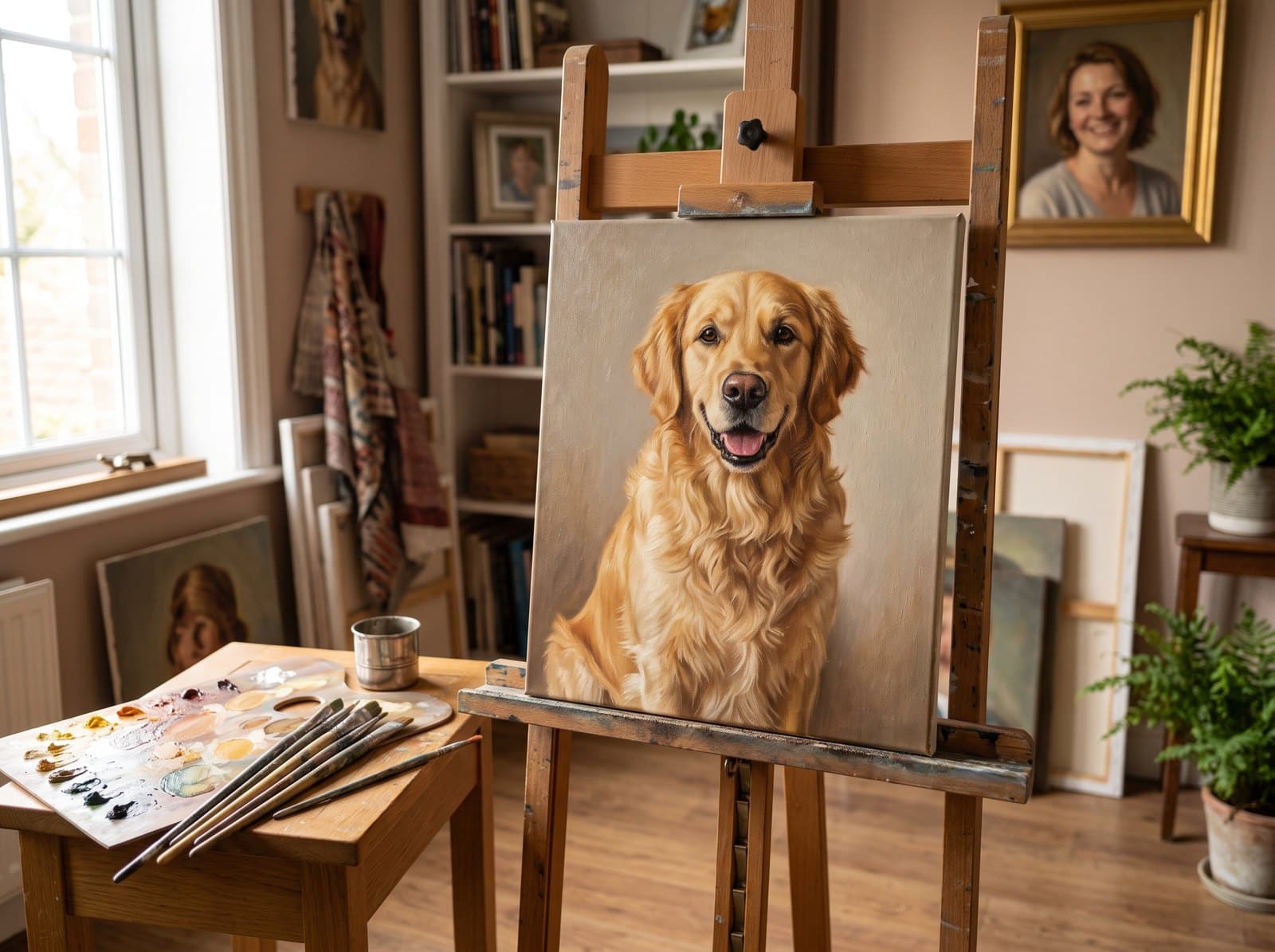
That last point is the one worth insisting on. We send a photograph of the finished painting on the easel and wait for you to approve it — and if something is wrong, the eyes, the coat colour, the background, it gets reworked before it is packed. You are not committing £330 to a surprise in a box. Full terms and sizes are on the pricing page.
What it costs, honestly
Our commission prices run by canvas size, with the first subject included:
| Size | Price | Usually chosen for |
|---|---|---|
| 12 × 16″ | £220 | One pet or one face; a shelf or a small wall |
| 16 × 20″ | £275 | The default portrait size |
| 20 × 24″ | £330 | A living room wall with space around it |
| 24 × 36″ | £449 | Two or three subjects, or a full-length figure |
| 36 × 48″ | £549 | Above a fireplace or a sofa |
Additional people or animals start at £35 each, which covers a couple with their dog on one canvas — the most common couple commission we take. Everything arrives rolled in a tube, unframed. Take it to a local framer, who stretches it onto bars and frames it to suit the room, and it's ready to hang once that's done.
So the real oil painting vs print gap at portrait size is roughly £200. Whether that is a lot depends entirely on what you're comparing it to. Against another print, it's expensive. Against a piece of furniture you'll replace in ten years, or a weekend away, it's not.
Frequently asked
Is an oil painting vs print price gap worth it for a pet?
If the animal is still here and you want something cheerful on the wall, a canvas print does the job for under £60. If the animal has died, or is elderly, people almost never regret the painting — the reason is that a print reproduces the photo you already have, so it adds nothing you didn't own before. A painted pet portrait is a new object about that animal, and it does not look like a phone screen. That's the whole of it.
Can you print an oil painting?
Yes, and this trips people up. A print of a painting is still a print. Some sellers photograph a stock oil painting, print it onto canvas, add a few dabs of gel medium for texture and sell it as "hand-embellished". It is not a lie exactly, but the image underneath is machine-made and identical to everyone else's.
Does the canvas itself differ?
The fabric is similar — cotton or linen over a wooden stretcher. The difference is what happens to it. A print canvas is primed for ink absorption and coated afterwards. A painting canvas is primed with gesso to hold oil paint, and what ends up on it is paint, not ink: oil colour mixed and blended by hand, in layers. Ours are painted with fine brushes to a smooth finish, so don't look for thick ridges. The proof is the photograph of your actual canvas, which we send before it ships.
How long do I actually wait?
About three to four weeks from the day you send the photo, plus delivery. Most of that is the painting itself; near the end we send a photograph of the finished piece for you to approve, and any changes happen before it's dried, packed and posted. If you're working to a birthday or Christmas, order with a month's clearance rather than a week's — we cover the timing in more detail in the commissioning guides.
What if I hate it?
Then it doesn't ship. You see the finished painting photographed on the easel and either approve it or tell us what's wrong. Changes at that stage are normal and expected — it is a person painting, not a printer, so it can be corrected. That is one advantage of the slow option that the fast one cannot offer at all.
More onCommissioning a painting