Care · · 9 min read
How to Frame an Oil Painting in the UK (and What It Costs)
How to frame an oil painting on canvas in the UK: floater versus traditional frames, whether you need glass, what a framer charges, and how to hang it safely.
By Thomas Mark
Last updated: October 2026
How to Frame an Oil Painting
Quick answer: An oil painting on canvas is framed without glass and without a mount. That leaves two real choices: a floater frame, which sits around the canvas with a small gap and shows its edges, or a traditional frame with a rebate, whose lip overlaps the front of the picture by a few millimetres. Ready-made frames in standard inch sizes cost £15 to £90 and arrive in days; a bespoke framer charges roughly £70 to £300 for most sizes and wants two to three weeks. A commissioned portrait arrives rolled in a tube, so a framer stretches it over bars first — £30 to £80, normally done as part of the same job — which means you choose the moulding with the painting in front of you.
What you are actually framing
Before any advice on how to frame an oil painting makes sense, it helps to be clear about the object, and about the order things happen in. A commissioned painting arrives rolled in a tube, unstretched and unframed, because that is the safest way to post oil on canvas. So the first stop is a framer, who stretches it over wooden bars for £30 to £80 and then frames it, usually as one job.
A stretched canvas is primed cotton or linen pulled over a wooden stretcher and stapled at the back or sides. It has three dimensions that matter: height, width and depth. Standard stretcher bars are around 18 to 20mm deep; gallery or deep-edge bars are 35 to 40mm. The depth decides which frames will fit, so settle it with the framer before buying anything.
Measure the finished height and width too, rather than trusting the size you ordered. A canvas sold as 16 × 20in often ends up a few millimetres over or under once it is on bars, which is the difference between a frame that drops in cleanly and one that has to be forced.
Oil paint is dry to the touch when it leaves a studio but goes on curing underneath for months. Unroll it flat and face up, and give it a day or two to relax before it goes to the framer; do not wrap the face in cling film or lean it picture-side in against a wall while you decide.
No glass, and no mount
Oil paintings are not put behind glass. The paint film needs air, glass traps moisture against it, and on a painting still curing the surface can stick to the glazing. Glass also kills the thing you paid for: the paint reads as flat behind a sheet of reflections, and from across the room a glazed canvas looks exactly like a print. Museums glaze certain works with spacers and special glass; none of that is relevant to a portrait above a fireplace.
Mounts are a paper convention, there to hold a photograph or watercolour off the glass, and a canvas needs neither. The traditional equivalent for oils is a slip or liner: a narrow inner frame, often covered in linen, between the painting and the outer moulding. It adds £20 to £60 at a framer and suits formal portraits better than modern rooms.
Floater frame or traditional frame
Once glass and mounts are out of the picture, how to frame an oil painting comes down to two choices.
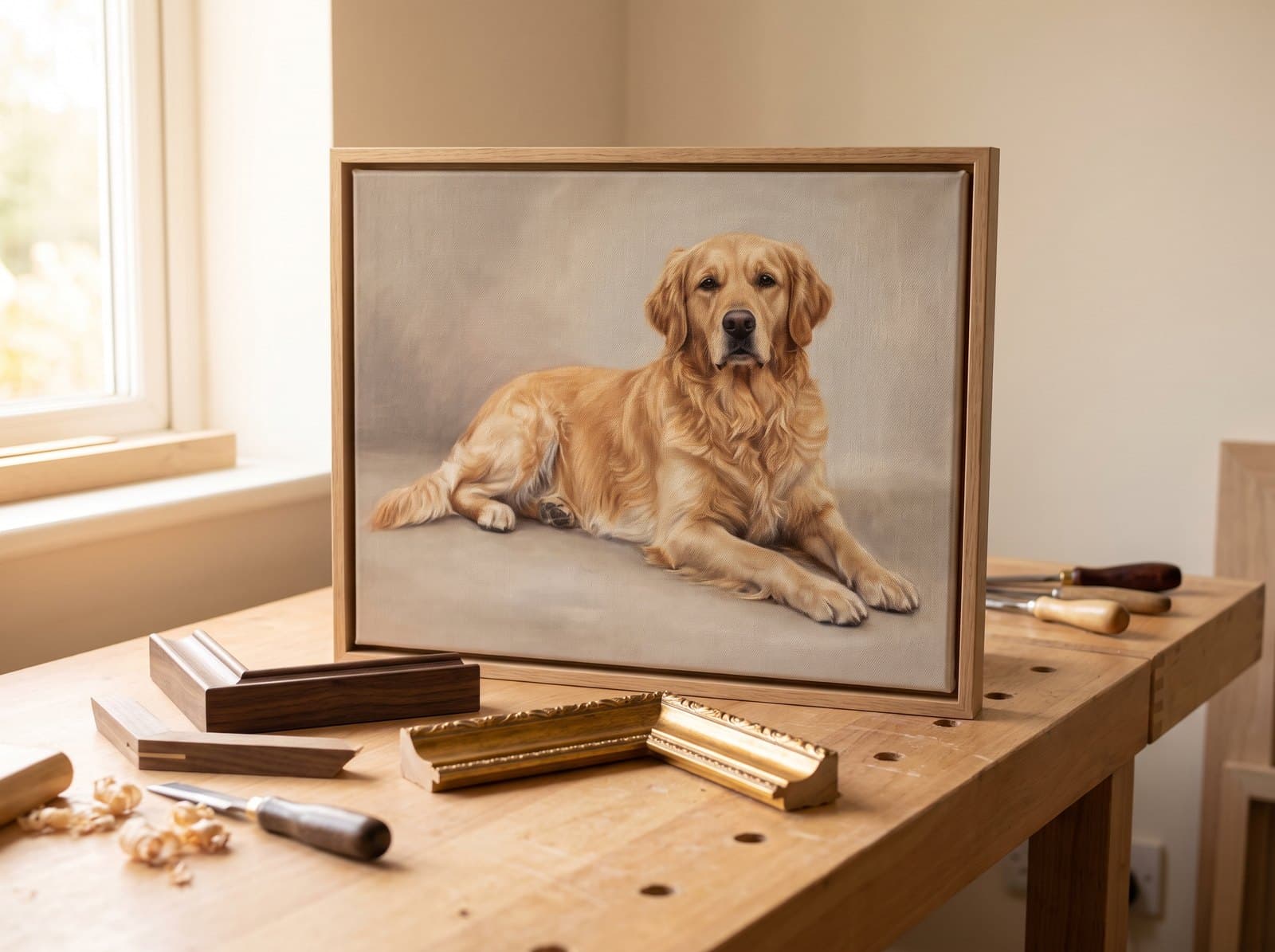
A floater frame (or tray frame) is a shallow open box. The canvas sits inside it with a gap of 5 to 10mm all round, fixed from behind, so the whole painted surface and the edges are visible and the picture appears to float. It suits deep-edge canvases, contemporary rooms and looser, more impressionistic styles. Because nothing touches the front, it is also the safest option for a painting that is only weeks old.
A traditional frame has a rebate: a stepped recess behind the moulding into which the canvas drops, with a lip that overlaps the front by 6 to 8mm on each side. That lip hides the edges but also covers a little of the picture, which matters if a face or hand sits close to the border. The rebate needs to be at least as deep as the stretcher, or the canvas stands proud at the back; framers get round a shallow rebate with offset clips, small Z-shaped brackets that screw into the frame and hold the stretcher at whatever height it lands.
On style, match the frame to the painting rather than the room: a classical, tightly rendered portrait takes a dark wood or plain gilt moulding, a loose, impressionistic one a black or oak floater. Ornate gold suits period paintings and very little else.
Frame width follows canvas size: 3 to 5cm up to 20 × 24in, 5 to 8cm above that. The frame adds twice its width to the footprint on the wall, which is the number to check against an alcove. If the canvas size itself is not settled, the portrait size guide works through that arithmetic.
What it costs and how long it takes
| Option | Typical UK cost | Lead time | Pick it when |
|---|---|---|---|
| Stretched only, hung bare | £30–£80 | 3–10 days at a framer | Deep-edge bars, modern room, or you are not ready to choose a moulding |
| Ready-made traditional frame, standard size | £15–£60 | 2–7 days | 12 × 16in to 20 × 24in, tight budget |
| Ready-made floater frame | £30–£90 | 3–10 days | Standard size, contemporary look, fresh painting |
| Bespoke framer, plain moulding | £70–£180 | 1–3 weeks | Odd size, or you want to see corner samples against the painting |
| Bespoke floater, or traditional with linen slip | £120–£300 | 2–3 weeks | A formal portrait, or anything 24 × 36in and up |
| Bespoke ornate or gilt, large | £250–£500 and up | 2–4 weeks | Period style, big canvas, a room that can carry it |
These are ranges rather than quotes, they move with the moulding and the framer, and every one of them sits on top of the £30 to £80 for stretching. On a £220 to £549 commission, a £30 ready-made frame is proportionate at the small end and a £200 bespoke one at the large end; spending more on the frame than the painting is a sign something has gone wrong.
Ready-made or bespoke
Ready-made works because canvases and frames share standard inch sizes. Commission sizes run from 12 × 16in to 36 × 48in, and the smaller three (12 × 16in, 16 × 20in and 20 × 24in) are stocked by most online framers and larger art shops. 24 × 36in is available from some; 30 × 40in and 36 × 48in are almost always bespoke. The pricing page lists every size.
When buying ready-made, look for "fits artwork size" rather than the outer dimension, and check the rebate depth: a frame designed for a print has a rebate of 8 to 10mm, which is useless for a 20mm stretcher.
For bespoke, take the rolled canvas in: the framer stretches it, measures the result, you hold corner samples against it in daylight, and you agree a price. Ask for offset clips rather than nails, D-rings and cord on the frame rather than the stretcher, and a backing board if you want the canvas protected from behind. Allow two to three weeks for stretching and framing together, on top of the three to four weeks a painting takes plus delivery, if the whole thing is for a fixed date.
Fitting a canvas yourself
Stretching is not a DIY job — it wants a keyed frame, canvas pliers and even tension, and a portrait is the wrong place to learn — so leave that to the framer and collect the painting on its bars. After that, fitting a ready-made frame takes fifteen minutes and a screwdriver.
- Lay the frame face down on a towel so the front does not get scratched.
- Drop the canvas in, face down, and check it sits square in the rebate.
- Fix it with offset clips at four to six points, screwing into the frame, never into or through the canvas.
- Fit two D-rings to the frame about a third of the way down from the top, with picture cord or wire between them and a little slack.
Sawtooth hangers are fine for a 12 × 16in and nothing bigger. A framed 36 × 48in can weigh several kilograms and wants two rated hooks, or one heavy-duty fixing into a stud or masonry. Where it goes matters as much as how it is hung; where to hang a portrait covers radiators, sunlight and the rooms to avoid.
When to leave it unframed
Part of how to frame an oil painting is knowing when not to: plenty never see a frame, and a canvas on deep-edge bars looks deliberate hanging bare. Stretching alone, at £30 to £80, is the cheapest honest finish rather than a fallback. What you cannot skip is the framer's first job — a canvas out of the tube has to go on bars before it goes anywhere near a wall. If the painting is a gift, sending it unframed lets the recipient choose the moulding for their own wall rather than living with your guess, which is exactly why commissions ship that way. If you are simply not sure, have it stretched and hang it bare for a month; the room usually tells you whether it wants a frame.
Frame or no frame, an oil painting is happiest on an inside wall at ordinary room temperature, away from damp and direct sun, and keeping it clean is easier than most people expect.
Frequently asked
Do oil paintings need glass?
No. Oil on canvas is framed open, without glazing. Glass traps moisture against the paint, can stick to a surface that is still curing, and hides the painting behind reflections.
Can you frame an oil painting straight away?
Yes, provided the frame does not press on the painted surface. A floater frame touches nothing but the back and sides. A traditional frame's lip rests on the outer 6 to 8mm of the front, which is fine once the paint is dry to the touch.
How much does it cost to frame an oil painting in the UK?
Ready-made frames in standard sizes cost £15 to £90. A bespoke framer typically charges £70 to £180 for a plain moulding and £120 to £300 for a floater or a frame with a linen slip, with large or ornate work running higher. Stretching the canvas, which a commission needs before it can be framed or hung, adds £30 to £80.
What is a floater frame?
A shallow, open-fronted frame in which the canvas sits with a small gap all round, fixed from behind, so its edges stay visible and it appears to float. It suits deep-edge canvases and contemporary rooms, and is the safest option for a recent painting.
Can I put an oil painting in a normal photo frame?
Almost never. Photo frames are glazed, come with a mount, and have a rebate under 10mm, so a 20mm stretcher will not fit and the glass would sit against the paint. Look for canvas, floater or tray frames instead, and check the rebate depth.
The short version of how to frame an oil painting: have it stretched first, measure the canvas including its depth, rule out glass and mounts, choose a floater for a contemporary canvas and a traditional moulding for a formal portrait, and go to a framer for anything above 20 × 24in. If you cannot decide on a moulding, hang it bare on the bars and give it a month.
More onCommissioning a painting