Subjects · · 8 min read
What to Write in a Pet Loss Sympathy Card
What to write in a pet loss sympathy card: a four-line structure that always works, examples to adapt for dogs, cats and horses, and the phrases to leave out.
By Thomas Mark
Last updated: September 2026
What to Write in a Pet Loss Sympathy Card
Quick answer: Four short lines, in your own handwriting, are enough: the animal's name, that you are sorry, a single thing you remember about them, and a line that either gives permission to be upset or offers something concrete. "So sorry about Pip. I'll always picture her asleep across the doormat so nobody could get in or out. Fourteen years is a proper loss and you're allowed to feel it. I'm dropping a lasagne round on Wednesday and I'll leave it in the porch." That is a complete pet loss sympathy card. Leave out anything beginning "at least", any mention of a replacement, and any printed verse you would not say out loud yourself.
Why a card is worth sending at all
When a person dies there are forms, a funeral, a week off work and a shelf of cards in every supermarket. When a dog or cat dies there is none of that, and the loss is often just as sharp. Most people are back at work the next morning saying nothing, in case grieving an animal looks absurd.
A pet loss sympathy card is a physical object that says: this counted, and someone noticed. Years later it is often still in a drawer next to the collar.
The four lines
Nearly every card that lands well does four things.
Name the animal. Write "Otis", not "your dog". A card that could have been sent to anyone reads like one.
Say you are sorry, plainly. "Sorry for your loss" is a phrase for avoiding the word died. "I'm so sorry Otis has died" is harder to write and much better to receive.
Offer one memory. It does not need to be a story; "the way he carried his own lead home" is enough, and it proves the animal was noticed by someone outside the house.
Give permission, or make an offer. "Nobody expects you to be fine about this" covers the first. For the second, put a day and a thing in it: "the corner table at the Swan is booked for Friday, no need to be good company". Not "if there's anything I can do", which leaves them to think up the errand.
Handwriting, cards and signing off
Handwriting wins, even bad handwriting; a message typed into an online card service and printed in a script font looks like a renewal notice. If yours is hard to read, write slowly in capitals.
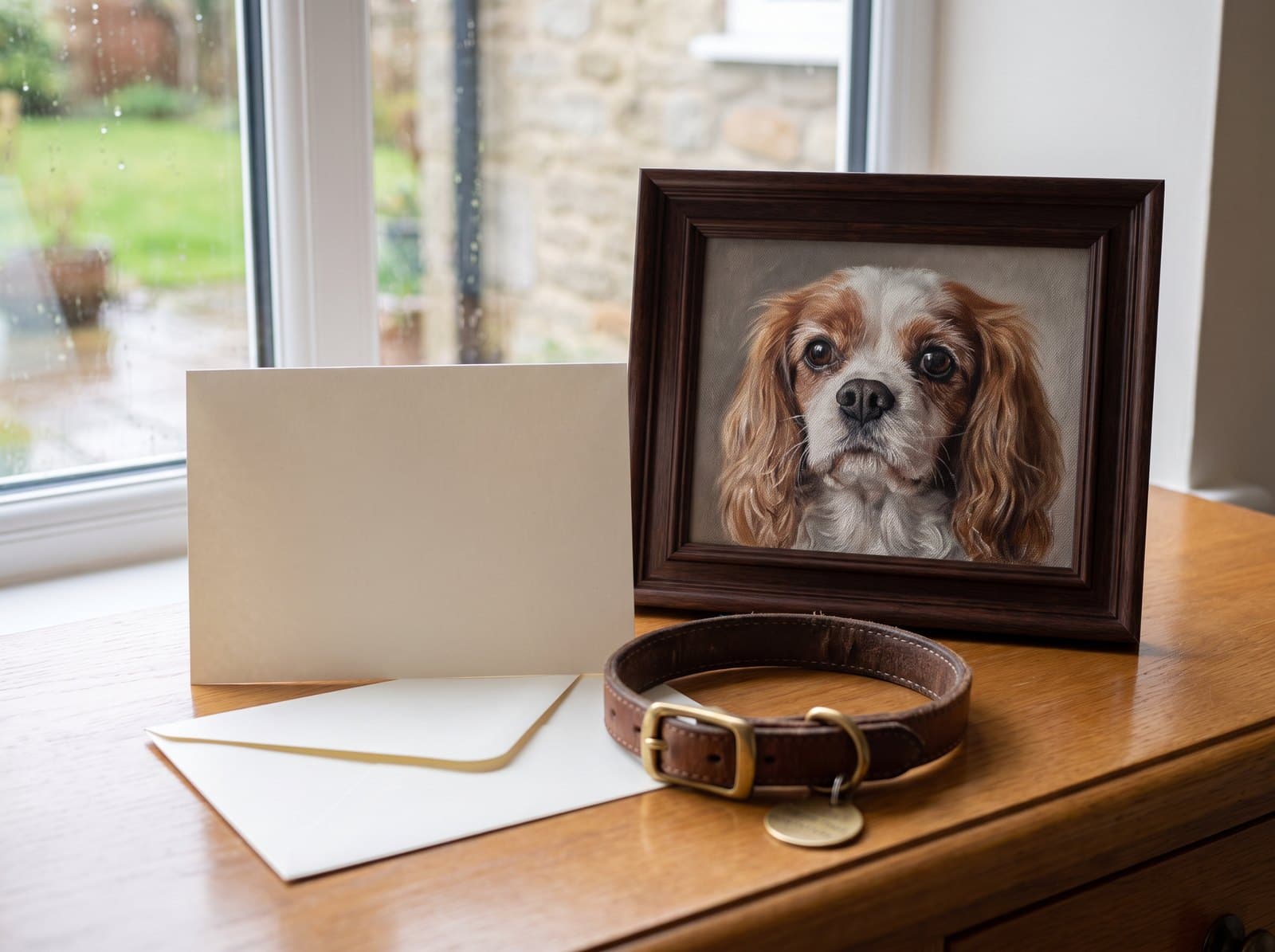
A blank card is the safe choice. The themed ones with a paw print and "In sympathy for the loss of your pet" on the front suit people who bought their dog a Christmas jumper and jar with everyone else.
Sign off with warmth or with nothing: "With love", "Thinking of you", or just your name. Not "Kind regards". If your own dog knew theirs, sign for the dog as well; "from Sam, Jo and Biscuit" reads as a card from a household.
Post it if you are not local or not close; a card through the letterbox gets read alone, which is often how people prefer it. Use a first-class stamp. If you are nearby, push it through the door rather than knocking; a knock asks for a conversation and a card does not.
Who the card is to
A couple or a household. Use both names inside. The card tends to go to the obvious owner while the one who also fed him for twelve years gets nothing. A line for each is enough: "I know he was Dave's shadow, but he was your alarm clock too."
A child. Send them their own card, in their own name; they will keep it. Say the animal died, not that it went to sleep, and give them a memory with themselves in it: "I remember Bella following you round the garden on your birthday, hoping for cake."
Examples you can adapt
Change the names and details; the shape stays the same.
A close friend's dog, after a long illness: "Maud. I'm so sorry. I keep thinking of her pretending not to hear you at the top of the field and then bolting the second you turned round. Fourteen years of that is a big thing to lose. I'll be at the café Saturday from ten. Come if you feel like it, don't if you don't."
A neighbour's cat: "I was so sorry to hear about Tabitha. She sat on our shed roof every morning like she owned the street, and it looks wrong without her. Thinking of you both."
A horse: "I'm so sorry about Solomon. Twenty-two years of early mornings, and he had you for every one of them. The yard will feel very quiet. If you want a hand with the others this week, I'm free from Thursday."
What to leave out of a card specifically
Three things belong to cards in particular, since nobody says them aloud.
Printed verses. A poem in a typeface is not a message from you, and the person can tell. If one is already printed inside, write on the facing page and let your lines outweigh it.
Pre-printed sentiment. "Thinking of you at this sad time" on the front and a signature underneath is what people send when they have run out of time. Better a smaller card with three lines of your own.
Questions. A card should not need answering; "What happened?", "Were you with him?" and "Will you get another?" turn a kindness into correspondence. The wider list of things not to say is in our piece on what to say when someone's pet dies; every item on it applies on paper.
Matching the card to the loss
Not every pet death is the same shape, and the card should bend to fit.
| Situation | Lead with | Leave out | Worth enclosing |
|---|---|---|---|
| Sudden death or accident | Shock and sorrow, no analysis | Anything about what could have been done | Nothing; keep it simple |
| Put to sleep after illness | That they made the last decision for the animal's sake | "It was the kind thing to do", said as if it were easy | A memory, written down |
| Very old animal | The length of the life and how well it was lived | "Well, he had a good innings" | A photo you have that they may not |
| Child's first pet | Simple, direct words addressed to the child | Euphemisms about farms or long sleeps | A small drawing, or a stamp for a reply |
| Horse or working animal | The years of routine and partnership | Treating it as smaller than a house pet | A donation to a rescue or sanctuary |
| Colleague you barely know | Brief, warm, no questions | Anything that needs a reply at work | Nothing |
| Someone who lives alone | An offer with a date and a time in it | "Shout if you need anything" | A promise to visit, and keeping it |
If the animal was put to sleep, one line saying they did the last hard thing for him is worth writing; the rest of that decision is theirs to raise, not yours.
If you want to put something in the card
You do not have to. If you do, the test is whether it puts the animal back in the room for a moment rather than filing them away.
The best enclosure is often free: a photograph you took that the owner has never seen, printed and slipped in the envelope. A donation to the rescue the animal came from, made in its name, is the next best thing. Our guide to gifts for someone whose dog died goes through the rest, and keeping a dog's memory alive has more ideas that cost nothing.
If you are thinking of something more lasting, a hand-painted memorial portrait is one option, but a card is the wrong place to spring a finished one. Ask which photograph they would want painted, or tuck in a voucher so they can choose the picture and the size; most people who have just lost an animal would rather be asked than tiptoed around. Portraits are oil on canvas from £220 to £549 depending on size, take three to four weeks plus delivery, and you approve a photograph of the finished painting before anything ships, so there is no rush. Three or four weeks after the death is soon enough to raise it.
FAQ
What should you write in a pet loss sympathy card for a dog?
The dog's name, that you are sorry, one specific memory, and either permission to grieve or a concrete offer, in three to five handwritten lines. "So sorry about Rufus. I'll miss him leaning his whole weight on my legs at the pub. Twelve years is a lot to lose. I'll take the kids Saturday morning so you get the house to yourself" is a complete card.
Is it appropriate to send a sympathy card when someone's pet dies?
Yes, and it is appreciated more than most people expect. With no funeral for an animal, the card is often the only acknowledgement they receive that the loss was real. The people who regret anything afterwards are the ones who sent nothing.
What should you avoid writing in a pet sympathy card?
Anything starting with "at least", anything suggesting a replacement animal, and "it was only a pet". Keep questions out, and any printed verse you would not say aloud yourself.
How long after a pet dies should you send a card?
Within the first week is ideal, but two or three weeks later is not late; by then the messages have stopped and the house has gone quiet, which is when it is most needed. A single line on the first anniversary is a kindness few people think to do.
Should I include the Rainbow Bridge poem in a pet sympathy card?
If you do, put it on a separate slip so your own words stay the main thing. A single line from it, quoted after your name, usually does more than the whole poem copied out. If you are unsure whether the person is the Rainbow Bridge sort, leave it out.
The short version: a pet loss sympathy card does not need to be eloquent. It needs the animal's name, your own handwriting, and one true thing about them. Everything else is decoration.