Subjects · · 8 min read
What to Do With Old Family Photos (Besides a Shoebox)
What to do with old family photos: how to sort a box without losing a weekend, what's worth scanning, how to store the rest, and what to make from the best.
By Thomas Mark
Last updated: October 2026
What to Do With Old Family Photos
Quick answer: Sort them once, properly, into three piles: the handful worth scanning, the majority worth keeping in a decent box, and the duplicates and blurred ones that can go. Scan the first pile at 600dpi, store the second somewhere cool and dry that is not a loft or garage, and share the scans with the rest of the family so no single house holds the only copy. Then do something with the best two or three — a framed print, a photo book, or a hand-painted family portrait worked up from the one photograph everyone keeps asking about. The worst thing you can do with a box of old family photos is keep meaning to.
Why the box is still in the cupboard
Most families have one. It came out of a parent's house or has been under the stairs since a move, and it holds a few hundred to a couple of thousand prints in no order. Nobody has gone through it because it feels like a weekend, and because the first print you pick up is of someone you can't name.
The answer to what to do with old family photos is mostly an answer to that feeling. You are not cataloguing an archive. You are finding the fifty that matter, making sure they survive, and letting the rest be what they are, which is a box of pictures of a caravan.
Two things argue for doing it this winter rather than next: colour prints from the sixties through to the nineties are fading now whatever you do, magenta first, and the people who can put names to faces are getting older.
The three-pile sort
Set aside two or three hours. Work through the box once, without stopping to reminisce, and put every print into one of three piles.
Scan. The photographs you'd be upset to lose: weddings, the only picture of a grandparent as a young man, every shot with three generations in it, anyone who has since died. Be strict. In a box of a thousand this pile is usually forty to eighty prints.
Keep. Everything that's a decent picture of a real person or place but not irreplaceable. Most of the box.
Let go. Blurred shots, doubles, the seven near-identical frames of the same beach, scenery with nobody in it, and prints faded past reading. Nobody is obliged to keep a bad photograph because it's old. Offer them to a sibling if binning feels wrong.
While you sort, pencil a name and a rough year on the back of anything in the scan pile — soft pencil, lightly, along the edge, not a biro and not a sticker. If you don't know who someone is, photograph that print on your phone and send it to the oldest relative you have while they can still tell you.
Scanning: what's worth doing and what isn't
For prints, 600dpi on a flatbed scanner is plenty; it gives you a file big enough to reprint at twice the original size or to paint from. Negatives and slides need a transparency unit and 2,400dpi or more, and it's usually cheaper to pay someone.
If you don't own a scanner, a phone will do. Lay the print flat by a window on an overcast day, hold the phone directly above it, switch the flash off and take three or four frames. What matters is that the faces are legible, not that the colour is right — colour that has drifted for forty years gets corrected on the way, not copied.
Scanning services in the UK typically charge between 20p and 60p a print and turn a shoebox round in a fortnight. For a scan pile of sixty, do it yourself in an evening; for a whole box, pay. Either way, keep the scans in two places. An external drive in the same cupboard as the box is not a backup, it's a second thing that burns in the same fire.
Storing the originals so they last
The prints that go back in the box deserve a better box. Cardboard is acidic and yellows paper over decades. An archival photo box — acid-free card — costs £15 to £40 and will outlast you.
Where the box lives matters more than what it's made of. Lofts and garages are the worst places in a British house for photographs: they swing between damp and hot, and damp makes prints stick together and grow mould. A cupboard in a heated room, off the floor and out of sunlight, is the answer.
Three things to stop doing:
- Magnetic-page albums. The glue hardens and lifts the surface of the print when you pull; ease prints out with dental floss slid underneath.
- Sellotape and rubber bands. Both perish and leave a residue that doesn't come off.
- PVC sleeves. The cheap, sticky-feeling pockets give off gas that attacks the print. Polypropylene or polyester sleeves, sold as archival, are fine.
What to make from the best ones
Once you've found the handful that matter, the question turns from what to do with old family photos in general to what to do with these five. The options solve different problems at very different prices.
| Option | Typical UK cost | Time | Pick it when |
|---|---|---|---|
| Archival box and sleeves | £15–£40 | An afternoon | You want the originals to survive, full stop |
| Scanning service, whole box | £60–£300 | 2 weeks | There are hundreds and you'll never do it yourself |
| Photo book, 20–40 pages | £35–£70 | 1–2 weeks | You want the story, not one picture |
| Framed print, properly mounted | £40–£120 | 3–10 days | One photograph, one wall, done |
| Loaded digital frame | £60–£150 | An evening to load | For a grandparent who won't use a phone |
| Restoration of a damaged print | £30–£150 | 1–3 weeks | The only copy is torn, stained or badly faded |
| Hand-painted oil portrait | £220–£549 | 3–4 weeks | One image the whole family wants, and a print won't do |
The photo book is the best value on the table: forty photographs rather than one, and copies for every household for the price of a round of drinks.
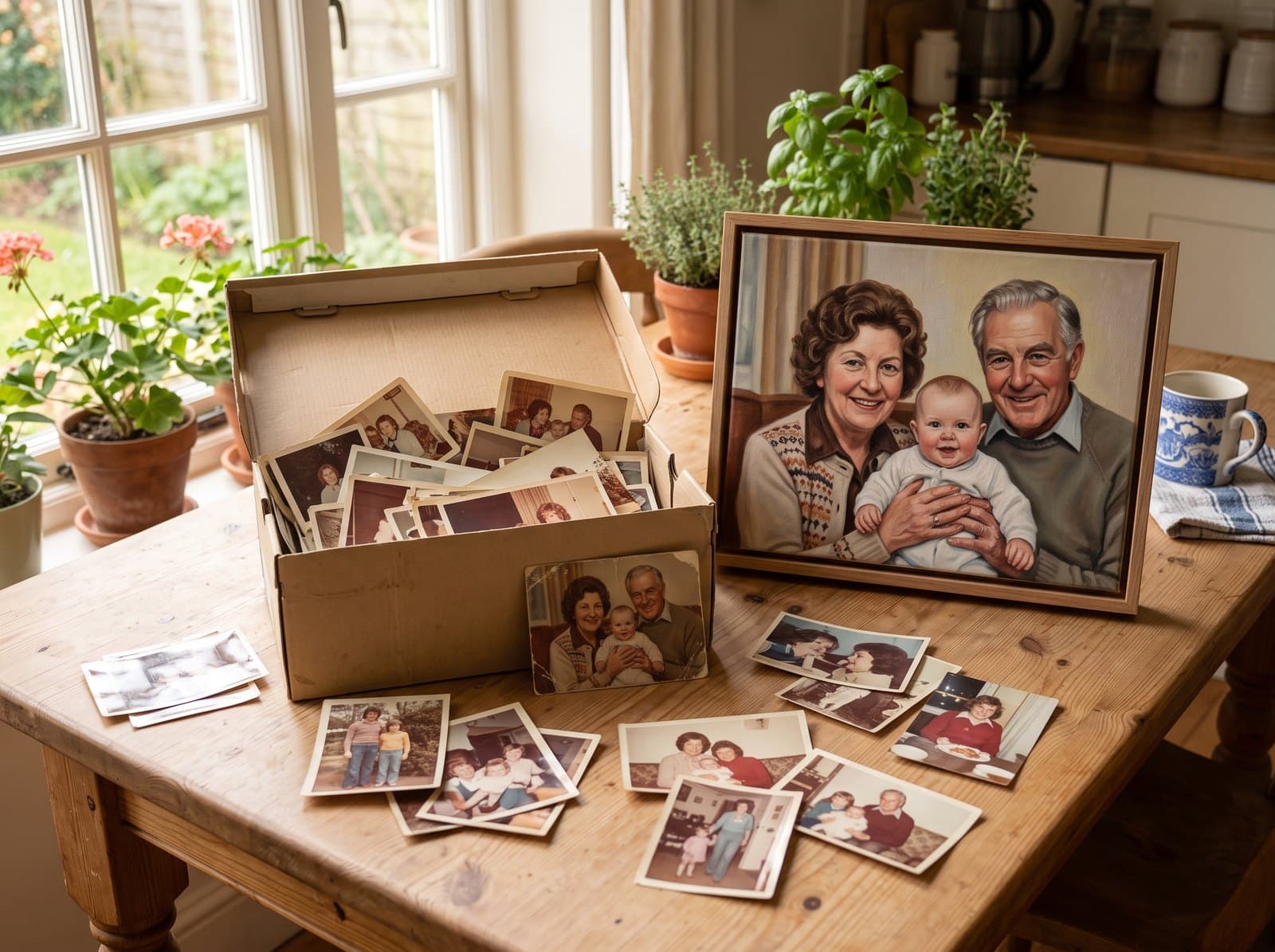
The painting is for a different situation. Every family box has one photograph that comes up more than the others — the grandparents on their wedding day, the four children lined up on a wall in 1974, the last picture of everyone together. A painting makes that image a new object rather than a reproduction: hand-painted oil on canvas, from the scan you send, at £220 to £549 depending on size, with each additional person from £35. The pricing page sets out where the lines fall. Painting takes about three to four weeks, plus delivery, and before it ships you receive a photograph of the finished painting — the point at which a faded print gets its colour back. If the print is badly damaged, the post on restoring and painting an old photograph covers what can and can't be recovered; the from-a-photo commission page covers the stages.
Don't have a painting done from a distant group shot where the faces are a few millimetres wide, or at all if the family would rather look at the photograph itself. Some would. Ask.
Sharing them without losing them
The part of what to do with old family photos that everyone skips is sending them round. A shared album every sibling and cousin can add to is the single most useful thing you can make, because the names get filled in. Someone will know that the man in the hat is Great-uncle Frank, and they'll say so in a comment rather than in a conversation nobody wrote down.
Name the files while the knowledge is fresh. A file called 1974-Blackpool-Mum-Dad-Susan is worth more in thirty years than scan0041 with a beautifully preserved print behind it.
When to leave the box alone
Not every box needs sorting this year.
If a parent has just died and the box is theirs, give it six months. Sorting their photographs in the first weeks turns a practical job into a very hard one; nothing in the box is deteriorating that fast. If the photographs are already in a reasonably ordered album, scan the important pages in place and leave it as it is. And if the sort is stalling because nobody agrees who should have the originals, scan first and argue later — once everyone has the files, the argument usually stops mattering.
Frequently asked
Should I throw away old family photos?
Some of them, yes. Duplicates, blurred frames, scenery with nobody in it and prints faded past reading are not heirlooms because they're old. Keep anything with a person you can name or a place that mattered, offer the rest to siblings, and bin what's left without guilt.
What resolution should I scan old photos at?
600dpi for prints, which is enough to reprint at double size or to paint from. Negatives and slides need 2,400dpi or more and a transparency unit, so those are usually better sent to a service.
How do I store old photographs at home?
In an acid-free box, in polypropylene or polyester sleeves if you use sleeves at all, in a heated room away from sunlight and off the floor. Never in a loft or garage. Get prints out of magnetic-page albums and PVC sleeves, which both damage them.
Can a faded or damaged photo be restored?
Usually. Fading, colour casts, creases and small tears can all be corrected digitally from a good scan, with prices starting at around £9 a photo for light damage. We restore photos for £9 each, colour included. A painting from the photograph corrects the same faults on the way, because the faded print is the reference, not the result.
What can I make from an old family photo?
In rough order of cost: a framed print, a photo book, a loaded digital frame, a restored and reprinted copy, or a hand-painted portrait in oils. The book suits a whole box; the print and the painting suit the one photograph everybody wants. The post on family portrait ideas goes through which images work on a wall.
The short version: what to do with old family photos is sort them once, scan the ones that matter, box the rest properly, and make something from the best. The box has waited twenty years; it can wait another fortnight while you buy a scanner, but not another decade.
More onOld photos