Subjects · · 8 min read
Can an Old, Damaged Photograph Become a Painting?
A painting from old photograph prints is more forgiving than you'd think: what a painter works around, what stops a commission, and how to copy the print.
By Thomas Mark
Last updated: October 2026
Painting From Old Photograph
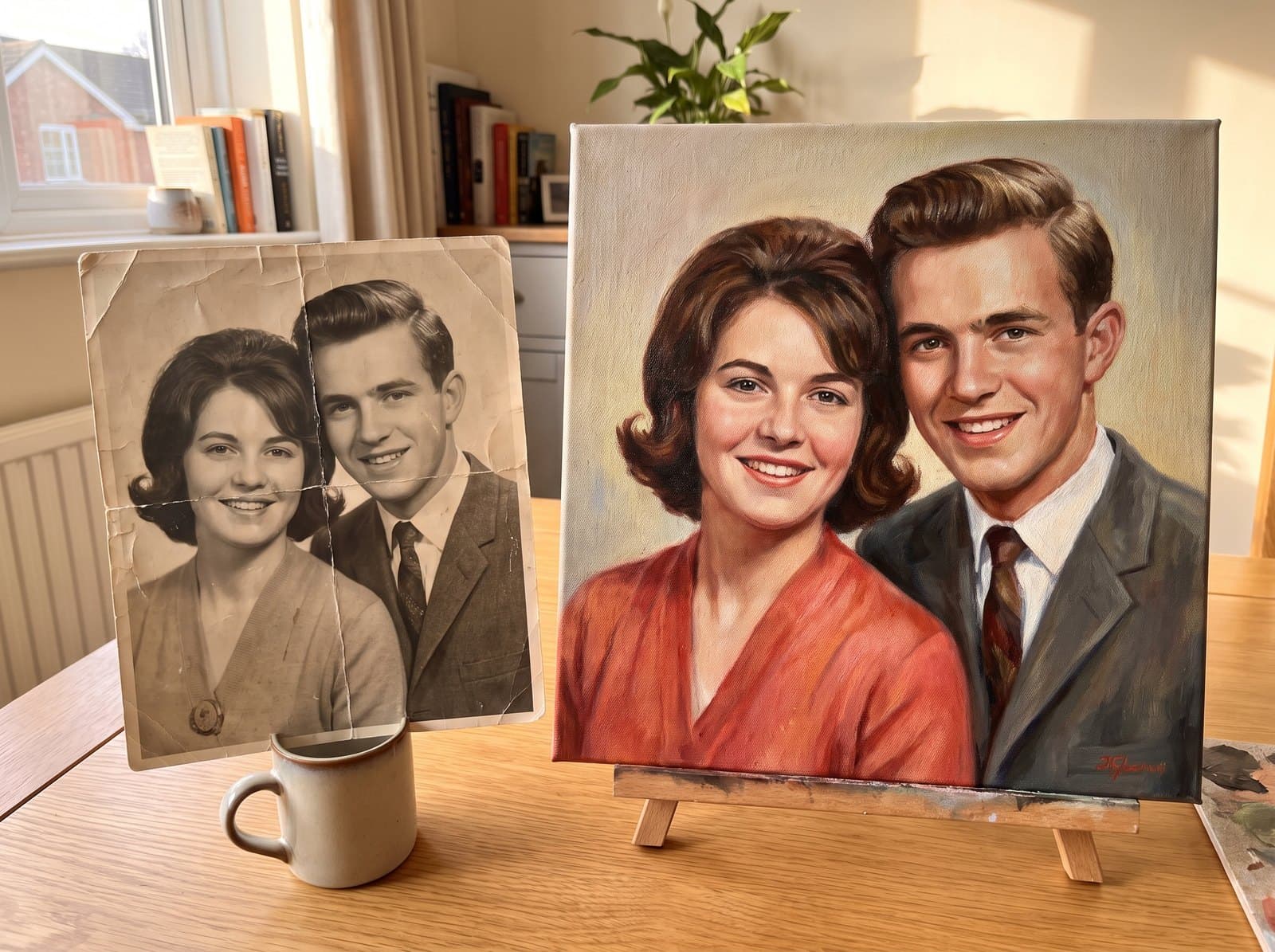
Quick answer: Almost always, yes. A painting from old photograph prints is one of the more ordinary jobs a portrait painter takes on, because the damage that ruins a photograph — fading, creases, a torn corner, a water stain — is not painted. The painter reads the face underneath it and paints that. The only damage that genuinely stops a commission is damage to the face itself: a tear through the eyes, or a print so small or so faded that the features have gone. A portrait painted from a photo costs £220 to £549 depending on size, takes three to four weeks, and before it ships you're sent a photograph of the finished painting to approve.
Why a painter cares less about damage than you do
A photograph is a surface, and damage lives on the surface. A painter isn't copying the surface. They're working out where the eyes sit, how the light falls across the nose and cheek, what the mouth is doing, and building that up in paint.
That is the difference between restoring a photograph and painting from one. Restoration has to reconstruct every damaged patch convincingly, which is slow and can look waxy. Painting omits the damage and replaces the whole surface with paint. What the painter needs is information about the person — eye spacing, the shape of the jaw, the hairline — and if those are readable to you, they're readable to a painter.
The kinds of damage, and which ones matter
Fading and colour shift. Colour prints from the 1960s to the 1990s lose their dyes unevenly, and the usual result is a drift towards orange and red. This is cosmetic — the colours are decided at the painting stage rather than read from the print.
Creases, folds and cracks. The emulsion cracks along the fold and takes a thin line of image with it. Unless the fold runs straight through an eye or the mouth, it's ignored.
Tears and missing corners. A torn edge with a missing piece of background is nothing. A missing piece of face is a different matter — a painter can't reconstruct half a face without inventing a person.
Water damage, foxing and mould. Brown spots, tide marks and patches where the emulsion has lifted. Usually workable: the damage is blotchy rather than total, so the face survives in patches.
Small size. A passport photo, or a tiny contact print from a 1950s album, where the face is a few millimetres across. This has nothing to do with damage and can still stop a commission, because even a well-scanned small print only holds so much.
What to do with a damaged photograph: the options
| Option | Typical UK cost | Time | When it's the right choice |
|---|---|---|---|
| Frame it as it is | £15–£60 | Same day | The damage is part of the object's history and you'd rather keep it |
| Digital restoration, light damage | From about £9 (ours: £9, colour included) | 1–2 days | You want the photograph itself back and the damage is minor |
| Digital restoration, heavy damage | £15–£200 (ours: £9) | 2 days to 3 weeks | Tears through faces, missing pieces, heavy mould; the photo needs rebuilding |
| Hand-painted oil portrait | £220–£549 | 3–4 weeks | The face survives and you want one object that outlasts the print |
| Restoration and a painting | £300–£750 | 4–7 weeks | It's the only image of that person and you want both the record and the heirloom |
The choice comes down to one question: do you want the photograph back, or something made from it? Restoration gives you the former; a painting from old photograph material gives you the latter, and it's the better answer when the print is beyond tidy repair.
How to copy the print properly
A bad copy of the print does more harm than the damage on it.
Scan it if you possibly can. A flatbed scanner at 600 dpi for a normal print, 1200 dpi for anything smaller than a playing card, saved as a TIFF or a maximum-quality JPEG. Turn off every automatic setting — dust removal, colour correction, "restore faded photo" — because they all smooth the image and take fine detail with them. Scan the whole thing, borders included.
If there's no scanner, photograph it flat. Lay it on a table by a window on an overcast day, hold the phone directly above it and parallel to it, turn the flash off and fill the frame. If the print is stuck to the glass of its frame, leave it there — pulling it off strips the emulsion — and photograph through the glass with the window behind you.
Don't flatten, tape or clean it. No iron, no sellotape, no damp cloth. A curled print can be weighted flat under a book for a week, and a taped tear is worse than an untaped one because the adhesive migrates into the paper.
Send the original at full size, untouched. Email it or use a file transfer service; messaging apps compress photographs heavily. And don't run it through an enhancer first — software that sharpens or reconstructs faces guesses at what was there, and the guesses land on the eyes, teeth and hairline. There's no need to apologise for the state of the scan; a damaged print is the normal starting point for a painting from old photograph prints.
What changes and what doesn't
The damage goes. Creases, spots, tears and stains are not painted, and nobody will ask whether you want them kept.
The colours are decided, not copied. If a 1978 print has gone orange, the painter needs to know what the real colours were, and will ask. If it's black and white, you'll be asked whether you want it painted in colour from family memory or kept monochrome. Both are legitimate; a monochrome oil portrait is a considered choice, not a fallback.
The person is not improved. Lines aren't smoothed, nobody is made younger, and an expression isn't swapped for a more flattering one; if you want a change, you ask for it once you've seen the photograph of the finished painting, before it ships.
When the missing piece is a face
This is the hard case: the tear, the mould or the fold has taken out the features of the one person you actually wanted painted.
There are three honest routes. The first is to find another photograph of the same person, however poor, and let the two do different jobs — one for the pose and setting, the other for the face, which is how combining two photographs into one portrait works in general. The second is to accept the crop: paint the people whose faces survived and let the composition change. The third is to stop, because a face reconstructed from nothing is a guess, and a portrait that's a guess is worse than no portrait.
Ask before you order: a look at the scan will tell a painter which route is open, and it's better to hear no then than once the painting is under way.
Who this tends to be for
A damaged photograph that somebody wants painted is usually the only surviving image of a person: a parent who died before anyone in the family owned a digital camera, or grandparents on their wedding day in 1952. It's damaged precisely because it was handled and looked at, which is also why it's the one worth painting.
That puts this territory next door to memorial portraits, and the same restraint applies: the aim is a likeness the family recognises, not an idealised version. It also comes up in family portraits that bring a grandparent from an old print together with grandchildren from last summer's phone photos. If you're sorting a whole box rather than one print, what to do with old family photos covers the wider question.
What it costs, and when a painting is the wrong answer
A hand-painted oil portrait costs £220 to £549 depending on canvas size, with each extra person or pet from £35. Allow three to four weeks, plus delivery, which is included worldwide; before it ships you're sent a photograph of the finished painting, and we keep painting until it's right. The pricing page sets out the sizes.
Two cases where the money is better spent elsewhere. If what you want is the photograph itself, restored and reprinted, commission a restorer, not a painter; a painting is a different object and won't satisfy the wish to have the original back. And if the budget is under £200, a professional restoration and a good frame is a perfectly good outcome — a restored print you look at every day beats a painting you had to stretch for.
The short version: the damage on an old photograph is almost never the problem. The problem, when there is one, is whether the face survived underneath it — and a painting from old photograph prints is the one option that treats the damage as irrelevant rather than something to be laboriously undone.
FAQ
Can a torn photograph be painted?
Yes, provided the tear hasn't taken out the face. Torn edges, missing corners and splits through the background are simply not painted. A tear through the eyes or mouth is different, and a second photograph of the same person, however poor, is usually the answer.
Should I restore the photograph before commissioning a painting?
Not for the painting's sake. The painter works from the original scan and ignores the damage, and a restored version can introduce guessed detail around the face. Restore it if you want the photograph itself back; send the unrestored scan for the portrait.
Can you paint from a black and white photograph in colour?
Yes. The colour has to come from you rather than the print — hair, eyes, complexion, clothing — and family memory is usually enough. If nobody remembers, keeping it monochrome is a proper choice rather than a compromise.
How small a photograph is too small?
It's less about the paper size than the size of the face. A passport-sized print with a large, clear face scans into something useful; a large print with a face the size of a fingernail doesn't.
More onOld photos