Subjects · · 8 min read
Combining Two Photos Into One Portrait
How to combine two photos into one painting: which photographs sit together, what the painter can and can't change, what it costs in the UK, and when not to.
By Thomas Mark
Last updated: October 2026
Combine Two Photos Into One Painting
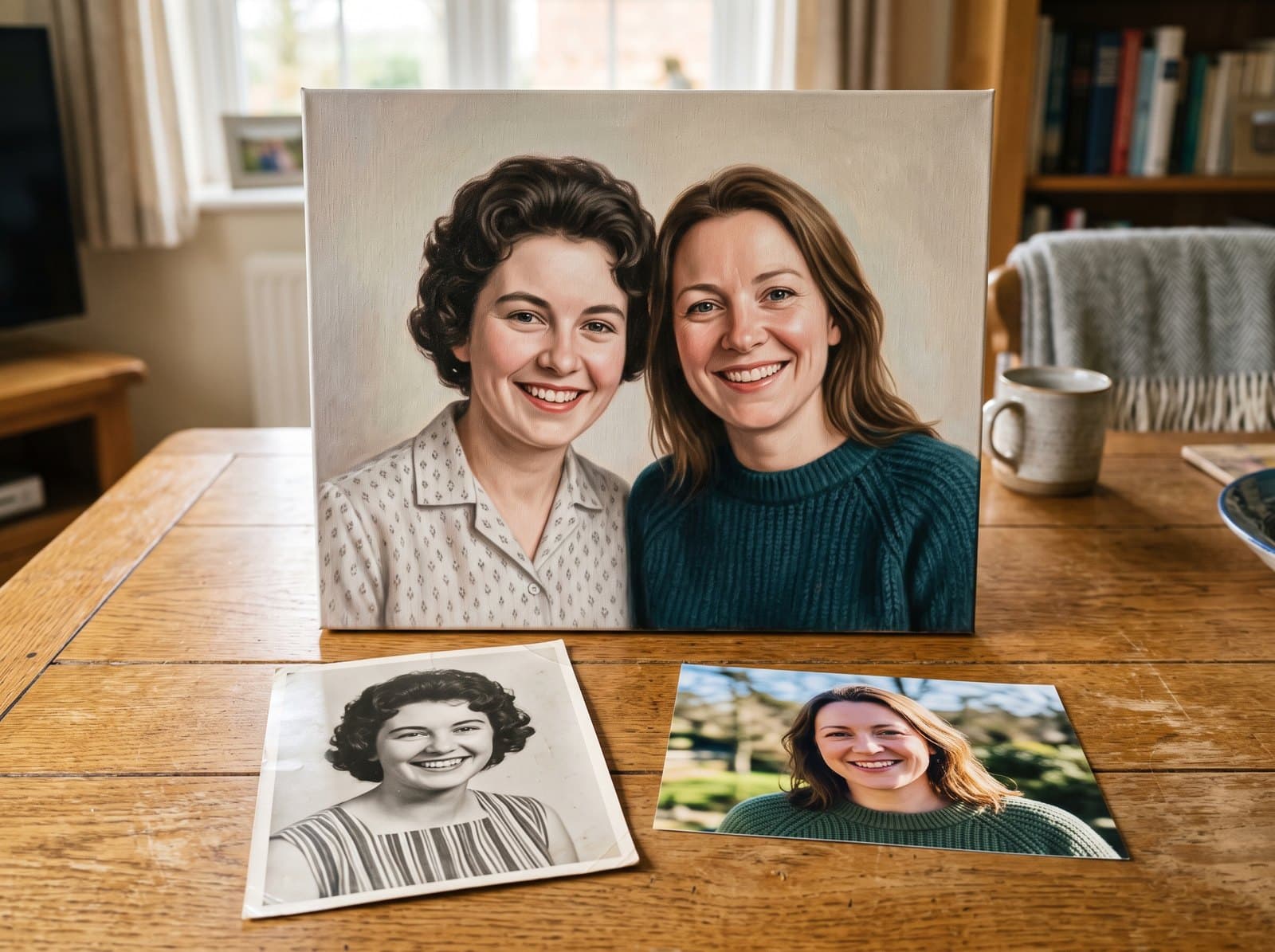
Quick answer: Yes, you can combine two photos into one painting, and it's a routine request rather than a special one. The painter takes the people (or the dog) from each photograph and composes them on a single canvas, matching light, scale and colour so the result reads as one scene rather than two pictures stuck together. It works best when both photographs share a similar distance and light, with the faces clear. A family portrait painted from two or more photos costs £220 to £549 by canvas size plus from £35 for each additional person or pet, takes about three to four weeks plus delivery, and you approve a photograph of the finished painting before it ships.
Why people ask for it
Almost nobody sets out wanting a composite. They arrive at it because the photograph they want doesn't exist, usually for one of these reasons:
- Someone has died. A good photo of Mum, a good photo of Dad, and no good one of the two of them together in twenty years.
- The family is never in one room. Grown children on three continents, or grandchildren whose only shared photograph is a christening from 2019.
- The dog wouldn't cooperate. A good picture of the couple and a good picture of the dog, forty minutes apart.
- The best photo of each person is from a different decade. A grandmother's 1962 wedding portrait beside her granddaughter's 2024 graduation photo.
All of these are solvable. The difference between easy and hard comes down to the two photographs, not the painter.
What makes it work
A composite succeeds or fails on three things, and none of them is artistic skill.
Light. If one photo was taken outdoors at noon and the other by a lamp in the evening, the shadows fall in different directions. A painter can correct colour — it's repainted, not copied — but the direction of light on a face is baked into the shape of its shadows. Two photos lit from broadly the same side sit together without argument. Two lit from opposite sides always look slightly off.
Distance from the camera. A face photographed close on a phone is subtly distorted — nose a little larger, ears a little further back — compared with the same face from two metres away. Put one of each on a canvas and one person looks nearer than they were. Further away is better than closer.
Angle and eyeline. Two people both looking at the camera compose easily. A three-quarter profile beside a straight-on face can be done, but they'll appear to be in the same room without being in the same conversation. Head angles matter more than backgrounds, which get repainted anyway.
Resolution matters less than people fear. A sharp 6 × 4 inch print scanned at 600dpi has plenty in it. What can't be recovered is a face that was already blurred, or a small figure in a wide group shot.
The options, compared
| Option | Typical UK cost | Lead time | When to pick it |
|---|---|---|---|
| Two photos digitally merged, printed | £30–£120 | 1–2 weeks | A quick fix that can look like a photo edit |
| Two framed prints, hung as a pair | £40–£150 | Under a week | Photos from different eras that shouldn't pretend otherwise |
| Two separate paintings, hung together | £440–£1,098 | 3–4 weeks | The light is hopelessly mismatched |
| One painting from two photos | £255–£628 | 3–4 weeks | You want them genuinely together and the photos are compatible |
| One painting from three or more photos | £290 upwards | 3–4 weeks | Grandchildren or siblings never in one place |
The digital merge is one photo pasted onto another, and it looks like it. Fine for a card; on a wall, the seam shows. A painting has no seam because nothing is pasted — every square inch is painted fresh, so both figures share the same light, palette and background.
Choosing the two photographs
Pick the anchor first. That's the photograph you'd want painted even if it were the only one — the best light, the clearest face, the expression that looks like them. Everything else is chosen to match it.
Then look for a second photograph that agrees with the anchor on the three things above: same side of light, similar distance, similar head angle. Often it won't be the "best" photo of that person, and that's fine. A less flattering photo that matches the anchor makes a better painting than a wonderful one that doesn't.
Three practical notes. Send more than two if you have them; a few candidates for the second person costs nothing and lets the painter pick the one that sits best. Don't crop before sending — wasted background is useful information about the light. And if either photo is a print, photograph it flat by a window without flash, or scan it at 600dpi; the post on restoring and painting an old photograph covers what's recoverable from a faded print.
Adding someone who has died
This is the most common reason to combine two photos into one painting, and it deserves a slower word.
The usual shape of it is a family photograph — a wedding, a christening, a big birthday — with one person missing who should have been there, painted in from a separate photograph. It can be done well, and the ones that work best are quiet about it: the person is simply there, at the same scale as everyone else, in the same light, not floating above the group or larger than life.
Two things to think about first. The photograph of the person who has died is often older, and they'll be painted at the age they were in it. Most families want that; a few find it odd to have Grandad at fifty beside grandchildren he only knew in his seventies. And ask the rest of the family. A memorial portrait one sibling finds comforting can land differently with another, and that conversation is easier before the finished painting comes back for approval than after.
What the painter can change, and what they can't
Can change: colour temperature, so a warm indoor photo and a cool outdoor one end up matching. Background, entirely. Clothing within reason — a jumper from another photo is easy, a full outfit from a description is not. Relative scale, so an adult and a child photographed at different distances end up the right size. Small things: glasses, a hat, an arm on a shoulder.
Can't change: the direction of light on a face, beyond a modest amount. A head angle — a profile stays a profile. An expression, other than very slightly. And a face that isn't clear in the source, which can't be invented and shouldn't be.
The honest line is that the painter can make two compatible photographs look like one moment, but can't make incompatible ones compatible. If yours are lit from opposite sides and shot at very different distances, two paintings hung as a pair is the better answer, and better to hear before you spend the money.
How the process runs
You send the photographs, say who goes where and what you'd like changed, and the painter composes and paints the scene in oil — that's when the figures get placed together and matched for light, scale and colour. Before it ships, you get a photograph of the finished painting to check: whether the figures sit together, whether the scale is right, and whether the person added in looks like they belong. Ask for changes at that stage; it's expected, and the painting is corrected and rephotographed until you're happy with it.
The finished piece then ships worldwide, rolled in a tube and unframed — a framer stretches it onto bars when you have it framed locally. Allow about three to four weeks from order to approval, plus delivery. The from-a-photo commission page sets the sequence out.
On price, canvas size sets the base — £220 for 12 × 16 inches up to £549 for 36 × 48 — and each person or pet beyond the first adds from £35, whether they came from one photograph or two. A couple from two photos on a 16 × 20 inch canvas is £275 plus £35; the pricing page has the full table. Two people want at least 16 × 20 inches to give the faces room; three or more, 20 × 24 or larger.
When it's the wrong idea
- The photos are from different eras and you want that to show. A 1962 wedding portrait and a 2024 graduation photo make a lovely pair of frames. Merged into one scene, they tell a lie about time that the eye picks up on even if it can't say why.
- One face isn't clear. Ask before ordering. If the only photograph of someone is a distant group shot, there may not be enough to paint from.
- You want it in a fortnight. Three to four weeks is the realistic floor, and composites aren't a thing to hurry.
Frequently asked
Can you combine two photos into one painting if they were taken years apart?
Yes, provided you're happy with each person painted at the age they were in their photo. The painter matches light, colour and scale so the figures sit together, but doesn't age anyone up or down. If the gap in years is the point, two frames hung as a pair usually says it better.
Does it cost more to paint from two photos than from one?
No. Price is set by canvas size and the number of people or pets on it — £220 to £549 by size, plus from £35 for each additional figure — whether they came from one photograph or several. Extra candidate photos cost nothing.
Can you add a pet from a separate photo?
Yes, and it's one of the easiest combinations, because nobody expects a dog or cat to have been in exactly the same light as the people. Send the clearest photo of the animal, ideally at a similar eye level to the humans, and say where you'd like them.
Will it be obvious the painting was made from two photos?
Not if the source photos are compatible. Every part of a painting is painted fresh, so there's no seam, no pasted edge and no mismatch in grain. Where it shows is in what the painter can't change — light direction and head angle — and those are decided when you choose the photographs.
The short version: to combine two photos into one painting, choose the anchor photo first, match the second to its light and distance, and check the finished painting's photograph carefully before it ships to make sure the figures belong together.
More onCommissioning a painting