Subjects · · 8 min read
A Family Portrait With the Dog In It (Even If the Dog Never Sat Still)
Family portraits with dogs: how to get one photo where everyone including the dog is looking, what to do when that never happens, and how a painting fixes it.
By Thomas Mark
Last updated: October 2026
Family Portraits With Dogs
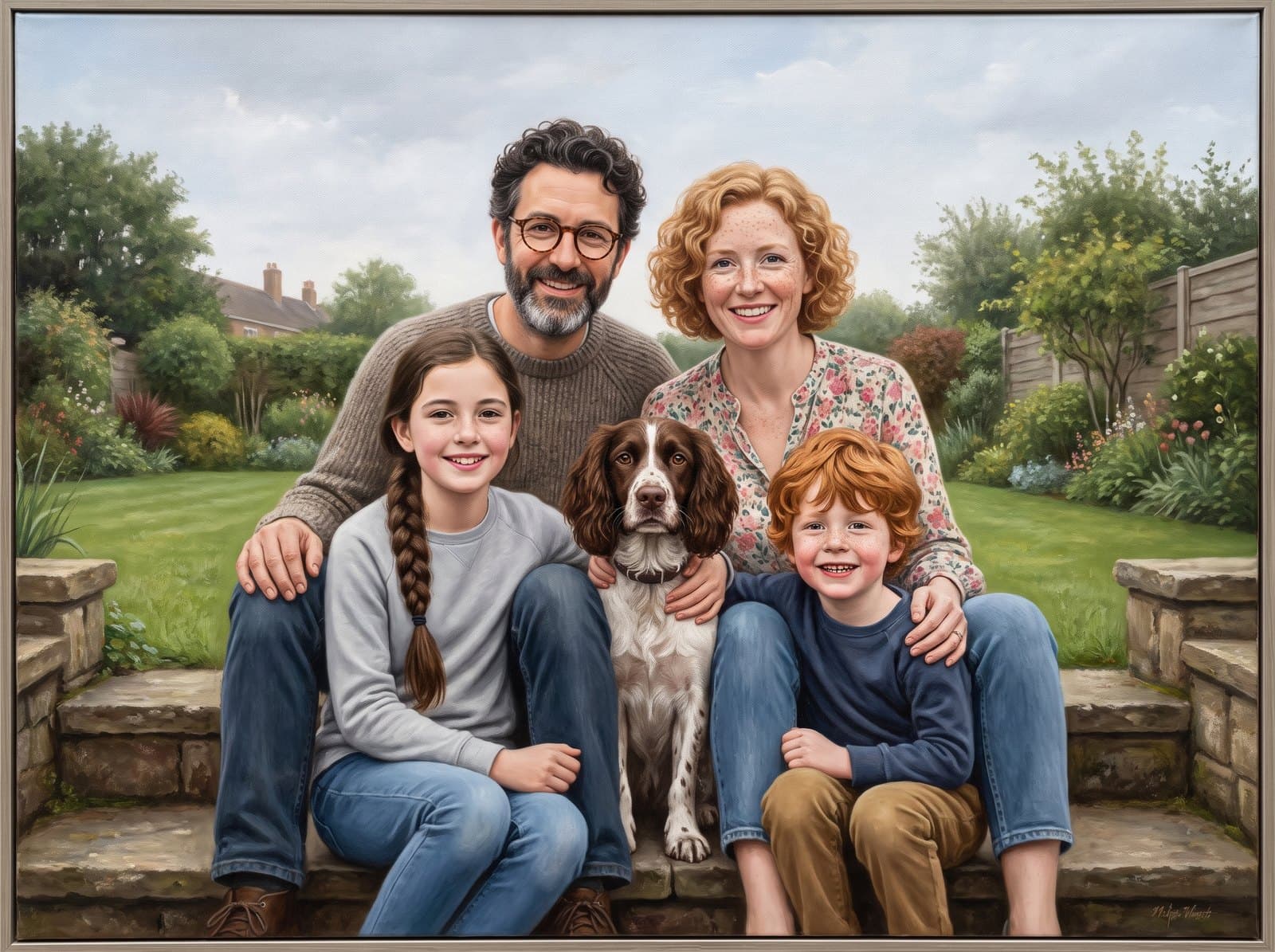
Quick answer: Family portraits with dogs come down to one problem: the dog is the only member of the family who can't be asked to hold still for three more seconds. The fix is not a better camera. It's daylight, a handler with a treat standing behind whoever is taking the picture, and bursts of frames rather than a single count of three. If the dog still won't cooperate — and plenty don't — photograph the family and the dog separately and have the two combined; a hand-painted family portrait works from more than one photo as a matter of routine, costs £220 to £549 by size plus from £35 for the dog, and takes about three to four weeks plus delivery. The dog doesn't have to be looking at the camera. It only has to be in the frame.
Why the dog is the hardest one in the frame
A family of four can be bribed, negotiated with or simply told. A dog cannot, and it wrecks group photographs in three ways.
It looks at people, not lenses. Its attention goes to whoever is holding food or just said its name, and that is rarely the phone. It moves faster than the shutter: even a dog that is nominally sitting will turn its head or lick its nose in the half-second between "everyone ready" and the click, which in a dim room means a blurred muzzle in an otherwise sharp picture. And it has about ninety seconds before a young dog wants to leave and an old dog wants to lie down. Families spend those ninety seconds lining up the humans, and by then the dog has gone.
None of that is fixed by saying its name louder. It's fixed by changing the order you do things in.
Getting the photograph: what actually works
Set everything up before the dog arrives. Choose the spot, arrange the people, take a couple of test frames. Then bring the dog in last and shoot immediately. Its ninety seconds go on the picture, not the preparation.
Use daylight. Outdoors on an overcast day, or beside a big window with the room lights off. Daylight lets the phone use a faster shutter, which is what stops the dog blurring, and it doesn't turn a black dog into a silhouette.
Put a handler behind the camera. One person holds a treat or a squeaky toy directly above the phone, so the dog looks roughly at the lens. One noise, once — a dog that has heard the same squeak six times stops caring.
Shoot in bursts. Hold the shutter down for two or three seconds. Out of thirty frames, one will have the dog's ears up and nobody blinking.
Get low, and anchor the dog. Have the family sit on a step, a low wall or the grass so everyone is near the dog's height, rather than a row of standing adults with a small dark shape at their feet. A small dog on a lap stays put; a big dog sitting in front of a seated family can be steadied by a hand on the collar.
Most of this is the same advice as for photographing your dog on its own; the difference is that you have people to organise as well, so the sequence matters more.
When one photograph is never going to happen
Some dogs won't do it: puppies, nervous rescues, elderly dogs who can't sit for long, and any dog that treats a phone pointed at it as a reason to leave the room. With those, stop trying for one frame.
Take the family photograph without the dog, in the spot and the light you wanted. Then, in the same light and from the same distance and height, photograph the dog on its own — in its bed, on the grass, held by one person. A painter can then put the two together. This is not a special request for family portraits with dogs; it's one of the most ordinary ones there is, and the post on combining two photos into one portrait explains what makes it work. Matching light and scale is what stops the dog looking pasted in.
The same route covers a dog that has died. A portrait of the family with a dog that isn't in any recent group photo is a common commission, and often the picture the family wanted all along.
The options, compared
| Approach | Typical UK cost | Time it takes | Dog has to cooperate | When to pick it |
|---|---|---|---|---|
| Studio session, dog welcome | £150–£400 | An hour, plus 2–3 weeks for prints | Briefly, in a strange room | A calm older dog; you want the formal one |
| Pet-friendly photographer outdoors | £250–£600 | Two hours, plus 2–4 weeks | Somewhat | A lively dog; you want candid frames to choose from |
| Photograph it yourselves | Nothing | An afternoon | A little | Any family with a phone and a treat |
| Framed print of a photo you already have | £40–£120 | 3–7 days | It already did | The photo is good and the budget is tight |
| Hand-painted portrait from one photo | £220–£549, plus from £35 for the dog | 3–4 weeks, plus delivery | Only in the source photo | The picture of that year deserves to last |
| Hand-painted portrait from separate photos | £220–£549, plus from £35 for the dog | 3–4 weeks, plus delivery | No | The dog won't sit, or the dog has died |
Everything above the last row depends on a dog doing something on cue. The last row doesn't: it only needs a photograph of the dog from some point in its life.
What the painting costs and how long it takes
Family commissions are hand-painted in oil on canvas from the photograph or photographs you send. Prices go by canvas size, from £220 for 12 × 16 inches to £549 for 36 × 48, and each additional person or pet beyond the first starts at £35. A family of four with the dog on a 20 × 24 canvas is £330 plus four extra subjects at £35, which is £470. The pricing page lays out the sizes. Don't go too small: five faces on a 12 × 16 canvas are each the size of a coin, and the dog, being lowest, loses detail first. 20 × 24 is the sensible floor for four people and a dog.
Painting takes about three to four weeks, plus delivery, and before it ships you receive a photograph of the finished painting so any changes can be made — "the dog's ears are too pointed", say. It arrives unframed, to frame locally or hang as it is. For Christmas delivery, order by 20 November.
Backgrounds can be simplified, a stray lead or a wheelie bin taken out, and the dog moved to the other side of the group. A photo of the family you like and one of the dog is enough to start; the from-a-photo order form is where both go.
Where the dog goes in the composition
A few things make family portraits with dogs read better on the wall, and they're worth deciding before you photograph anything.
Colour. A black labrador in front of a family in navy and charcoal becomes a dark shape with eyes. Put dark dogs against lighter clothing or a lighter background, and pale dogs against mid-tones.
Scale. A small dog on a lap sits naturally in the middle of the group. A large dog is best seated or lying at the front, where its size becomes part of the shape of the picture.
Touch. A hand on the dog's back or collar steadies it for the photograph and, in the painting, connects it to the family rather than leaving it as an object placed nearby. The pictures that work almost always have someone touching the dog.
Eye line. A dog looking up at one of the children is often a better picture than a dog staring at the lens, and it's the one you're more likely to get.
When a painting isn't the right call
- There's no usable photo of the dog. A distant shape on a beach won't do. If the dog is still with you, take a proper photograph first.
- The family is about to change shape. A baby due in the spring, a child leaving home, a second dog arriving. Wait for the photograph you'll actually want.
- You'd rather have fifty pictures than one. A photo book of the year, dog included, costs a fifth as much.
- The dog is the point, not the family. A portrait of the dog on its own is cheaper, simpler and gives it the whole canvas.
FAQ
How do you get a dog to look at the camera in a family photo?
Hold a treat or toy directly above the lens, make one interesting noise at the moment you shoot, and take bursts, not single frames. Accept that a dog looking at a child in the group is often the better picture anyway.
Can you have a family portrait painted with the dog from a separate photo?
Yes, and it is a routine request. Photograph the family and the dog in similar light from a similar height and distance, and the painter combines them. It's also how a dog that has died is included in a portrait with the family as they are now.
How much extra does it cost to add a dog to a family portrait?
Each additional person or pet beyond the first adds from £35 on top of the canvas price, which runs from £220 to £549 by size. A large dog costs no more than a small one.
What's the best photo for a family portrait with a dog?
Daylight, everyone at roughly the dog's height, faces sharp, and someone touching the dog. Check the dog's eyes at full zoom before sending — a blurred muzzle is the most common fault and the one thing that can't be painted round.
The short version: family portraits with dogs fail on the dog's timetable, not the family's. Set up first, use daylight, bring the dog in last and shoot in bursts. If it never sits, photograph it on its own and have the two put together — it's the same painting, and nobody will know which way it was made.
More onDogs, cats and horses