Subjects · · 8 min read
How to Photograph Your Dog for a Portrait (Phone Is Fine)
How to photograph your dog for a portrait with the phone you already own: light, height, focus, the settings to switch off, and how to get a dog to hold still.
By Thomas Mark
Last updated: September 2026
How to Photograph Your Dog
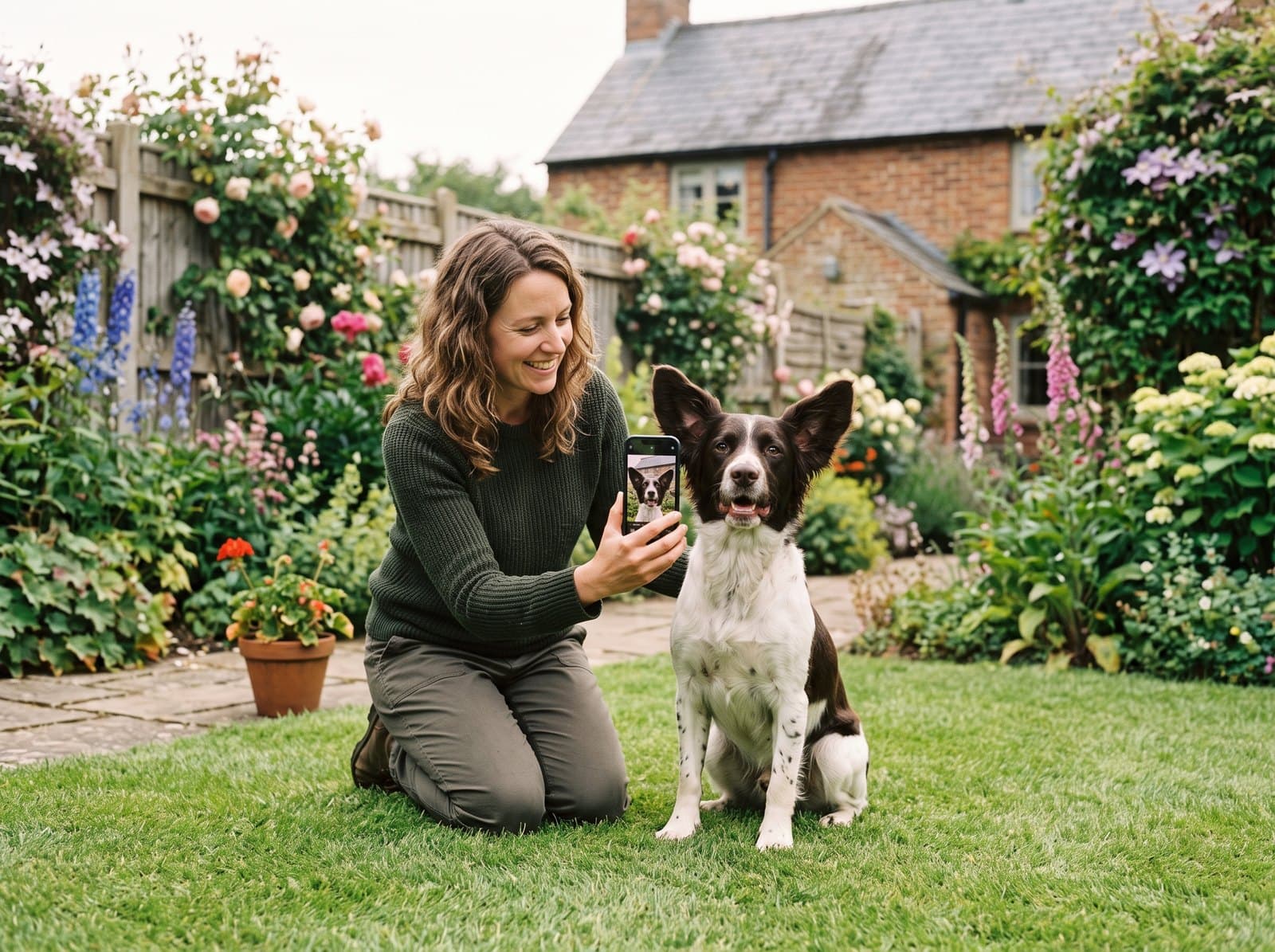
Quick answer: Take your dog outside on an overcast day, or sit them beside a large window with the room lights off, and get your phone down to the height of their eyes. Stand about a metre and a half back, use the ordinary 1x lens, turn Portrait mode and flash off, tap the nearest eye to focus, and hold the shutter for bursts while someone behind you makes one interesting noise. Keep the frames where the eyes are sharp and the ears are up. That is most of how to photograph your dog, and it needs nothing you don't already own. If the picture is going to become a hand-painted dog portrait, those same two things — daylight and sharp eyes — are what the painter needs most.
Light decides the photo before you press anything
If you learn one thing about how to photograph your dog, make it this: choose the light, then choose the pose.
Overcast daylight is the best light in Britain, and we have a great deal of it. A grey afternoon behaves like an enormous soft lamp: no hard shadows under the brow, no squinting, no burnt-out patches on a pale coat. Cloud is not a compromise; it is the ideal.
Bright sun is harder than it looks. Midday sun turns a golden retriever into a white blob and a black labrador into a silhouette. If the sun is out, walk into open shade and face the dog towards the open sky rather than the wall.
Indoors, one big window and nothing else. Turn the ceiling lights off, because bulbs and daylight together give a colour cast that makes fur look muddy. Sit the dog a metre from the window, three-quarters on to it, so one side of the face is lit and the other holds a soft shadow. That shadow is what gives a face its shape.
Flash is the one to avoid entirely. It flattens the coat, bounces a green-blue reflection off the back of the eye, and makes most dogs flinch. Set it to Off and leave it there.
Get down to their eyes
Almost every dog photo taken from standing height shows the top of a head, a lot of back and a stretch of lawn or laminate. The single biggest free improvement is to kneel, sit or lie down until the lens is level with the dog's eyes, or a fraction below. Wear something you don't mind getting muddy; this is not a job for good trousers.
Settings worth changing, and the ones that aren't
A phone from the last five or six years is more than enough. What it cannot do is rescue bad light or a bad angle, and the software layered on top of the lens is built to flatter a six-inch screen rather than record a dog faithfully. Most of this is about switching things off.
- Use the standard 1x lens from about 1.5 metres. The ultrawide makes noses bulge and ears recede.
- Don't pinch to zoom. On most phones that is a crop, not a zoom. Take a step forward instead.
- Tap the nearest eye to focus, and hold your finger there until it locks. If the dog moves, tap again.
- Turn off Portrait mode. The artificial blur guesses where the dog ends and reliably gets it wrong at the whiskers, the ear fringe and the fluff along the muzzle.
- Hold the shutter for a burst. Dogs blink, lick and look away constantly. Ten frames in a second gives you the one where the ears are forward and the tongue is in.
- Wipe the lens. A smeared lens is the most common cause of soft, hazy pictures no setting can fix.
Getting the dog to take part
Most guides on how to photograph your dog assume a dog that sits when asked. Plan instead for ninety seconds of attention, several times, with breaks.
Start with a short walk so the first mad ten minutes are spent, and get the light and your position sorted before you bring out anything interesting. Sounds work better than treats — a treat produces a fixed, slightly desperate stare at your hand, while a small unfamiliar noise (a squeak, a click of the tongue, a crinkled crisp packet) produces the alert, ears-up look for about two seconds. Have the camera ready before you make the noise.
A second person helps enormously. Have them stand directly behind you, holding the noise just above your phone, so the dog looks towards the lens rather than off to one side. If the dog doesn't know sit and stay, a lead clipped to something and cropped out later is entirely legitimate. Stop after fifteen minutes; a bored dog looks bored in every frame.
Black dogs, white dogs and the ones in between
Coat colour changes the approach more than breed does.
Black and very dark dogs are the hardest. The phone's meter either washes out the background or leaves the dog as a shape with no visible eyes. Get them into the brightest soft light you can find — open shade on a bright day beats heavy overcast here — with something mid-toned behind them, not a white wall and not another dark shape. Tap the eye to focus, then slide your finger down the screen a fraction to darken the exposure. A little sheen from side-light is what makes a black dog readable.
White and cream dogs have the opposite problem: bright light burns the coat out to featureless white. Overcast is ideal; failing that, keep them out of direct sun.
Brindle, merle and long-haired dogs do well in almost any soft light, and best when it comes from the side, because texture only shows when light rakes across it. Flat, front-on light makes a bearded collie look like a rug.
Phone, camera or professional: which to use
| Option | Typical UK cost | Time involved | Best for | Pick it when |
|---|---|---|---|---|
| Your phone, done properly | Nothing | 20 minutes, twice | Everyday dogs, quick turnaround, reference photos for a painting | Almost always — it is the default for a reason |
| A borrowed or second-hand camera with a 50mm lens | £0–£250 | An afternoon, plus learning the buttons | Fast, energetic dogs; larger prints | You already have one, or enjoy the process |
| A professional pet photographer | £150–£400 a session | Half a day, then 2–3 weeks for edits | A polished set of prints; several dogs; a nervous dog you'd rather not manage | You want the photographs themselves as the end product |
| A hand-painted portrait from your own phone photo | £220–£549 | 3–4 weeks | One image that will outlast the phone | You already have, or can take, one sharp daylight shot |
None of these is wrong and they aren't exclusive. What you cannot do is fix a dim, blurred, taken-from-above snap by spending money on it later.
If the photo is going to be painted
A painting asks for slightly less than people expect, and one or two things more.
Less: resolution. Around 2,000 pixels on the short side is comfortable for any canvas size, and any recent phone exceeds that. Background matters little too; a lead, a harness or a stray sofa cushion can be painted out.
More: the eyes must be sharp, and the light should be daylight. A dog's likeness lives almost entirely in the eyes and the set of the ears, and fur blurred by Portrait mode or flattened by flash has to be reconstructed rather than observed. Send the original file from the camera roll, not a WhatsApp forward — messaging apps compress photos to a fraction of their size.
Send two or three pictures rather than one: head and shoulders at eye level, plus a full-body shot or a close-up for colouring and markings. If the best expression is in one photo and the best light in another, combining two photos into one portrait explains how that goes, and dog portrait ideas covers which poses and settings work on canvas.
Our own dog portraits are painted by hand in oils from the photo you send, £220 to £549 depending on canvas size with a second dog adding from £35, and take three to four weeks. We reply with an honest read on the photo within hours, 9am to 5pm Monday to Saturday (UK time), so one that turns out not to work costs you nothing but the afternoon. Sizes are on the pricing page.
Frequently asked
What is the best time of day to photograph a dog?
Whenever the light is soft. On an overcast day that is any time between mid-morning and mid-afternoon. On a sunny day it is the hour after sunrise or before sunset, or any time at all if you move into open shade.
How do I get my dog to look at the camera?
Have a second person stand behind you and make one short, unfamiliar noise just above your phone, with your thumb already on the shutter. The alert look lasts about two seconds and you get perhaps three goes before the dog stops caring. Looking slightly off-camera is fine for a portrait, so don't force it.
Should I use Portrait mode on my phone for dog photos?
Not for anything you might print or paint. The background blur is estimated by software and consistently smears whiskers, ear fringe and muzzle fluff into the background. For a photo you'll only ever see on a screen it is harmless.
How do I photograph a black dog?
Use bright but soft light — open shade on a sunny day, or a north-facing window — with a mid-toned background rather than a white wall or a dark sofa. Tap the eye to focus and nudge the exposure down slightly so the coat keeps its detail. Side-light that puts a sheen on the fur separates a black dog from a black shape.
Is a phone photo good enough for a painted portrait?
Yes, provided it was taken in daylight with the eyes in focus and sent as the original file. The photos that fail are almost never short of resolution; they were taken with flash, taken from above, or squeezed through a messaging app.
The short version of how to photograph your dog: grey sky, knees on the ground, 1x lens, eyes in focus, flash off, bursts. Twenty minutes and the phone already in your pocket.