Subjects · · 8 min read
Dog Portrait Ideas: 14 Ways to Paint the Same Dog
Dog portrait ideas beyond the head-and-shoulders default: 14 ways to paint one dog, which photo each needs, what it costs in the UK and when to pick each.
By Thomas Mark
Last updated: September 2026
Dog Portrait Ideas
Quick answer: Most dog portrait ideas come down to four decisions: the pose, the background, whether anyone else is in the frame, and how much of the dog you show. Head and shoulders at eye level is the default because it suits almost every breed and almost every photo, but a long dog sitting side-on, a collie on a hillside or two dogs painted onto one canvas from separate photos can each suit a particular dog far better. Whichever you choose, the painting is only as good as the photograph behind it, so pick the idea your photos can support. A hand-painted dog portrait from a photo costs £220 to £549 depending on size, takes three to four weeks plus delivery, and you approve a photograph of the finished painting before it ships.
Start with the dog, not the style
The usual mistake is to browse other people's portraits, pick one, and try to fit the dog into it. A lurcher that spends nineteen hours a day folded on a sofa isn't a standing-in-a-field dog, however handsome the field. So settle three things first. What shape is the dog, and is that shape part of the appeal? Where do you picture them when you think of them? And which photos do you actually have, as opposed to the ones you wish you had? If the dog is still around, better pictures are twenty minutes' work — how to photograph your dog for a portrait covers it. If the dog has died, the idea has to fit the photo. The dog portrait ideas that disappoint are nearly always the ones chosen before anyone looked at the camera roll.
The classic poses
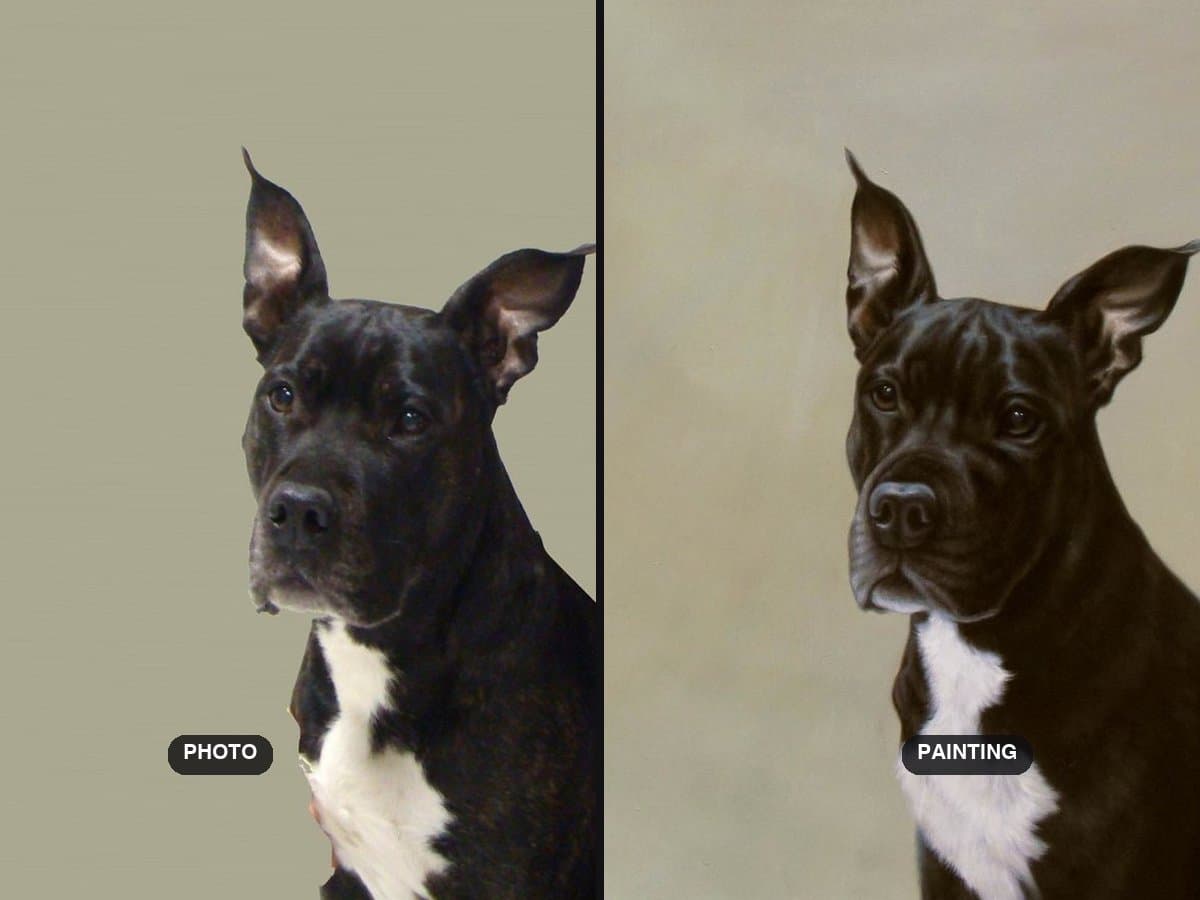
1. Head and shoulders, at eye level. Suits nearly every dog. The face carries almost all the character, a tight crop makes a modest phone photo go a long way, and it fills a 12 × 16" canvas without wasting space on floor.
2. Full body, sitting. For dogs whose shape is the point. Dachshunds, greyhounds, wolfhounds and anything with absurd proportions lose something when cropped to the face. Side-on or three-quarter on, all four feet in frame.
3. The three-quarter turn, looking off-frame. A dog looking slightly past the viewer reads as calmer and more like a portrait than one staring down the lens. It's the old convention for portraits of people, and it works on dogs for the same reason.
4. Curled up asleep. Often the truest picture of an older dog, and a sensible choice when the eyes have gone cloudy or the dog never tolerated a camera. A sleeping dog shows very little face, so the coat, the curl and the setting have to do the work.
Settings and backgrounds
5. A plain painted ground. A single colour behind the dog, usually a warm dark tone or a muted mid-grey. It's the oldest convention in portraiture and the most forgiving, because it removes the cluttered room or the car park from the photo entirely. Nearly any photo can be painted this way.
6. Their own spot. The armchair they weren't allowed on, the bed by the radiator, the second stair. A domestic setting makes the painting specific to your house, and it ages well — in twenty years the sofa will be gone and the painting will be the only record of it. It needs a photo taken there with the curtains open and the lamps off.
7. Out on the walk. A field, a beach, the woods. The right idea for a dog whose life was mostly outdoors. The photo has to be taken there, in daylight, at the dog's level; a distant speck on a hillside is a landscape with a dog in it, not a dog portrait.
8. The doorway or window. Light from one side, the dog waiting or watching. Quieter than the walk, and it flatters coats that photograph badly in flat light — black dogs in particular, which come alive with a window to one side.
Two or more in the frame
9. Two dogs together. The obvious idea for a two-dog household and the hardest to photograph, because dogs don't pose in pairs. The usual solution is to paint them from separate photos — each dog from its best picture, composed on one canvas with the sizes matched. The same goes for the dog and the cat, who have never been in a photo together voluntarily. Each extra animal adds from £35.
10. The dog with you in it. Almost nobody has a good photo of themselves with their own dog, because they're always the one holding the phone. Ask someone else, or prop the phone on a shelf and use the timer. It goes through as a family portrait rather than a pet one, with the second face adding from £35.
11. The same dog at two ages. Puppy on one side, grown dog on the other, or the young dog and the grey-muzzled one overlapped. It's a portrait of the years you've had, not just of the animal. It needs two clear photos in similar light — the puppy photo already exists, so it's the recent one that needs taking properly.
Ideas that ask more of the photograph
12. The working dog at work. A collie on the hill, a gundog carrying a bird, a spaniel in the beet. For a dog with a job, the job is the portrait. These need a photo taken in the moment, which usually means someone other than the handler holding the camera.
13. The character shot. The head tilt, the one ear that never went up, the mid-yawn. These are the photos people love most and the ones that paint least reliably, because a split-second expression can look strange held still in oil for fifty years. Keep those as photos — except the head tilt, which paints well because it's a pose rather than a moment.
14. The memorial detail. For a dog that has died, some people don't want a face at all. The collar and tag on the hook, the lead by the door, the dent in the bed. It's a smaller, quieter object and it suits people who find a full likeness too much to look at every day. Others want the face and nothing else. Neither is wrong, and it's fine not to know yet — a memorial portrait can wait a year without losing anything.
Which idea for which dog
| Idea | Photo it needs | Extra cost | Pick it when |
|---|---|---|---|
| Head and shoulders (1) | One sharp face shot, eye level, daylight | None | One good photo, no strong preference |
| Full body, sitting (2) | Side-on or three-quarter, all feet in frame | None | The dog's shape is part of the appeal |
| Plain ground (5) | Any decent photo — background replaced | None | The photo's setting is a mess |
| On the walk (7) | Outdoors, close, at the dog's level | None | Outdoor or working dog |
| Two dogs (9) | Two separate photos, similar light | From £35 per extra animal | Two-dog household |
| With you in it (10) | Someone else holds the phone | From £35 for the second face | Almost always, if the photo exists |
| Memorial detail (14) | A still photo of the object | None | A full likeness is too much right now |
What it costs and how long it takes
Prices run from £220 for a 12 × 16" canvas to £549 for 36 × 48", set by size rather than by idea; the full list is on the pricing page. An extra dog, cat or person adds from £35.
The process is the same for all fourteen. You send the photo, or photos, with a note about the idea, and we reply with a plan for the composition — that's where the background gets swapped or a second dog added. Once you're happy to go ahead, the painting is finished in oils, and a photograph of the finished piece comes back for you to approve before it ships — we keep painting until it's right. Posted worldwide, three to four weeks plus delivery end to end, rolled in a tube, unframed.
On size, head-and-shoulders and asleep ideas sit happily at 12 × 16" or 16 × 20". Full-body, on-the-walk and two-dog compositions want 20 × 24" upwards. What size portrait for your wall goes through the arithmetic.
When a painting is the wrong choice
- The dog is a puppy. A four-month-old doesn't look like the dog it will be at two. Wait, or plan for idea 11 later.
- The only photos are action blurs. If the dog is still here, take a still set. If not, ask before ordering rather than hoping.
- You want the ridiculous expression. Some dogs are best remembered mid-yawn, and a good photo of that beats an oil painting of it.
Frequently asked
What is the best pose for a dog portrait?
Head and shoulders, at the dog's eye level, looking slightly off-camera. It suits almost every breed and puts the face where the viewer's attention goes anyway. Full body is better only when the dog's shape is a large part of its character.
What background is best for a dog portrait?
A plain, single-colour ground is the safest and works with nearly any photo, because the background is painted rather than copied. A real setting — the armchair, the beach — is better when it means something and the photo was taken there in good light.
Can two dogs be painted in one portrait from separate photos?
Yes, and it's the normal way it's done, because two dogs rarely sit well together for a camera. Each dog is painted from its own best photo and the two are composed on one canvas with sizes and lighting matched.
Should a dog portrait be head only or full body?
Head and shoulders for most dogs; full body for dogs whose proportions are the point — long, tall, very short or very hairy. Full body wants 20 × 24" or bigger.
How much does a hand-painted dog portrait cost in the UK?
Between £220 and £549 depending on canvas size, plus from £35 for each additional animal or person. That's oil on canvas painted by hand from your photo, unframed, with a photograph of the finished painting to approve before it's posted.
The short version: the dog portrait ideas worth paying for are the ones your photographs can carry. Choose for the dog you actually have, not the one in somebody else's painting.