Subjects · · 8 min read
A Cat Portrait From a Photo: What Works and What Doesn't
Getting a cat portrait from photo to canvas: which pictures work, which don't, what each option costs in the UK, and how long a hand-painted one takes.
By Thomas Mark
Last updated: September 2026
Cat Portrait From Photo
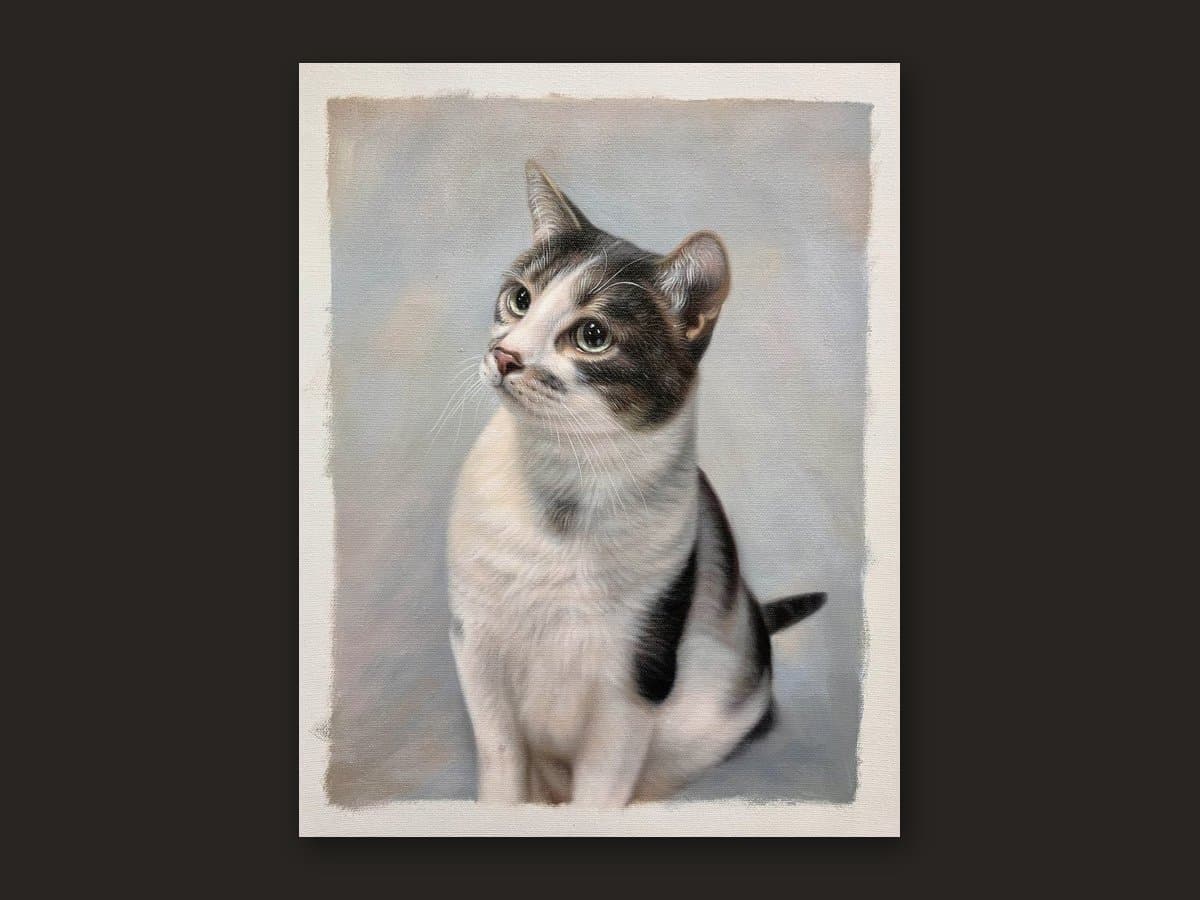
Quick answer: A cat portrait from photo reference stands or falls on one thing — whether the eyes and the shape of the face are sharp in at least one picture you own. Everything else (a dark coat, a cluttered sofa, a slightly soft phone photo) can be corrected by the painter; a face the camera never caught cannot. A hand-painted oil portrait of your cat from your own photograph costs £220 to £549 depending on size, takes about three to four weeks plus delivery, and you approve a photograph of the finished painting before it ships. If you have several imperfect photos rather than one good one, send them all.
Why cats are harder than dogs
Dogs sit. A dog will hold a pose for a biscuit, look into the lens, and let you get down to floor level. Cats do none of this. Point a phone at a cat and it either leaves, closes its eyes, or shows you the back of its head. The result is that most people's camera roll has hundreds of photographs of the cat and almost none a painter would choose.
The typical archive: dozens of pictures taken from standing height looking down at a cat on the floor; a great many asleep with no face visible; several silhouetted against a window; and two or three that are actually good, usually by accident. That last group is what you're looking for. The rest aren't useless — they show colour, markings, the set of the ears — but they are supporting evidence rather than the main reference.
What the painter actually needs
In descending order of importance:
- Sharp eyes. Not the whole cat — the eyes. Cat eyes are the whole likeness: the colour, the shape of the pupil, the slight asymmetry every cat has. If the eyes are soft, the painting will be of a cat rather than of your cat.
- A face roughly at the cat's own level. Photographs from above foreshorten the face into a wedge and turn the body into a loaf. Sit or lie on the floor. Yes, really.
- Daylight, from the side or front. A window behind you, cat facing it. Ceiling lights flatten the coat and put a green cast on everything; flash gives you reflective eyes and a startled cat.
- The characteristic expression. A painter can only paint what's in front of them, so the photo should carry the look you want on the wall — contented, alert, or mildly disgusted.
- The whole head in frame, with a bit of room. Ears cropped off by the edge can be reconstructed, but it's guesswork.
Notice that "high resolution" isn't on the list. A phone photo from the last five years is more than enough. What sinks a cat portrait from photo reference is motion blur and bad angles, not pixel count.
The photos that don't work, and the ones that surprisingly do
For a cat portrait from photo reference, some categories are reliably hopeless. A cat asleep in a ball with its face tucked in gives the painter nothing. A cat in front of a bright window is a black shape with a fringe of light, and no amount of brightening recovers a face the sensor didn't record. A photo where the cat is mid-move — turning, blinking, yawning — freezes an expression you've never seen in real life and won't want on the wall for twenty years.
Then there are the ones people apologise for that work fine. Old prints from the 1990s, photographed flat on a table with a phone. Screenshots from a video, if the frame is sharp — a cat that won't pose for a photo will often hold still for a video. Photos with a hand, a laptop or a radiator in the background; backgrounds are dropped or simplified as a matter of course.
Coat colours that cause trouble
Black cats are the classic problem, and the trouble is in the photograph rather than the painting. A phone exposes for the average of the scene, so a black cat on a pale carpet becomes a silhouette with two eyes. Fix it when photographing: soft daylight, no harsh shadows, and tap the cat's face on the screen before you shoot so the phone exposes for the cat rather than the room. In paint, a black cat is a range of warm and cool darks with light catching the fur, and a painter with a decently exposed reference will give you that. From a silhouette, they can't.
White cats have the opposite problem: the coat blows out into a featureless shape unless the light is gentle. Overcast daylight is ideal; direct sun is not.
Tabbies and tortoiseshells are the easiest to photograph and the most demanding to paint, because the markings are the identity. The stripe over the left eye, the exact split of orange and black down the nose — the owner will notice instantly if these are approximated, so a second, closer photo of the face is worth sending.
Ways to turn the photo into something for the wall
Not every cat needs an oil painting, and pretending otherwise would be silly. The honest comparison, at typical 2026 UK prices:
| Option | Typical UK cost | Time | Pick it when |
|---|---|---|---|
| Framed photographic print | £15–£40 | About a week | The photo is already excellent as it is |
| Photo printed on canvas | £25–£70 | 3–7 days | You want it cheap and large, and the photo can take enlarging |
| Digital illustration | £30–£120 | 1–2 weeks | You want a stylised, graphic look rather than a likeness |
| Pencil or watercolour commission | £80–£300 | 2–4 weeks | A lighter, sketchier feel suits the room |
| Hand-painted oil on canvas | £220–£549 | 3–4 weeks | You want the cat, in paint, for decades |
If the photograph is genuinely good, a large print may be all you want. A painting earns its place when the photograph is only a starting point: when the background needs to go, the colour needs correcting, the lighting is dull, or you want two photos combined into one image. That is most cats.
Size, composition and more than one cat
Cats are small subjects, which is a point in their favour. A 12 × 16" canvas at £220 gives a head-and-shoulders cat at close to life size, and a 16 × 20" at £275 is the most common choice for a single cat with a little room around it. Going larger than 20 × 24" for one cat is usually for the wall rather than the cat. Working out what size suits the wall is a separate question, but the short version is to measure the wall before you pick the canvas.
Head-and-shoulders is the safe composition and almost always the better likeness, because it puts the eyes at the centre of the painting.
Two cats who were never photographed together is the most common complication, and a solved one. Each additional animal or person in the same painting starts at £35, and the painter works from separate photographs to build a single composition. The only requirement is that both cats are lit from broadly the same direction, so they don't look pasted together.
What happens after you send the photo
You send the photograph — or several, with a note about which is for the face, which for the pose and which for the true colour of the coat. The painter works from these, and before anything ships you get a photograph of the finished painting to approve. This is the point to be fussy: if the eyes are the wrong green, if the white chin is too big, if it doesn't look like them, say so — it gets repainted and rephotographed until it does. Nothing ships until you're happy with it.
The finished painting is hand-painted in oil, ships worldwide rolled in a tube, and arrives unframed — a framer stretches it onto bars as part of framing it locally. Three to four weeks end to end is typical, plus delivery. The from-a-photo commission page sets out each stage.
When a painting is the wrong choice
Be straight with yourself about the reference. If the only photographs are from above, asleep, or silhouetted, and the cat is still with you, spend an afternoon on the floor with a phone and try again rather than commissioning from what you have and hoping. If the cat has died and the photos genuinely don't include a clear face, say so when you enquire; a painter would rather tell you honestly what can be done than deliver a portrait of a generic tabby.
Frequently asked
What kind of photo do I need for a cat portrait?
One where the eyes are sharp, the face is roughly at the cat's own level and the light is soft daylight from the side or front. Resolution barely matters; a phone photo from the last few years is fine. Avoid photos from above, against a window, or mid-movement.
Can you paint a cat portrait from a blurry photo?
Sometimes. If the blur is mild and the eyes and face shape are still readable, yes — coat detail and colour can be recovered from other photographs. If the face itself is a smear, no honest painter can invent it.
How much does a cat portrait from a photo cost in the UK?
A hand-painted oil portrait runs from £220 for a 12 × 16" canvas to £549 for a 36 × 48", with a second cat or a person in the same painting from £35. Canvas prints from about £25 and digital illustrations from about £30 are cheaper, but they reproduce the photo rather than interpret it.
How long does a cat portrait take?
About three to four weeks from sending the photo to the painting arriving, plus delivery, including approving a photograph of the finished painting before it ships. Add more time if you're having it framed locally.
Is a black cat harder to paint?
Harder to photograph, not to paint. Expose for the cat's face in soft daylight and the painter will have plenty to work with. A black coat in oil is a range of warm and cool darks with light on the fur, a good deal more interesting than the flat shape a phone produces.
The whole business comes down to one question: is there a photo where you can see the eyes? If yes, a cat portrait from photo to canvas is straightforward. If not, get down on the floor and take one. It costs nothing, and it's the single most useful thing you can do.