Care · · 9 min read
How to Hang a Canvas Painting: Unframed, Framed, Heavy, or From a Picture Rail
How to hang a canvas painting in a UK home: fixings for plasterboard and brick, unframed canvases, heavy paintings, picture rails and the right height.
By Thomas Mark
Last updated: October 2026
How to Hang a Canvas Painting
Quick answer: A canvas painting hangs from two D-rings fitted to the back, on the wooden stretcher bars if it is unframed or on the frame if it is not, with picture cord between them and two hooks in the wall so the weight is shared. On plasterboard, use proper picture hooks or self-drilling anchors; on brick or block, drill, plug and screw; above about ten kilograms, or in an older house with a picture rail, use a cleat or rail hooks instead. Hang it with the centre around 145cm from the floor, on an inside wall away from radiators and direct sun. A commissioned oil portrait arrives rolled in a tube rather than stretched, so before any of this applies, take it to a framer to have it stretched onto bars and framed — the framed method below is what most people end up using.
What you are hanging, and what it weighs
Before deciding how to hang a canvas painting, look at the back of it. A canvas is fabric pulled over a wooden frame called a stretcher and stapled at the back or sides. Standard bars are about 18 to 20mm deep; deep-edge bars are 35 to 40mm. You fix into the bars; the fabric itself is never touched.
Weight is lower than most people guess. A 12 × 16in canvas on its bars weighs well under a kilogram, a 24 × 36in about a kilogram and a half, and a 36 × 48in on deep bars perhaps three to four. A plain frame adds a kilogram or two; a wide bespoke or gilt frame on a large canvas can push the total past ten.
A painting from us arrives rolled in a tube rather than on bars, whatever the size, so a framer needs to stretch it before any of the fixings below go anywhere near it. A commissioned painting takes about three to four weeks to paint, plus delivery, and you see a photograph of the finished painting before it ships, so there is time to book the framer and have the wall ready by the time it arrives.
The fixings, and which wall they suit
Most of how to hang a canvas painting is knowing what your wall is made of. Tap it. A hollow sound means plasterboard, on timber studs or stuck to the masonry with dabs of adhesive; a dull, solid sound means brick or block under plaster. In a house built before about 1930 the internal walls may be lath and plaster, which is soft and unpredictable.
| Fixing | Holds roughly | Cost | Time to fit | Pick it when |
|---|---|---|---|---|
| Single-pin picture hook | 4–5kg | £2–£4 a pack | 2 minutes | Small unframed canvas on plaster or plasterboard |
| Double- or triple-pin picture hook | 8–12kg | £3–£6 a pack | 2 minutes | Medium canvas or light frame on sound plaster |
| Hardwall hook | 5–10kg | £3–£5 a pack | 5 minutes | Plaster over brick, no drill |
| Self-drilling plasterboard anchor | 10–15kg each | £5–£10 a pack | 5 minutes | Framed canvas on plasterboard, no stud in the right place |
| Wall plug and screw into masonry | 20kg and up | £3–£6 plus a bit | 15 minutes | Any heavy painting on brick or block |
| Screw into a timber stud | 20kg and up | Under £1 | 10 minutes with a stud finder | Heavy painting on a stud wall |
| French cleat | 30kg and up | £10–£25 | 30 minutes | Large framed painting, anything wide, anything above a bed |
| Picture rail hook with cord or chain | 5–15kg per hook | £3–£8 each | 5 minutes | Period house, lath and plaster walls |
These are working ranges rather than promises: a hook is only as strong as the plaster around it, and if a pin goes in with no resistance, move along and try again.
Hanging an unframed canvas
Once a framer has stretched a canvas onto bars, hanging it without a frame on top is the simpler of the two options, and plenty of people choose to leave a deep-edge canvas bare rather than pay for a frame as well.
Fit two D-rings to the back of the stretcher bars, one on each side, about a third of the way down from the top. Use the short screws that come with the rings; the bars are not thick and a long screw will come out the front. Run picture cord between the rings with a little slack, so that pulled taut towards the top it sits 5 to 8cm below the top edge. That distance is what you measure from later.
Then put two hooks in the wall, not one. A single hook lets the painting swing off level every time a door slams; two hooks about a third of the width apart hold it square and share the weight.
One shortcut to avoid is a sawtooth hanger nailed to the top bar: fine on a 12 × 16in, a liability on anything larger, because the whole weight sits on two small nails in soft timber. Finish with two rubber bumpers on the bottom corners, which keep the canvas off the wall, let air move behind it and hold it level.
Hanging a framed canvas
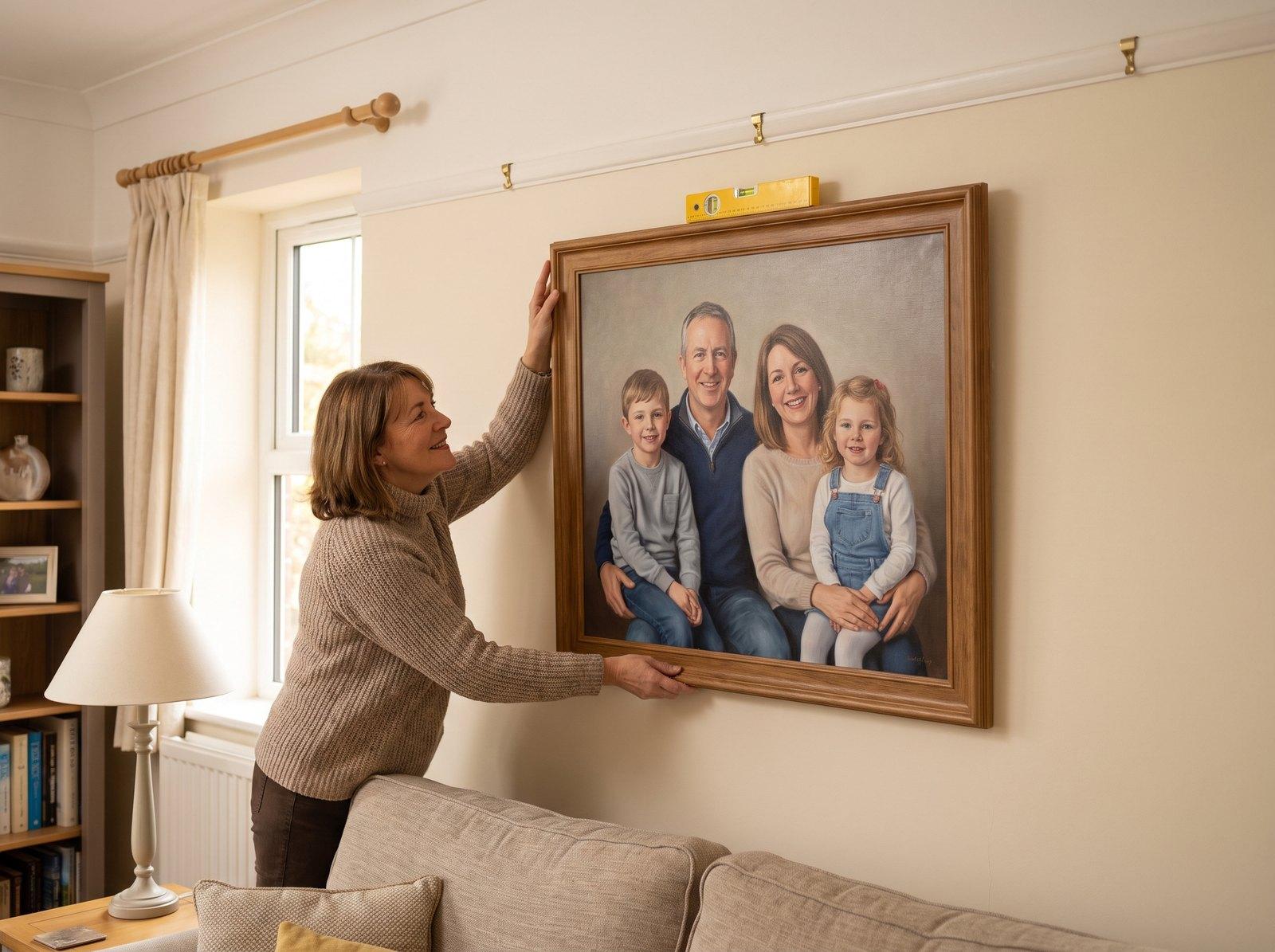
Since a framer stretches a rolled painting onto bars and frames it as one job, this is the method most people commissioning a painting end up using. A framer will normally fit D-rings and cord as part of that job; ask for them on the frame rather than the stretcher, because the frame is the stronger of the two.
Cord or wire is a question of weight. Braided picture cord is fine to about ten kilograms; above that, use plastic-coated picture wire, twisted back on itself through the ring at least four times. Wire on a single hook concentrates the whole load on one point in the plaster, so two hooks, spaced, is the rule for anything framed. The framing guide covers what a framer fits to the back and what it costs.
Heavy paintings
Above ten kilograms, or above about 30in in either direction, hooks and cord stop being the right answer.
A French cleat is the trade solution: two lengths of timber or aluminium cut at 45 degrees along their length, one screwed to the wall with the angled edge up and out, the other to the back of the frame or across both stretcher bars with the angled edge down and in. The painting lifts on and locks. The wall half must go into studs, or into masonry with plugs and screws at three or four points, never into plasterboard alone.
Between five and ten kilograms, two fixings into solid material will do: plugs and screws into brick, or screws into a stud if one falls where you need it. Big paintings are a two-person lift, and a heavy painting over a bed is asking for trouble on a plasterboard wall whatever the packet says; put it opposite the bed, or cleat it into the studs.
Hanging from a picture rail
Victorian and Edwardian houses often have a picture rail, a moulded timber strip 30 to 45cm below the ceiling. It is still the best way to hang a canvas painting on lath and plaster, which will not reliably hold a hook of any kind.
Brass or steel rail hooks slot over the rail and a length of cord, chain or wire drops from each to the painting. Two hooks with a separate drop to each D-ring keeps the painting square and is the stronger arrangement; one hook with a single cord through both rings in a V is easier to adjust but lets the painting swing. Chain looks right in a period room and shortens a link at a time; cord is cheaper and less visible; wire is strongest but awkward to adjust. Check the rail is still firmly fixed, and keep anything above fifteen kilograms off it altogether.
Getting the height right
The centre of the painting sits at about 145cm from the floor in a room where people stand, and around 135cm where they mostly sit. Above a sofa or sideboard, ignore the eye-line rule and leave 15 to 25cm between the furniture and the bottom of the canvas. Most paintings in British homes are hung too high. If the size of the canvas is the doubt rather than its height, what size portrait for your wall works that through.
To mark the wall, halve the height of the canvas and add it to 145cm; that is where the top edge goes. Pull the cord taut towards the top edge, measure from edge to cord, subtract that, and you have the hook height. Pencil it, check with a spirit level if there are two hooks, and only then pick up the hammer.
Where it goes matters as much as how it is fixed: an inside wall, away from a radiator, out of direct sun, and never a bathroom. Where to hang a portrait works through the rooms one by one.
FAQ
Can you hang a canvas painting without a frame?
Yes, once it has been stretched onto bars — a framer can do that without adding a frame on top. Fit two D-rings to the stretcher bars about a third of the way down, run picture cord between them, and hang from two hooks. Deep-edge canvases in particular look finished without a frame.
What is the best way to hang a heavy canvas painting?
Above ten kilograms, use a French cleat fixed into studs or masonry rather than hooks and cord. Between five and ten, two plugged screws in brick or two screws into a stud will do. Never trust a single hook in plasterboard with a heavy framed painting.
Do you need to drill to hang a canvas?
Not for small and medium canvases on plaster or plasterboard; picture hooks and hardwall hooks go in with a hammer. Adhesive strips work for a light canvas under about a kilogram in a rental, but they let go when the room warms up and can lift paint off the wall when removed.
How high should a canvas painting be hung?
With its centre about 145cm from the floor where people stand, nearer 135cm where they sit, and 15 to 25cm above the top of any furniture beneath it. Hanging too high is the commonest mistake.
Can you hang a canvas painting from a picture rail?
Yes, and in a house with lath and plaster walls it is the safest way. Use two rail hooks with separate drops of cord or chain to each D-ring, and keep anything over about fifteen kilograms off a rail.
The short version of how to hang a canvas painting: D-rings a third of the way down, cord between them, two hooks matched to the wall, a cleat for anything heavy, and the centre at eye level rather than above it.
More onCommissioning a painting