Care · · 8 min read
Where to Hang a Portrait So It Actually Gets Looked At
Where to hang a portrait so it gets seen and survives: the rooms and walls that work, hanging height, the light and heat to avoid, and how to test a spot first.
By Thomas Mark
Last updated: October 2026
Where to Hang a Portrait
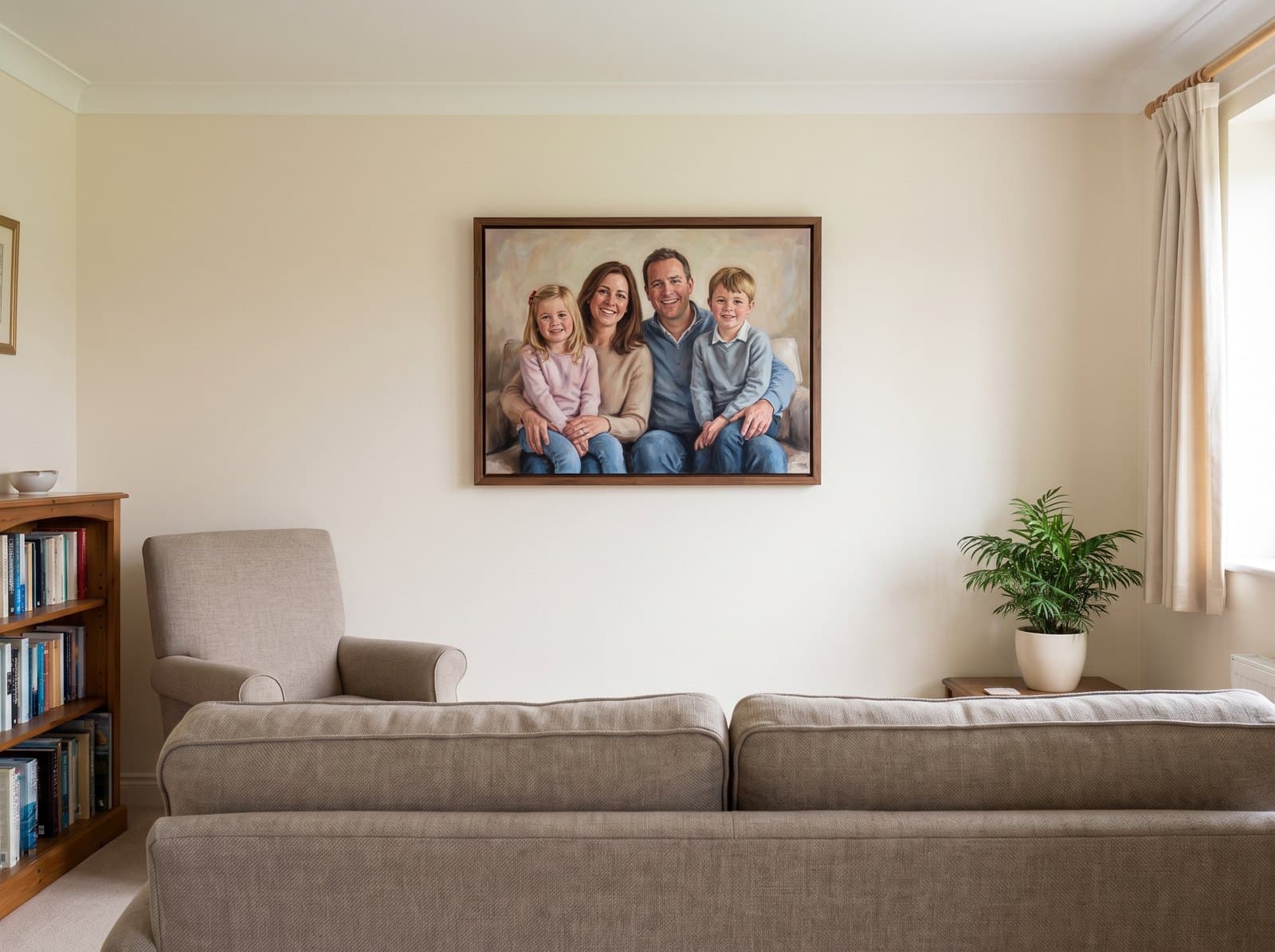
Quick answer: Hang it where people stop, not where they pass through, with the centre of the canvas around 145cm from the floor. In most British homes that means the living room wall you face from the sofa, the chimney breast if the fire is not lit every night, or the wall at the top of the stairs. Keep it out of direct sun, a metre or more from any radiator, and out of any room that steams. A family portrait that has cost £220 to £549 and taken three to four weeks to paint deserves the wall you look at most, not the one that happened to be empty.
Start with where you already look
Most people decide where to hang a portrait by walking round the house looking for a gap. That is how paintings end up on the landing, seen for a second at a time by someone carrying washing.
Reverse it. Sit in each of the places you actually sit for more than ten minutes a day and note which wall is in front of you. Sofa, kitchen table, bed, desk. Those three or four walls are the only real candidates, because a portrait is something you look at for a while rather than glance at.
Room by room
Living room. The obvious answer and usually the right one. The wall opposite the main sofa gets more sustained attention than any other surface in the house. Above the sofa is the second choice: a good wall, but only seen properly from the doorway or the other seats.
Chimney breast. The traditional home for a portrait, with one caveat covered below. The breast is narrow, so it suits a single subject or a couple better than a wide group.
Hallway. Fine for a small canvas, and a natural spot for a dog or cat portrait, since that is where the animal gets greeted anyway. Poor for anything large, because you can never stand far enough back.
Stairs and landing. The wall facing you as you climb is one of the best-looked-at walls in the house: you approach it slowly, head-on, several times a day. The wall beside the stairs is the opposite, seen sideways and at a tilt.
Bedroom. Private, soft light, no heat. A portrait of a late parent or a first dog often ends up here for good reasons.
Kitchen and bathroom. No. Not for an oil painting, whatever the wall looks like.
The three things that shorten an oil painting's life
A hand-painted oil on canvas will outlast you if it is treated sensibly. Three ordinary household conditions age it faster than anything else, and all three are about location.
Direct sunlight. Oil pigments are far more lightfast than a photographic print, but the varnish yellows and the canvas dries under a south-facing window. A wall that takes a stripe of afternoon sun for two hours a day is a wall to avoid. Bright rooms are fine; direct beams are not.
Heat. Radiators are the usual culprit. Warm rising air dries the canvas, and repeated warming and cooling makes the paint layer move at a different rate from the fabric beneath it, which is how cracking starts. Leave at least a metre between the bottom of the canvas and the top of a radiator. A chimney breast above a fire or stove lit every evening is the same problem.
Damp and steam. Kitchens lay a film of cooking grease on every vertical surface, and bathrooms swing from dry to saturated twice a day. Either gets into the canvas from the back, where there is no paint to protect it, and mould on the reverse is not something you notice until it has spread.
Picture lights sit in the same category. In a modern room with decent overhead lighting they mostly add glare, and halogen units run hot centimetres from the paint. If a dark chimney breast genuinely needs one, fit an LED unit angled to cover the whole canvas.
If a portrait has already spent a few years somewhere it should not have, how to clean an oil painting covers what you can safely do at home and what to leave alone.
The height everyone gets wrong
Knowing where to hang a portrait is only half of it; the other half is how high. The centre of the picture sits at roughly 145cm from the floor, which is average standing eye height. Most people hang higher, because a painting level with your eyes feels low while you are holding it against the wall, and then it spends its life being looked at from underneath.
Two adjustments. In a room where you mostly sit, drop the centre to around 135cm. Above furniture, ignore the eye-line rule and leave 15 to 25cm between the top of the sofa back or sideboard and the bottom of the canvas. Any less and the two objects read as one lump; any more and the painting looks as though it is drifting away.
If the canvas is too big or too small for the wall you have chosen, that is a sizing problem rather than a hanging one, and what size portrait for your wall works through the arithmetic.
Where to hang a portrait: the options compared
| Location | How much it gets looked at | Risk to the painting | Verdict |
|---|---|---|---|
| Living room, wall facing the sofa | High, daily, for long stretches | Low, unless it faces a south window | First choice |
| Living room, above the sofa | Medium, seen from across the room | Low | Good if the facing wall is taken |
| Chimney breast, fire rarely lit | High | Low | Good for one subject or a couple |
| Chimney breast, fire lit nightly | High | High: heat and soot | Avoid |
| Wall facing the top of the stairs | High, briefly, many times a day | Low | Very good, often overlooked |
| Wall beside the stairs | Low, seen at an angle | Low | Small pieces only |
| Hallway | Medium, at close range | Low | Small canvases and pets |
| Bedroom, wall facing the bed | Medium, private | Very low | Good for a memorial portrait |
| Dining room | High while eating | Low if it is a separate room | Good |
| Kitchen | High | High: grease and steam | No |
| Bathroom or conservatory | Low to medium | Very high | No |
Fixing it so it stays put
A framed 24 × 36in oil comes out at around four kilograms once it has bars, moulding and glazing on it — heavier than most people expect, and it needs more than a single panel pin.
A decent framer fits proper D-rings and cord to the back as part of stretching and framing the piece, so ask for that when you collect it rather than adding hanging hardware yourself afterwards. On plasterboard, use two proper picture hooks spaced so the cord takes the weight in two places. On brick or block, drill and plug. Avoid self-adhesive strips for anything over about a kilo; they hold until the day the room warms up.
How to frame an oil painting in the UK covers that whole step — what a framer does with a painting that arrives rolled in a tube, what fittings they add to the back, and what it costs.
Test the spot before the painting arrives
A commission takes three to four weeks to paint, plus delivery and the time a framer needs afterwards, which is plenty of time to find out whether the wall you have picked is the right one. Cut a piece of card to the size you have ordered, tape it up at the height above, and leave it for a week. If afternoon sun lands on it, if the radiator underneath is warm when the heating is on, or if you keep failing to notice it, move it.
Working out where to hang a portrait before it exists has a second benefit. Tell us the orientation and crop the wall calls for when you send the photograph, and if anything still needs adjusting once you see the photograph of the finished painting, say so before it ships — we keep painting until it is right. The from-a-photo commission page explains how ordering works.
When the answer is not a wall at all
Some portraits are better propped than hung. Ask your framer to stretch a small canvas onto bars without adding a moulding round it, and a pet portrait finished that way on a bookshelf or a mantelpiece out of the sun gets picked up and looked at more than the same picture fixed to a wall. If you are renting with a no-holes clause or between houses, leaning it there for a year or two does it no harm.
And sometimes a painting is the wrong object for the house. A small flat with one south-facing living room and a galley kitchen has nowhere safe to put a 30 × 40in oil, and pretending otherwise is how canvases end up above cookers. Go smaller, or wait for the next move.
FAQ
How high should a portrait be hung?
Centre the canvas at about 145cm from the floor in a room where people stand, and 135cm where they sit. Above a sofa or sideboard, ignore eye level and leave 15 to 25cm between the furniture and the bottom of the canvas instead.
Can you hang an oil painting above a fireplace?
Above a decorative fireplace, or one lit a handful of times a year, yes. Above a fire or stove that runs every evening, no. The repeated heating dries the canvas and cracks the paint over time, and an open fire adds soot.
Is it safe to hang a painting in a bathroom?
No. The daily swing from dry to steamy gets into the canvas from the unprotected back and encourages mould. Kitchens are nearly as bad because of cooking grease. A framed print behind glass tolerates a bathroom; an oil on canvas does not.
Should a portrait be hung in direct sunlight?
Avoid it. Oil paint resists fading far better than a photograph, but direct sun yellows the varnish and dries the canvas. A bright room is fine; a wall that takes a beam of sun for part of the day is not.
Where is the best place to hang a family portrait?
The living room wall you face from the main sofa, because that is the wall that gets looked at longest and most often. The wall facing the top of the stairs is the underrated second choice. A portrait of a late relative or pet often sits better in a bedroom, where it is private and away from both sun and heat.
More onCommissioning a painting