Subjects · · 7 min read
What to Do With Your Dog's Ashes: 11 Ideas
Wondering what to do with dog ashes? Eleven gentle UK ideas — scattering, burial, jewellery, glass and portraits — with real costs, timings and no pressure.
By Thomas Mark
Last updated: September 2026
What to do with dog ashes
Quick answer: In the UK there is no law telling you what to do with dog ashes — unlike human remains, pet ashes can be kept, buried, scattered or split between family members however you want. Individual cremation costs roughly £120–£250 depending on your dog's weight, and the ashes usually come back within 7–14 days, often in a plain wooden casket you can keep or transfer. The three most common choices are scattering somewhere the dog loved, burying them in the garden under something living, or keeping some at home in an urn, a piece of jewellery, or beside a painted portrait of your dog. There is no deadline on deciding.
There is genuinely no rush
The casket can sit in a cupboard for two years. Plenty of people find they can't face any of this in the first few months, and then one spring morning they know exactly where they want to scatter them. Ashes don't spoil. Kept dry and sealed in the bag inside the casket, they will be exactly the same in five years as they are today.
So if you're looking up what to do with dog ashes only because someone else has asked what your plans are, and you genuinely don't know — "not yet" is a complete answer.
Ideas 1–4: giving them back to a place
1. Scatter somewhere they actually loved
Not somewhere symbolic — somewhere specific. The corner of the field where they always turned back to check you were still coming. The bit of beach where the sand goes hard enough to run on. If you have to think hard about where, that's a sign to wait.
Practical note: scatter low, downwind, and expect ash to be paler and coarser than you're picturing. Grit, not dust.
2. Bury them in the garden
Legal on land you own, in England, Wales and Scotland, provided the dog wasn't treated with anything hazardous shortly before death. Dig deeper than feels necessary — 60cm or so — and mark it with something you'd keep if you moved. A stone you chose beats a plaque you ordered.
3. Plant them with a tree or shrub
The idea everyone likes, and the one most often done wrong. Dog ashes are alkaline and very high in salt and calcium, so tipping a kilo of them straight into a planting hole will kill the roots you're trying to feed. A 30kg labrador leaves roughly 900g–1.2kg of ash.
Either use a biodegradable urn designed to buffer the pH (£40–£120), or mix the ashes through at least ten times their volume of compost and spread that across a wide area rather than one hole. Acid-tolerant plants — rhododendron, blueberry, camellia — are the worst choice here. Lavender, rosemary and buddleia cope far better.
4. Scatter on water
A river, a lake, the sea. There's no permit required for pet ashes, but the sensible courtesy is to ask the landowner or harbour master first, choose a spot away from anglers and swimmers, and go at slack tide or on a flat morning. Ashes on choppy water blow back into the boat.
Ideas 5–8: keeping them at home
5. An urn you'd actually have on a shelf
Crematorium caskets are functional and often not to anyone's taste. Wooden, ceramic and pewter urns run £30–£150 and take a few days to arrive; transferring the ashes takes two minutes and a steady hand over a sheet of newspaper.
6. Split them between the family
Ask the crematorium before collection and most will divide the ashes into two or three containers for free or a few pounds. This solves the argument nobody wants to have — the son who wants them scattered on the moor and the daughter who wants them at home can both be right.
7. Make one corner of a room the memorial
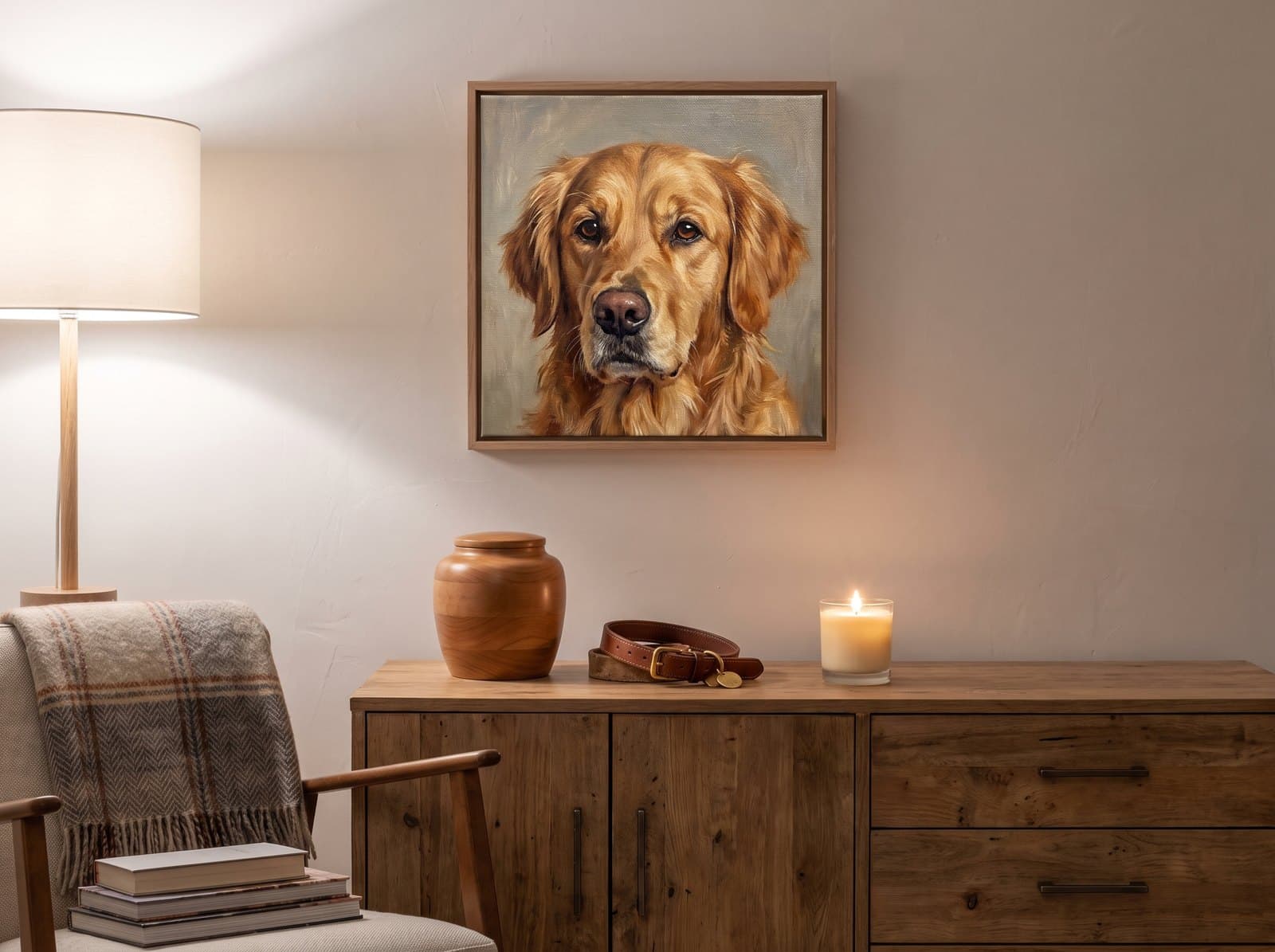
This is the option people arrive at most often and plan for least. An urn on its own in a hallway tends to feel like something you walk past guiltily. An urn under a picture of the dog feels like a place you go on purpose.
That's the reason a lot of our pet portraits are commissioned within a few weeks of a cremation. A painting is the thing you look at; the ashes are the thing underneath it. Ours are hand-painted in oils from your own photograph, £220–£549 depending on size, taking three to four weeks plus delivery — you're sent a photograph of the finished painting to approve before anything ships, and we keep painting until it's right. Full sizes and prices are on the pricing page, and if you want the dog painted with the family rather than alone, that's a family portrait instead.
8. Ashes set into glass
A glassblower suspends a small quantity of ash inside a paperweight, pebble or ornament, usually leaving faint white swirls through coloured glass. £90–£220, three to six weeks. It uses only a spoonful, so it combines happily with scattering the rest.
Ideas 9–11: carrying them, or not using them at all
9. Memorial jewellery
Pendants, rings and small brass keyrings with a sealed chamber, from about £60 for a simple silver pendant to £350 or more for cast or resin-set pieces. Most hold about a teaspoon. Check the chamber seals with a screw and an O-ring rather than glue alone, and never travel with the only portion you have.
10. Ash in tattoo ink
Real, and done by a small number of UK artists who sterilise and grind a tiny amount of ash into the pigment. Worth knowing before you ask: many studios decline it outright on infection-control grounds, and it is not reversible. If it appeals, ring three artists before committing to the idea.
11. Do nothing with the ashes, and put the memorial somewhere else
Some people never open the casket, and that's fine. The remembering doesn't have to be attached to the ashes at all — a portrait, a photo book, a bench, a donation to the rescue you got them from. If the ashes are a difficult object for you, you're allowed to leave them alone and mark the dog some other way.
Comparing the main options
| Option | Typical UK cost | How long it takes | Uses ashes? | Suits you if |
|---|---|---|---|---|
| Scattering | £0 | An afternoon | All or part | There's one obvious place |
| Garden burial | £15–£60 | An afternoon | All | You own the garden and plan to stay |
| Biodegradable tree urn | £40–£120 | 1–3 weeks to arrive | All | You want something living |
| Urn on a shelf | £30–£150 | Days | All | You're not ready to let go |
| Ashes in glass | £90–£220 | 3–6 weeks | A spoonful | You want something to hold |
| Memorial jewellery | £60–£350 | 2–5 weeks | A teaspoon | You want them with you daily |
| Hand-painted portrait | £220–£549 | 3–4 weeks | None | You want something to look at |
| Ash tattoo | £80–£300+ | One sitting | A pinch | You're certain, permanently |
Nothing on that list rules out anything else on it. Splitting the ashes is the norm, not the exception.
Frequently asked
How long can I keep my dog's ashes before deciding?
Indefinitely. Ashes are inert. Keep the sealed bag inside the casket, somewhere dry and not in direct sun, and there's no practical limit. Six months to a year is a very common gap between collection and doing anything.
Can I bury my dog's ashes in the garden if I rent?
Not without the landlord's written permission, and even then you lose them when you move. A large planted pot is the usual workaround — mix the ashes into the compost, plant something hardy, and the whole thing comes with you.
Can the ashes be split between family members?
Yes. Ask the crematorium before they're returned and they'll divide them into separate containers, usually free. Splitting them yourself afterwards is straightforward too, using a funnel over a tray, though it's a job most people would rather someone else did.
Is it safe to scatter ashes on a lawn?
In small amounts, spread thinly, yes. In a single heap, no — the salt and lime content will scorch a brown patch that lasts a season. Scatter as you walk rather than tipping in one place, and water it in afterwards.
What if I didn't get the ashes back?
Communal cremation doesn't return ashes, and a lot of people only realise afterwards what that meant. If that's you, the memorial simply moves to something else you do have — the photographs. A portrait painted from a photo works from an ordinary phone picture, and our guides cover which photos work best, including old, small or slightly blurred ones.
If you take one thing from this
There is no single right answer to what to do with dog ashes. Choose the option you'll be glad of in five years, not the one that resolves this week fastest. Scattering is final. Keeping is not. Splitting the ashes lets you postpone the final decision indefinitely, which for most people is exactly the right amount of pressure to be under right now.