Subjects · · 8 min read
Family Photo Poses That Still Work When They're Painted
Family photo poses that survive being painted: which arrangements hold up in oil, which fall apart, where the hands go, and what to do with small children.
By Thomas Mark
Last updated: October 2026
Family Photo Poses
Quick answer: The family photo poses that paint well are the ones that make a single shape — a loose triangle or a huddle, heads at different heights, shoulders overlapping, nobody more than a step from anyone else. The ones that fall apart are the line-up by height, the row of arms round shoulders and anything with daylight between the bodies. If the photograph is going to become a hand-painted family portrait, the arrangement matters more than the smile, because a painter can borrow an expression from a second frame but can't invent an overlap that isn't there. Get the shape right, take twenty frames, and send the near misses along with the winner.
What a painter keeps and what gets lost
A photograph records everything in front of it with equal indifference. A painting doesn't. Somebody spends the better part of a month deciding what the picture is about, and what survives is the large structure: the silhouette of the group, the pattern the heads make, and whether each face has room to be a face.
Most advice on family photo poses is written for the camera, and it's mostly fine. But a camera forgives a gap between two people because there's a hedge behind it; on canvas that gap is a wedge of green cutting the family in half. Six heads at the same height are tolerable in a photograph and a fence in a painting. The question is whether the pose still makes sense once everything except the shapes has been simplified.
Poses that paint well
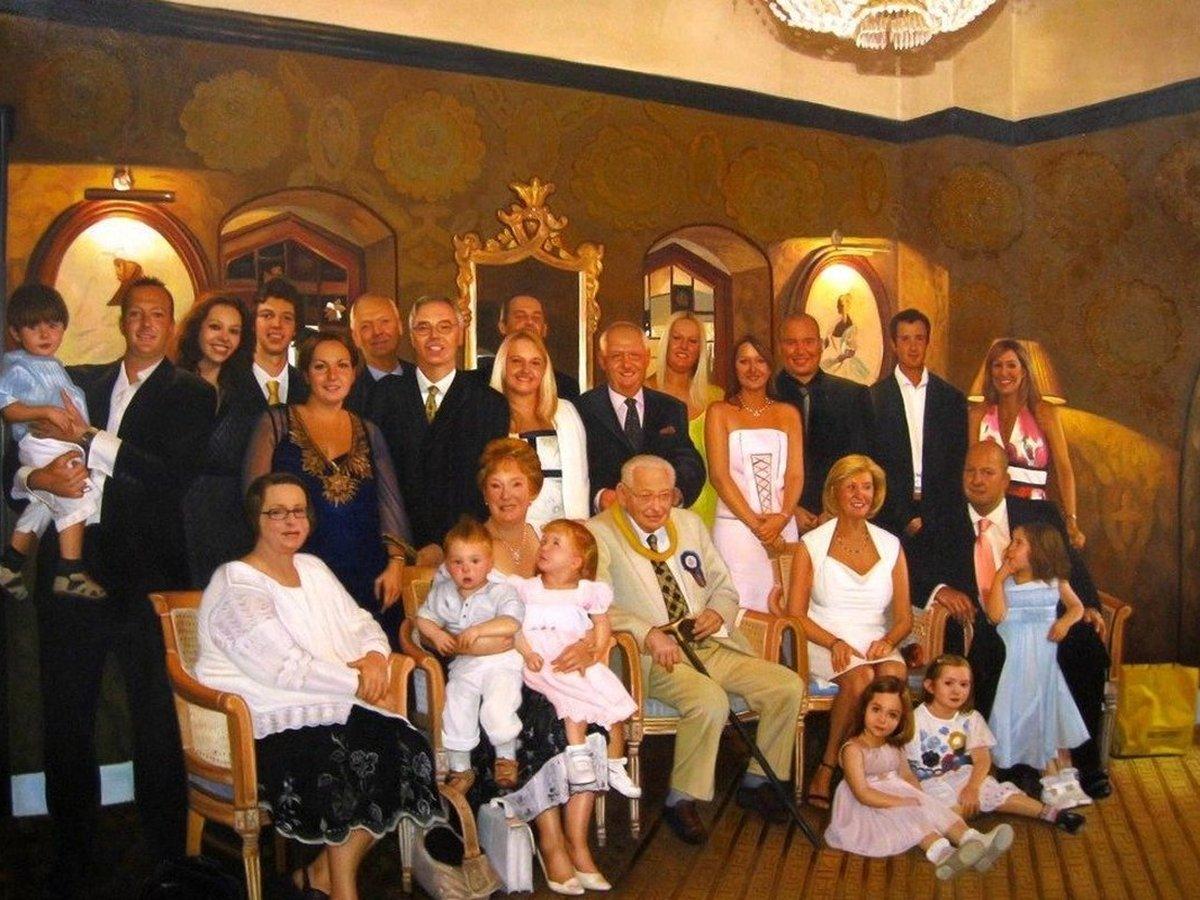
The triangle. One person seated or a child at the front, two behind, the tallest at the apex. It's the oldest arrangement in portraiture because it gives the eye a route through the picture, and it scales: a family of nine is three overlapping triangles.
Seated and standing. Put the grandparents or the parents on a bench, a wall or the arm of a sofa, and stand the rest behind and beside them. It sorts head heights without anyone thinking about it, and it's the pose for a gathering where you get one chance.
The huddle. Everyone leans towards the middle as if about to be told a secret. Shoulders overlap, heads tilt in, and the group becomes one shape with a clear centre. Slightly stagey in a photograph; paints beautifully, because there's no background between the figures.
The lap and the hip. Small children on a knee, a baby held facing the camera, a toddler on a hip. The child is held still, the adult's hands have a job, and the two figures read as one mass.
The three-quarter turn. Bodies angled slightly towards the centre, faces to the camera. Shoulders overlap without effort and each face gets a bit of a turn, which a portrait painter wants. Straight-on, square-shouldered figures look like passport photographs, and paint like them.
Poses that fall apart on canvas
The line-up. Tallest to shortest in a single row. Heads at one level, no overlap, a strip of background above and below. It's how school photographs are taken, and school photographs are not paintings.
Arms round shoulders in a row. It looks friendly. It also puts an elbow across every chest and a hand on every far shoulder, so the painter is rendering eight arms belonging to nobody in particular.
The wide spread. Six people across a garden, each in their own patch of lawn. On a 20 by 24 inch canvas the faces come out the size of a fingernail and the picture is mostly grass.
The poses, compared
| Pose | Suits | How it photographs | How it paints | Watch out for |
|---|---|---|---|---|
| Triangle | 3–7 people | Classic, slightly formal | Best of the lot; clear structure | Apex person looming |
| Seated and standing | 4–12 people | Natural at gatherings | Very well; heights sorted, faces clear | A back row too far back |
| Huddle | 3–6 people | Warm, a bit stagey | Well; one shape, no gaps | Heads tilted so far they're sideways |
| Lap and hip | Families with under-fives | Relaxed, honest | Well; child and adult read as one figure | A baby's face turned into a shoulder |
| Line-up by height | Any | Tidy, dated | Poorly; a fence of heads | Almost everything |
| Wide spread across a lawn | Large groups | Shows the garden | Poorly; faces too small to read | Faces the size of a fingernail |
Of these family photo poses, seated-and-standing is the one for twelve relatives and four minutes; the triangle is the one for four people and half an hour. The bottom two rows can be rescued for a print, not for a painting.
Hands, heads, gaps and where the camera goes
Hands cause more trouble in a painting than faces. Empty hands hang awkwardly and half-hidden hands look amputated. Give each pair something to do — a child, a pocket, a knee, a partner's arm — and keep them inside the frame or fully outside it, never cut at the wrist.
Heads should sit at different levels, with no two directly above each other; shift people half a step so each face has clear air on one side.
Gaps are the big one. If you can see background between two bodies, close it. A family that's physically touching reads as a family; a family with a hand's width between each person reads as a queue.
The camera goes at the eye level of the middle face — slightly above if anything, never below. Phone lenses are wider than they look: get close and tilt up and the front person's head becomes a football. Stand back, let the group fill two-thirds of the frame, and zoom rather than walk closer. Overcast daylight, or a window to one side indoors, is the light to want; direct sun makes people squint and puts hard shadows under noses.
Then take twenty frames, not three, and say nothing between them. The best one is rarely the frame where you said "smile"; it's the one two seconds after, when someone made a remark. Check every face at full zoom before you leave the spot.
Clothes matter as much as the pose, and the post on what to wear for family photos covers colour and pattern from the same side of the easel.
Small children, babies and the tall one
Small children go in last and at the front, because they will last roughly as long as it takes to say "one more". Hold them, sit them, or put something in their hands.
Babies are held facing the camera, a little higher than feels natural, so the face isn't buried in a shoulder. A newborn whose face isn't visible isn't in the portrait, whatever the birth certificate says.
The tall one sits down, or goes to the back and leans in. A six-foot-four son standing straight behind a five-foot-two mother puts his face in a different postcode.
If the photo is going to be painted
Three things change.
First, the near misses are useful. Send the best frame and two or three others from the same set; if the arrangement is right in one and the baby's face in another, the two can be put together, and the guide to combining two photos into one portrait explains what makes that work.
Second, some things can be changed and some can't. A background can be simplified, a stray relative removed, someone who missed the day added from a separate photograph, a gap closed a little. What can't be fixed is a face that isn't there — turned away, shadowed, blurred — so the pose has to get the faces right.
Third, size decides how much pose the painting can carry. Family portraits run from £220 for a 12 by 16 inch canvas to £549 for 36 by 48, plus from £35 per additional person; the pricing page has worked examples. Painting takes about three to four weeks, plus delivery, and before it ships you receive a photograph of the finished painting so any changes can be made. The from-a-photo commission page is where the photographs go.
None of which disqualifies the photograph you already have. All of the above is for a picture you're setting up; the one most families end up painting was never set up at all — a wedding table, a beach in 2019, the last Christmas everyone was there. If it exists, use it, gaps and all. The rules for family photo poses raise your odds when you're starting from nothing.
FAQ
What is the best pose for a family photo?
A loose triangle: one or two people seated or at the front, the rest behind, tallest at the back and slightly to the middle. Heads at different heights, shoulders overlapping, bodies turned a little towards the centre. It works for three people or ten.
How do you pose a large family for a photo?
Seat the oldest generation and the smallest children at the front, stand everybody else behind and beside them, and keep the back row close enough to touch the shoulders of the front. Build overlapping triangles rather than rows, and shoot from slightly above eye level.
Where should hands go in family photos?
On something: a child, a knee, a partner's arm, a pocket. Hands hanging loose look stiff; hands cut off at the wrist look worse. Avoid the row of arms round shoulders, which puts an elbow across every chest.
Should everyone look at the camera in a family photo?
Not necessarily. A group where one or two people are looking at a child usually reads as more alive than one where every face is fixed on the lens. For a painting, what matters is that every face is visible and sharp, not where the eyes are pointed.
Do posed or candid photos make better paintings?
Either, provided the shape is right. A posed photograph with a stiff expression can be softened with a second frame; a candid one with a good arrangement is ideal. A candid with people strung out across a lawn is neither, however natural the expressions.
The short version: for family photo poses that survive being painted, think in shapes rather than smiles. One group, not a row; heads staggered; gaps closed; hands busy; faces lit and sharp. Get that far and the painter can do the rest.
More onCommissioning a painting