Subjects · · 8 min read
What to Wear for Family Photos, From Someone Who Paints Them
Family photo outfit ideas from the painting side: the colours, fabrics and patterns that hold up on camera and canvas, and the ones that quietly ruin the shot.
By Thomas Mark
Last updated: October 2026
Family Photo Outfit Ideas
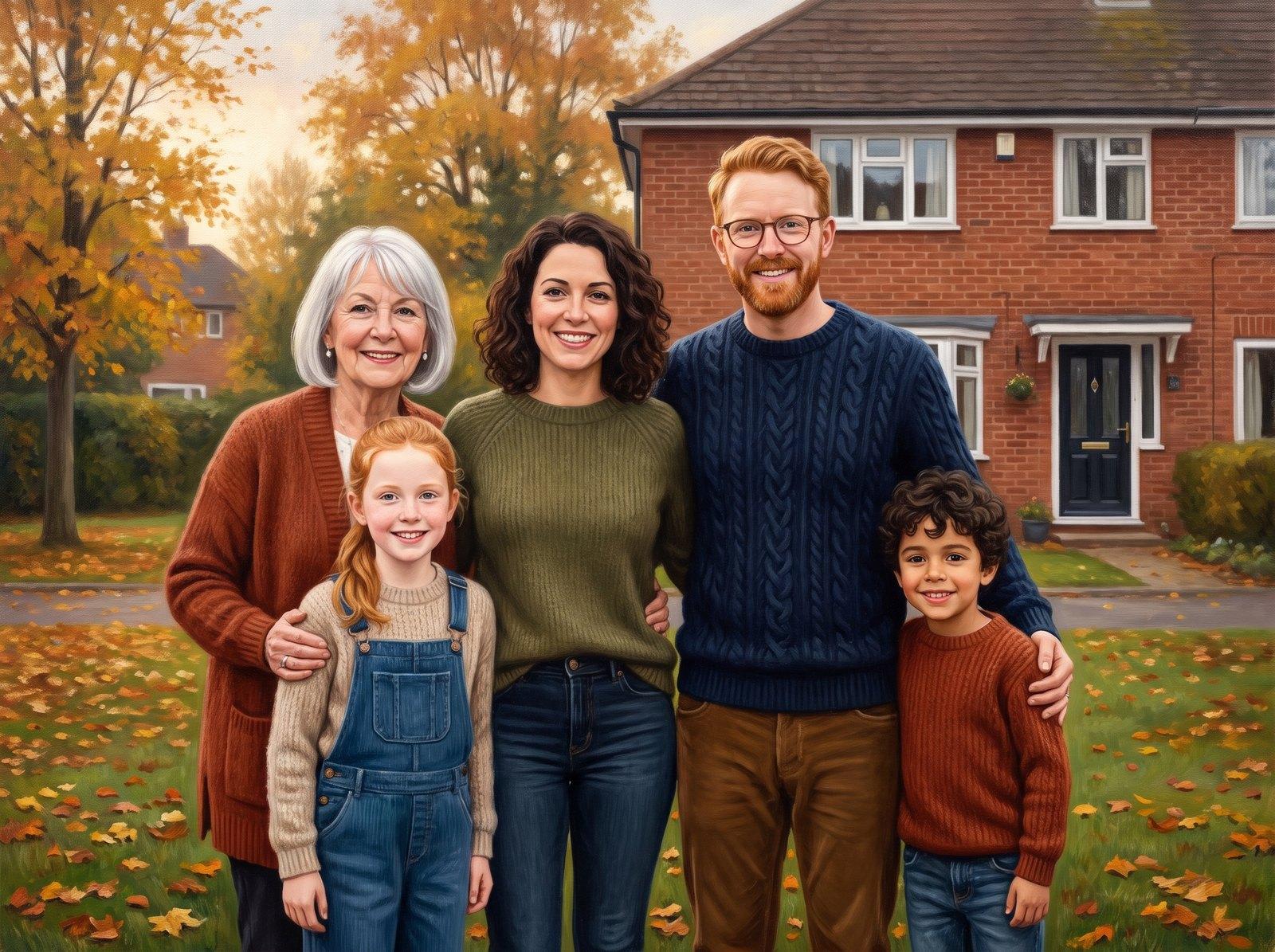
Quick answer: Choose two or three colours for the whole group, make one of them a neutral, and let everyone dress from their own wardrobe within that range instead of matching. Mid-tone colours with a bit of texture — navy, rust, olive, oatmeal, in knitwear, denim, linen or cord — hold up in almost any light; pure white, pure black, fine patterns, slogans and anything fluorescent do not. Keep the strongest colour near the centre, and check that nobody matches the wall or the lawn behind them. If the picture is going to end up as a hand-painted family portrait, the same rules apply with more force, because every stripe and logo in the photograph has to be painted.
What a painter sees that a camera doesn't
A camera records a family in a fraction of a second and moves on. A painter spends the better part of a month with the same picture, deciding what to keep. What survives is the large stuff: the shape each figure makes, its colour, how it sits against the next one, and whether the faces are the clearest thing in the frame. What gets dropped is the small stuff — the pattern on a shirt, the lettering on a hoodie. Clothing that helps the large stuff and stays out of the small stuff works for both, which is why most of the family photo outfit ideas photographers give hold up.
Start with a palette, not a shopping list
Pick two or three colours for the group before anyone opens a wardrobe. Navy, cream and rust. Olive, denim and oatmeal. Burgundy, grey and camel. One of the three should be a neutral, so the eye has somewhere to rest, and the other two should sit comfortably next to each other on a paint chart.
Then each person dresses themselves within that range. Coordination, not uniform. Six people in identical white shirts read as a shop display in a photograph and as a single pale mass with heads in a painting. Six people in related colours, each in their own clothes, read as six people who belong together.
Two refinements, both cheap. Put whoever is wearing the strongest colour near the middle of the group; a red jumper on the far left drags the composition sideways. And if you know where the picture will hang, look at that room before settling the palette. Autumn tones above a cool grey sofa look like they wandered in from another house.
Colours and fabrics that hold up
Mid-tones are the safe ground. Sage, mustard, teal, denim blue, rust, burgundy, camel, charcoal: they keep their colour in sun and shade, flatter most skin, and none of them shouts.
Texture is the second ally. A cable knit, a corduroy jacket, a linen shirt — anything with surface gives the light something to catch and the painter something to describe. Flat, shiny synthetics paint as flat patches.
Sleeves matter. Bare arms and low necklines put a lot of skin in the frame, and skin is the hardest thing to paint convincingly; three-quarter or long sleeves push attention back to the faces. If the shot is full-length, agree the shoes. Most family photo outfit ideas stop at the waist, and then the photograph includes three pairs of trainers and one pair of heels.
Glasses stay on if they are always worn — Dad without his glasses is somebody else — with the chin tipped slightly down to lose the reflections. Hats come off, because they shade the eyes and the eyes are the point.
Six things that wreck the shot
Pure white. In sunlight it burns out to a blank shape with no folds. On canvas a white shirt against a pale sky is a hole. Cream, stone or pale grey do the same job and keep their form.
Pure black. The opposite failure: every fold vanishes and two people in black become one person. Charcoal or navy read as dark without disappearing.
Fine stripes, small checks, busy prints. They shimmer on a phone screen and are a nuisance on canvas: the painter either spends a day on a shirt instead of a face or paints the pattern out. A broad Breton stripe survives; a pinstripe does not.
Text and characters. Lettering has to be rendered letter by letter, it pulls the eye from the faces, and it dates the picture to the season the T-shirt was bought.
Fluorescent anything. A lime top throws lime onto the chin above it. That cast is in the skin, not the shirt, and correction never removes it convincingly.
Whatever colour the background is. Green on a lawn, navy against the sea, cream against a magnolia wall: the figure dissolves into the setting. Check the setting before choosing.
The approaches, compared
| Approach | Cost | Time to organise | How it paints | When to pick it |
|---|---|---|---|---|
| Coordinated palette, own clothes | Usually nothing | One group message, a fortnight ahead | Cleanly — each figure separates from the next | Almost always |
| Matching outfits | £0–£150 if buying | Low | Figures merge into one block; white burns out | Only if you want the catalogue look |
| Wear whatever you like | Nothing | None | Noisy; the painter simplifies and may lose something | A candid you aren't planning |
| Themed: matching jumpers, team colours | £15–£40 a head | Low | Logos and lettering; dates instantly | Christmas cards, not walls |
| Formal: suits and dresses | Wardrobe or hire | Medium | Well, except dark suits merging together | An occasion you're already dressed for |
The first row wins on every column except effort, and the effort is one message: roughly navy, cream or rust, not matching. Everything below it trades money, comfort or the family looking like itself for a picture that isn't better.
Children, teenagers and people who hate this
A small child will tolerate an outfit for about twenty minutes, so it goes on last. Something soft, in a colour from the palette, with nothing on the front. If the dinosaur T-shirt is non-negotiable, a plain cardigan over it settles the matter. Comfortable children photograph better than well-dressed ones.
Teenagers get the palette and nothing else. Tell a fifteen-year-old the colours are navy, green or cream and they will find something they don't object to. Tell them what to wear and the resentment will be in the picture.
Adults who hate being photographed usually hate being told what to wear even more, so give them the range, not the garment. The guide to family photo poses that paint well picks up from the moment everyone is dressed and in the same room.
If the photograph is going to be painted
Three additions.
Decide the canvas before the clothes. A family portrait is priced by size and by headcount — £220 for a 12 × 16 inch canvas up to £549 for 36 × 48, plus from £35 for each additional person or pet; the pricing page sets out the sizes. On a smaller canvas there is less room for anything but faces, which makes plain clothing more important, not less.
Know what can be changed. Backgrounds can be simplified or swapped, a stray relative removed, a slogan painted out. What can't be rescued is a face in the shadow of a hat, or a figure lost against a background of the same tone; those are problems in the photograph, and the guide to the best photo for a portrait painting goes through them.
Allow the time. Painting takes about three to four weeks, plus delivery, and before it ships you receive a photograph of the finished painting so any changes can be made. For Christmas delivery the cut-off is 20 November, so a photograph taken after that is a January painting. The from-a-photo order page is where the photograph goes.
When none of this matters
All of this is for a photograph you are planning. The one that most often turns into a painting wasn't planned at all: the beach picture from three summers ago where everyone is laughing and half of them are in anoraks. Nobody sends that back because of the anoraks. The family photo outfit ideas here improve the odds when you're setting a shot up from nothing; they don't disqualify the picture you already love.
FAQ
What colours should a family wear for photos?
Two or three related mid-tone colours across the whole group, with one neutral among them — navy, cream and rust, or olive, denim and oatmeal. Avoid pure white, pure black and fluorescents, and check nobody is in the same colour as the background.
Should everyone match in a family photo?
No. Matching outfits turn a group into a single block and date the picture within a few years. Coordinating — related colours in different garments — keeps the family looking like one family while each person still looks like themselves.
What should you avoid wearing for family photos?
Fine stripes, small checks and busy prints; logos, slogans and character clothing; fluorescent colours; head-to-toe white or black; and anything that matches the setting. Hats and sunglasses come off for the picture itself.
What should children wear for family photos?
Something soft and plain in a colour from the family palette, with nothing written on it, put on as late as possible. A comfortable child in the wrong colour beats a miserable child in the right one.
Does it matter what we wear if the photo is being painted?
More than for a print, because whatever is in the photograph has to be painted. Plain mid-tone clothing with some texture paints best; fine patterns, lettering and pure white or black cause the most work for the least reward. Even so, a good photograph in the wrong clothes beats a poor one in the right ones.
The short version: the family photo outfit ideas worth following are dull ones. A palette rather than a uniform, mid-tones rather than extremes, texture rather than print, and nothing on the front. Get those right and the clothes stop being the subject, which is the whole idea.
More onCommissioning a painting