Subjects · · 8 min read
A Family Portrait With Someone Who Has Died In It
Portrait of family with deceased relatives: how two photographs become one painting, which photos work, what it costs in the UK, and when it is the wrong idea.
By Thomas Mark
Last updated: September 2026
Portrait of Family With Deceased
Quick answer: A portrait of family with deceased relatives in it is made from two photographs: the family as they are now, and a separate picture of the person who has died, brought together into one image. A retoucher can do that digitally (£30 to £150), or it can be painted in oils as a memorial portrait from both photographs, which costs £220 to £549 plus from £35 for each additional person and takes about three to four weeks, plus delivery. Painting copes best when the two photographs are decades apart, because nothing is cut and pasted. For some families the right answer is a portrait of the person alone, hung beside the family picture rather than inside it.
Why the photograph was never taken
Almost everyone asking for a portrait of family with deceased members is in one of three situations.
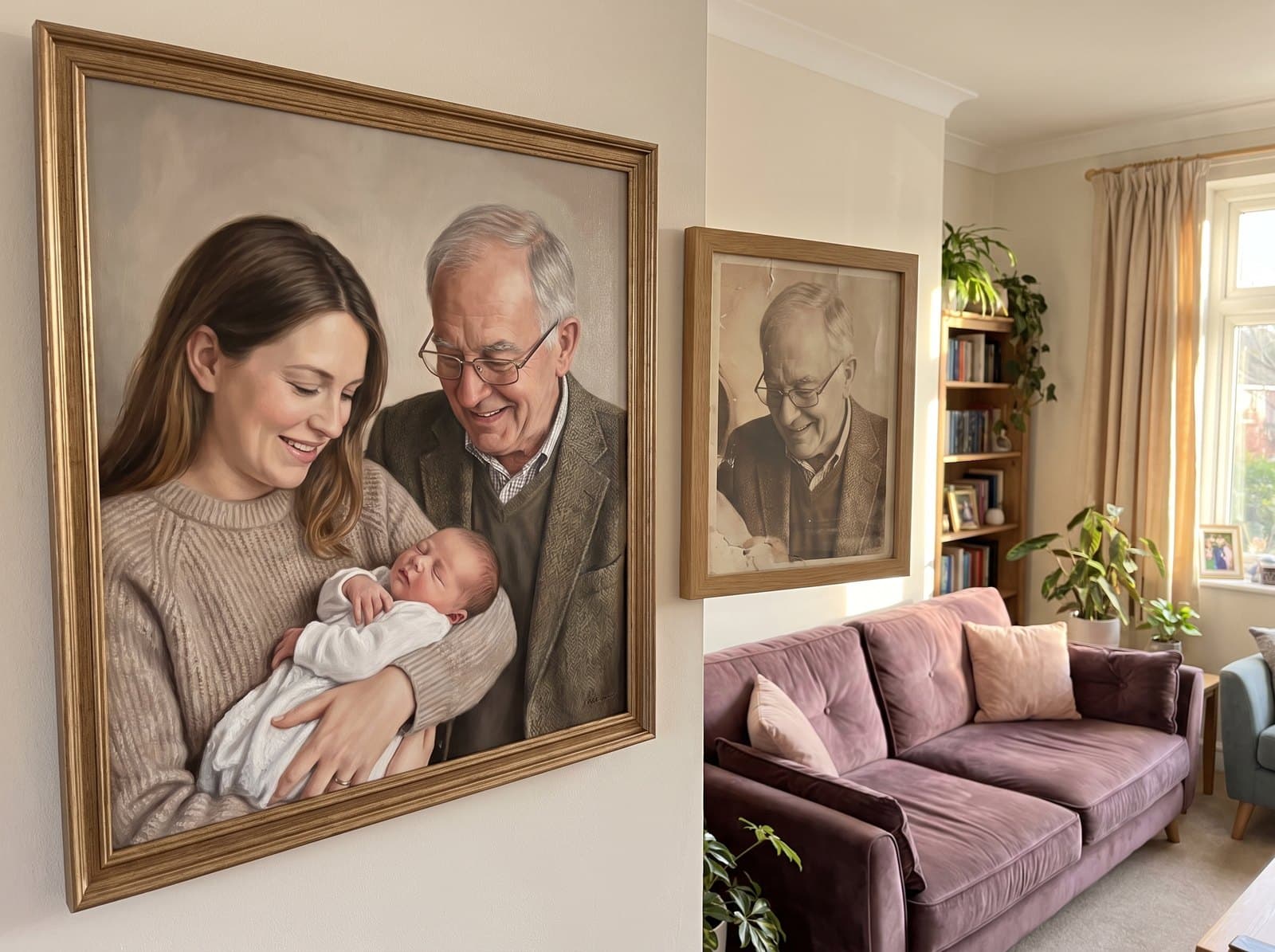
The first is the grandparent who never met the baby. A father dies in March; his granddaughter arrives in October. There is no photograph of the two of them and never will be, and the family wants the picture that would have existed if the dates had fallen differently.
The second is the group photograph that kept being put off. The last time everyone was in one frame turns out to be a wedding in 2011, with two people who have since died and three not yet born.
The third is a parent or partner who died young, whose children have since grown up. The pictures of them together stop at a certain age, and a painting of the family as it is now, with that person in it, says they are still counted.
How two photographs become one picture
The mechanics are the same whichever route you take. You need a base photograph of the family as they are, and a second photograph of the person who has died. The second is placed into the first, scaled and lit to match, and the join is made to disappear.
What differs is how well it disappears. A retoucher working on the photographs themselves has to make the pixels agree: the same direction of light, the same sharpness, skin tones from the same generation of camera. When the sources are twenty years apart that is hard, and the result often looks like a person standing in a room they were never in.
A painter has an easier job, because nothing from either photograph survives into the finished picture. The photograph of your father is a reference for his face and the set of his shoulders, not a piece of film to be blended. The light, the clothing and the background are all decided afresh. Combining two photos into one portrait goes through what can and cannot be done, but the more the source photographs disagree, the more the painting has the advantage.
Choosing the photograph of the person who has died
This is the decision that matters, and usually the slowest.
You want a photograph in which the face is clear, reasonably large in the frame and turned roughly the way they will be turned in the finished picture. If the family in the base photograph are looking at the camera, a three-quarter view of your mother laughing at somebody off to the side will not sit easily among them. A plainer photograph in which she is looking at the lens will paint better.
Old prints are fine. Take the picture out of its frame, lay it flat by a window on a dull day and photograph it straight down without flash. Faded colour, a crease and the soft focus of a 1980s print are all workable, provided the face reads. The one thing that consistently disappoints is a small face lifted out of a distant group shot. The best photo for a portrait painting is a short checklist worth running through before the family settles on anything.
What age to paint them
This is the one families argue over.
A grandfather who died at seventy-eight can be painted at seventy-eight, beside the grandchild he never met, which is truthful. Or he can be painted at forty-five, from the photograph his children think of first, which is how they remember him. Both are legitimate. What does not work is dodging the choice and hoping the painter will average it out.
Use the photograph the widow or the children instinctively reach for, whatever age it shows. If that makes Grandad look younger than his own son, that is not a mistake; the portrait is for the family, not for the record. Where the family are genuinely split, two separate portraits beat one that half of them dislike.
Where they stand in the picture
A portrait of family with deceased relatives can place the missing person in the group, as if present, or set slightly apart: in the background, in a doorway, as a framed picture on the wall behind everyone else.
In the group is the natural choice for a grandparent and a baby, where the whole point is the meeting that never happened. Slightly apart suits a family that wants to acknowledge the loss rather than paint over it. Some families find the first consoling and the second unbearable, and others exactly the reverse, so ask before anything is commissioned.
A plain painted background is easiest and ages best. A place the person never stood in can feel wrong to the people who knew them.
The options, compared
| Option | Typical UK cost | Time | Best when | Weakness |
|---|---|---|---|---|
| Two framed photographs hung side by side | £40–£120 | 1–2 weeks | The family are not ready for a combined image | It is two pictures, not one |
| Digitally combined photograph, printed | £30–£150 | 1–2 weeks | Both photographs are recent and lit alike | Older sources look pasted in |
| Combined photograph printed on canvas | £60–£200 | 2–3 weeks | You want it large and inexpensive | The same join, only bigger |
| Hand-painted oil portrait from both photographs | £220–£549, plus from £35 per extra person | 3–4 weeks, plus delivery | Sources are decades apart, or the best photo is small or damaged | Cost, and the wait |
| A portrait of the person alone, hung with the family picture | £220–£549 | 3–4 weeks, plus delivery | The family disagree about age or placement | Does not put them in the group |
The first row is not a consolation prize. In the first year after a death it is often the right answer, and the combined picture can come later.
What the painted version involves
A family portrait in oils is hand-painted on canvas from the photographs you send: the base picture of the family and the separate picture of the person who has died. Prices run from £220 to £549 depending on size, with each additional person from £35; the pricing page sets out where the lines fall. Backgrounds can be changed, people added or removed, and the stranger's elbow at the edge of the wedding photograph left out.
Painting takes about three to four weeks, plus delivery, which is included worldwide, and before it ships you receive a photograph of the finished painting so any changes can be made. That matters more here than in any other commission, because the family are the only people who know whether the likeness is right. The painting arrives unframed, to be framed locally.
If it is for Christmas, order by 20 November, which is the last date for the Christmas run. For an anniversary or memorial service, work back from the date and allow six weeks, so there is room to change something after you have seen the finished painting.
When it is the wrong idea
It is wrong when the family are not agreed. If one sibling finds the thought of their father painted in beside children he never met unbearable, the picture ends up somewhere it cannot be seen, which is the worst outcome for something that cost several hundred pounds.
It is wrong in the first weeks. Nothing about a portrait of family with deceased relatives needs deciding in the month after a death, and every choice in it is made better once the house has gone quiet.
It is wrong when the only photograph is poor. A face that is small, blurred or turned away will be painted as exactly that. A good photograph of the person alone beats a weak likeness in a group.
And it is wrong as a surprise for a widow or widower. They are the one who most wants that face on the wall, and the one whose view on which face it should be cannot be guessed. Ask them.
FAQ
Can you add a deceased person to a family photo?
Yes. A retoucher can combine two photographs digitally, or a painter can work from both into a single painting. Digital is quicker and cheaper but needs the two pictures to match in light and era; painting copes far better when they are decades apart.
What photo should I use of someone who has died?
One in which their face is clear, reasonably large and turned the same way as the rest of the family in the base photograph. Old prints are fine if photographed flat in daylight. Avoid a small face lifted from a distant group shot.
Should they be painted at the age they died?
Not necessarily. Use the photograph the family instinctively chooses, which is often from years earlier. The portrait is for the people who remember them, and it is their version that counts.
How much does a portrait of family with deceased relatives cost in the UK?
A digitally combined photograph, printed and framed, is typically £30 to £150. A hand-painted oil portrait from combined photographs is £220 to £549 depending on size, plus from £35 for each additional person, and takes about three to four weeks plus delivery.
Is it strange to want a portrait like this?
No. Absent relatives have been painted into family portraits for centuries; the only new thing is that it is done from photographs rather than from memory. What matters is that the people who will live with it want it there.
The picture that was never taken can still be made. Choose the photograph slowly, settle the question of age before anyone lifts a brush, and if the family are not ready, hang two pictures side by side and let the third wait.
More onRemembering someone