Styles · · 8 min read
Oil Portrait Styles Explained: Classical to Impressionist
Oil portrait styles explained: classical, Renaissance, photorealist and impressionist, what each does to a face, and which suits your photo and your room.
By Thomas Mark
Last updated: October 2026
Oil Portrait Styles
Quick answer: Oil portrait styles are mostly a question of how much the paint is allowed to show. At one end, classical and Renaissance portraits hide the brush almost entirely and give you smooth skin, deep shadow and a dark, quiet background. At the other, impressionist portraits leave every stroke visible and treat light as the subject rather than the face. Photorealism, our default, is as smooth as the classical styles but keeps the photograph's own light and setting, and is the safest choice for most photographs. All of them are painted by hand in oil from the photo you send, cost the same £220 to £549 by canvas size, and take three to four weeks plus delivery, so the decision is about the picture and the room, not the budget.
What "style" means in a portrait
People tend to think of style as a filter applied at the end. It isn't. Style is a set of decisions the painter makes before the first stroke: how tightly to draw the features, how far to push the contrast, whether the background is a place or a colour, and how much of the brush's movement is left on the canvas.
The same photograph of your mother, painted classically, comes out dignified and slightly formal. Painted impressionistically, it comes out lit, moving and less precise around the mouth. Which is why the sensible way to choose between oil portrait styles is to start with the photograph and the wall, not with a list of art movements.
Classical, or Old Master
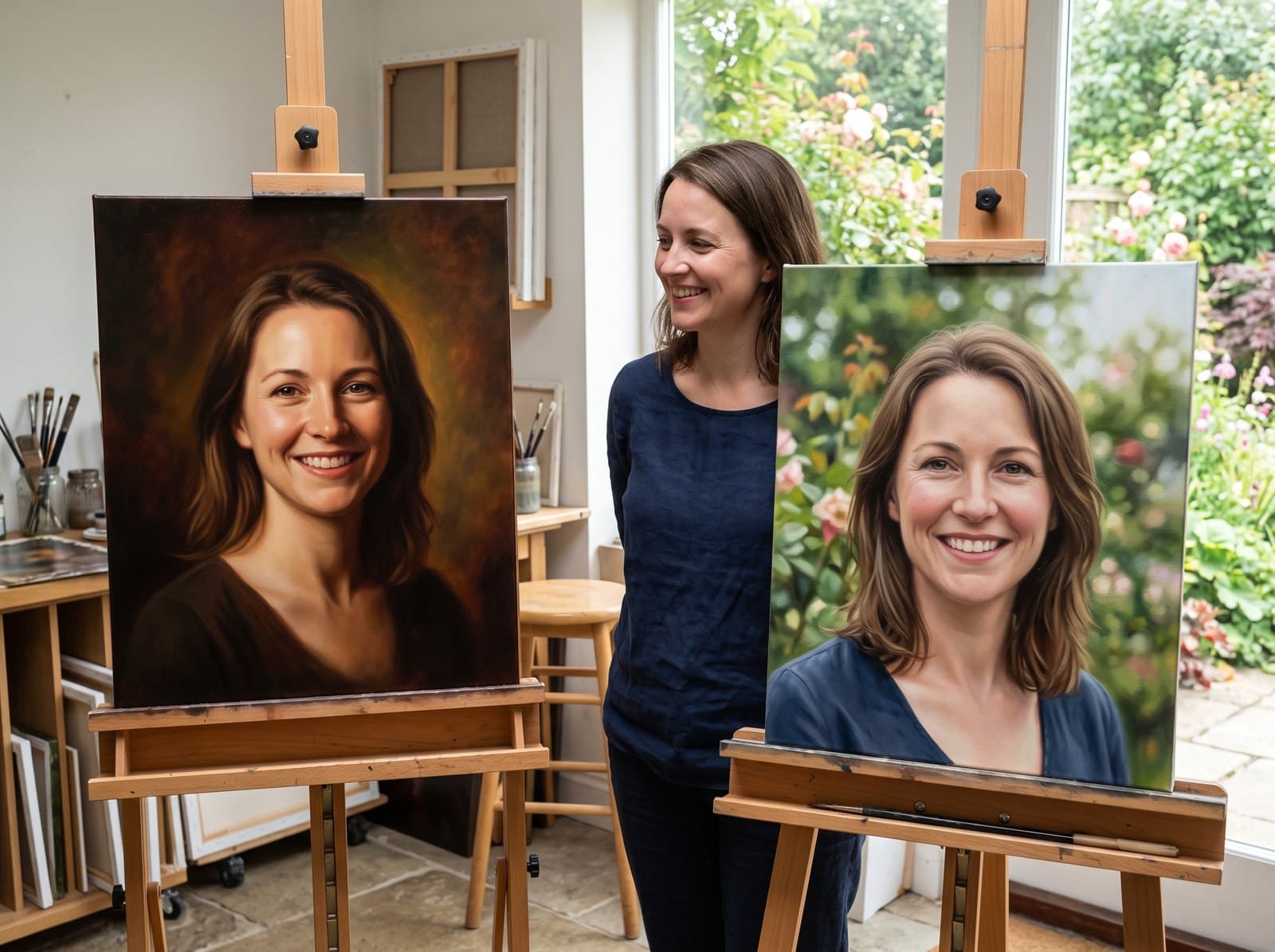
This is the style most people mean when they say "a proper portrait": a single figure or a small group, lit from one side, against a dark, warm brown or plain grey-green background. The skin is built up in thin layers so no individual brush mark reads from more than a foot away. Shadows go deep. Highlights are few and placed carefully — the bridge of the nose, the lower lip, a catch of light in each eye.
What it does well is gravity. A classical portrait makes someone look considered, which is why it remains the default for memorials, for grandparents and for anyone whose photograph you want to outlast the room it hangs in. It also forgives a busy background completely, because the background is simply replaced.
What it does badly is informality. A grinning holiday snap given the classical treatment either has its grin tidied into something more composed or ends up looking slightly odd against all that shadow.
Renaissance
Renaissance is a branch of the classical tradition and it behaves differently. Where a seventeenth-century portrait is about shadow, a fifteenth- or sixteenth-century one is about line and colour. Faces are evenly lit and finely drawn. Backgrounds are a landscape or a window rather than darkness, and there is a fondness for costume — ruffs, velvet, gold thread, the occasional piece of armour.
In practice this is the style people pick when they want the portrait to be a little bit of theatre. A dog in a ruff is not a serious painting and does not pretend to be. It works because the costume is painted with exactly the same care as the face, so the joke is well-made. The caveat is that it will always be a conversation piece, and if you are not sure the recipient wants one on their wall for thirty years, it is not the style to guess with.
Photorealism
This is our default, and it is where most photographs land. The likeness is precise — the eyes, the set of the mouth, the exact shape of a dog's ears — and the finish is smooth: fine brushes, thin layers, the paint blended until no single stroke reads. The result sits closer to the photograph than to a van Gogh, which is what most people want of a face they love.
The lighting usually follows the photograph rather than being reinvented, so it handles smiles, natural daylight and modern clothes without any of them looking out of place. Backgrounds can be simplified rather than replaced: the garden stays a garden but loses the wheelie bin. If you have a clear, well-lit photograph you already love, this is very probably the answer, and it is the one to choose for a family portrait where several faces have to be individually right.
Impressionist
Impressionism moves the subject from the person to the light on the person. Strokes are short, visible and often unblended. Colour is broken into neighbouring dabs that resolve into skin or foliage from across the room and stay resolutely paint up close. Detail in the features drops back, and the painting is composed around a mood — a garden in afternoon sun, a child moving through long grass, a figure at a window.
It is the most beautiful of the oil portrait styles when it goes right and the most disappointing when the brief was wrong. The catch is likeness. An impressionist portrait is recognisable from the posture, the hair, the shape of the head and the way the light falls, rather than from a sharply drawn face. If the whole point is that it looks exactly like Grandad, choose something tighter. If the point is that particular summer, this is the style built for it. It is also forgiving of poor photographs: a soft, overexposed outdoor picture gives an impressionist painter more to work with than a crisp studio shot.
Which style, compared
| Style | Likeness | Paint visible | Best photograph | Best wall | Pick it when |
|---|---|---|---|---|---|
| Classical / Old Master | Very high | Hardly at all | Calm expression, any background | Hallway, study, dining room | You want gravity and a portrait that reads as formal |
| Renaissance | High | Little | Straight-on pose, good detail | Anywhere with a sense of humour | The portrait is meant to be a piece of theatre |
| Photorealism | Very high | Hardly at all | Well-lit, sharp faces | Living room, above a sofa | The photograph is already good and you want it kept honest |
| Impressionist | Moderate | Everywhere | Outdoor light, movement, soft focus | Bright room, bedroom, kitchen | The mood matters more than the exact features |
| Charcoal (paper) | High | Drawn, not painted | Single face, strong light | Small walls, stairs, landings | You want quiet rather than colour |
Price does not move between oil portrait styles. A plain grey background and full Renaissance armour cost the same money; canvas size and the number of subjects are the only things that change the figure on the pricing page.
Charcoal is in the table for completeness, but it isn't oil. It is a drawing on paper — black, grey and the white of the sheet — quicker to make, lighter to hang and framed behind glass because the surface smudges. Where it loses to oil is permanence and presence: it will not carry a large wall, and it will not last centuries the way a well-kept oil painting can.
Matching the style to the photograph and the room
Look at the photograph before the style list, every time. A sharp, evenly lit picture with a plain background can go anywhere. A sharp picture with a cluttered background suits classical or photorealist work, where the background gets replaced or simplified. A soft or slightly blurred picture pushes you towards impressionism, which was made for that kind of light, or towards classical, where the painter reconstructs the face from what is legible.
Expression matters as much as focus. Big grins sit uneasily in classical and Renaissance work and comfortably in photorealism. A pet caught mid-motion is an impressionist subject; a dog sitting square to the camera with the light on its face is a classical one. Old photographs and faded prints are handled better than people expect in every style — colour that has drifted is corrected, not copied.
Then the wall. A dark classical portrait in a bright white kitchen looks like it wandered in from somewhere else; an impressionist canvas over a formal mahogany sideboard looks underdressed. Rooms with dark walls, timber or a lot of books take classical and Renaissance work naturally. Light, modern rooms take photorealism and impressionism. Loose brushwork needs distance to resolve, so an impressionist portrait wants a larger canvas and a bigger room, whereas a tightly finished classical head holds up at 12 × 16″ on a landing. The size guide covers the measurements.
Everything arrives rolled in a tube, unframed, ready for a framer to stretch onto bars — and framing is where style meets room in earnest. A classical portrait in a plain oak tray frame looks modern; the same painting in a gilt swept frame looks like it came with the house. Decide on the frame once you have seen the photograph of the finished painting, not before — the framing guide sets out the options.
FAQ
Which oil portrait style should I choose?
For most photographs, photorealism — a precise likeness with a smooth, blended finish that stays close to the photograph. It suits the widest range of pictures and rooms. Go classical for gravity, impressionist for mood, Renaissance for theatre.
Does the style change the price of a commissioned portrait?
No. Canvas size and the number of people or animals are the only two things that move the price, which runs from £220 for a 12 × 16″ canvas to £549 for a 36 × 48″ one, with each extra subject from £35. The finished canvas is delivered unframed, with delivery included worldwide.
Can I see the painting before it ships?
Yes. A photograph of the finished painting is sent for your approval before anything ships, and that is the point to say the background is too dark or a colour has drifted. We keep painting until it is right. Nothing is posted until you have said yes.
Which style is best for a memorial portrait?
Classical, most often, because the quiet background and careful handling of the face suit the occasion, and because it works from the imperfect photographs memorials usually have to start with. Photorealism is the alternative if the person was never formal a day in their life.
Can two styles be mixed in one painting?
Within limits. A tightly painted face against a loose, impressionist background is a long-standing approach. What does not work is a Renaissance costume on an impressionist canvas — the two pull in opposite directions and the result satisfies neither.
More onCommissioning a painting