Subjects · · 8 min read
A Portrait for a Funeral: What Is Realistic in a Week
Funeral portraits: what can actually be done in a week in the UK, which photograph to choose, print sizes and costs, and when a painted portrait fits later.
By Thomas Mark
Last updated: September 2026
Funeral Portraits
Quick answer: Most funeral portraits in the UK are a well-chosen photograph, enlarged to A3 or A2, mounted or framed, and stood on an easel beside the coffin or at the chapel door. That can be done properly in two to four days and costs £15 to £120 depending on whether it is mounted on board or framed. A hand-painted portrait is not a funeral-week option: painting takes about three to four weeks, plus delivery, so a memorial portrait in oils belongs to the interment, the memorial service or the first anniversary rather than the funeral itself. Spend the week getting the right photograph printed well and decide about a painting later.
How long you actually have
In England and Wales a funeral usually takes place one to three weeks after a death, with around a fortnight being typical; it stretches longer in cities, over Christmas and whenever a coroner is involved. In Scotland things often move faster, and Jewish and Muslim funerals are usually held within a day or two. So "a week" is roughly right for most families, and for some it is generous.
The days at the end of that window are already spoken for. The order of service normally has to be with the printer two to four working days before the funeral, and if the crematorium is showing photographs on its screen, the funeral director will want those a couple of days ahead too. So the photograph needs choosing in the first few days, not the last few. That is the single most useful thing to know: the decision is urgent, the object itself is not.
What funeral portraits are for
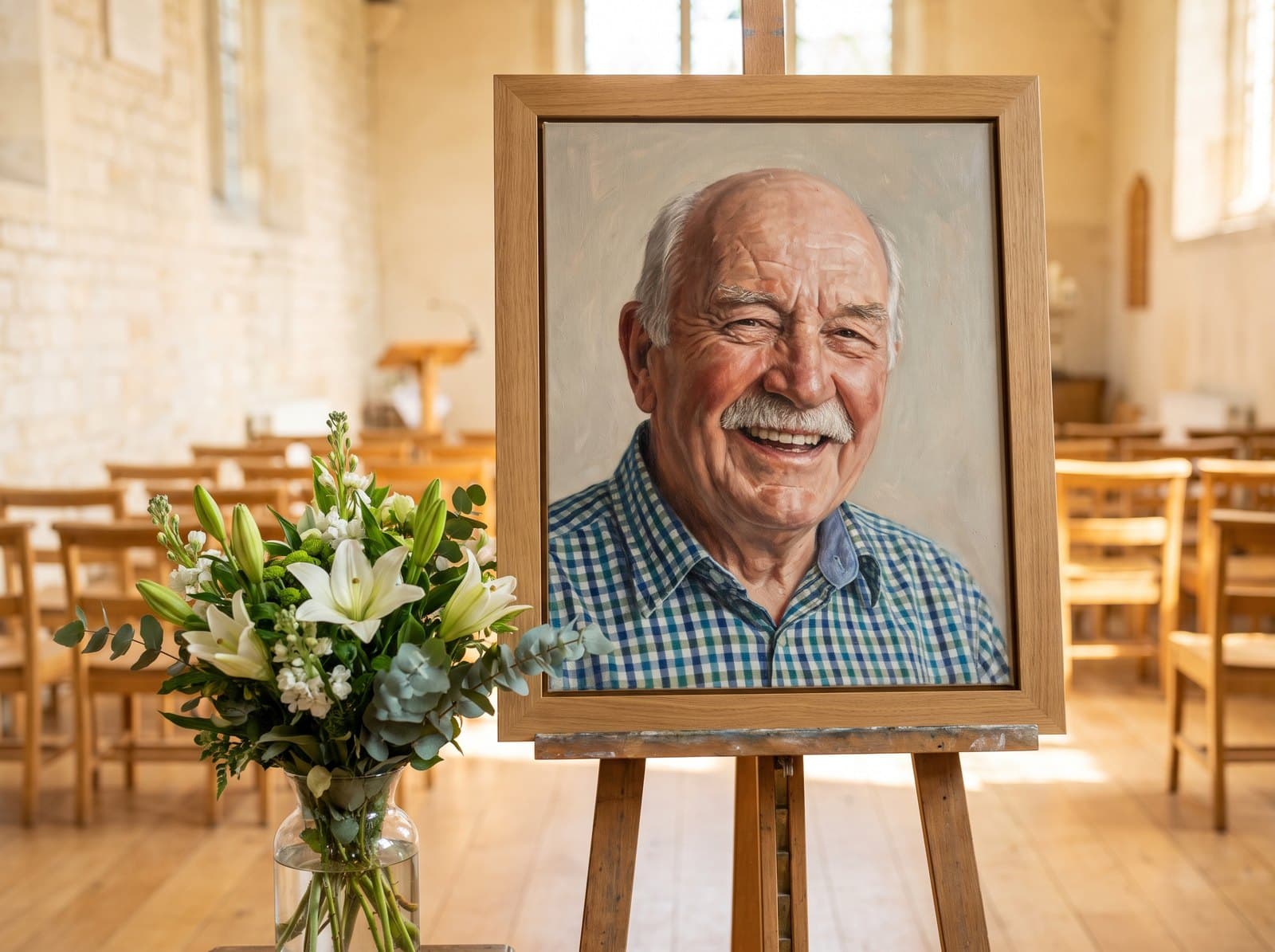
The portrait at a funeral is there so that people arriving see the person as they were, rather than a coffin. It stands at the chapel entrance or near the front during the service, usually goes on to the wake to sit by the book of condolence, and then goes home with the family, where it tends to stay propped on a sideboard for months.
That tells you what it needs to be: big enough to read from the back of a room — A3 at minimum, A2 in a large chapel — and robust enough to be carried between three venues in a day. It does not need to be a work of art. It needs to be them.
Choosing the photograph in a hurry
This is where the week is best spent, and where families most often go wrong by picking the most recent picture rather than the truest one.
The most recent photo is frequently from the last months, and the last months are frequently not how anyone wants to remember them. There is no rule that a funeral photograph has to be current. A picture from five or fifteen years ago, in which they look like themselves — the expression, the way they held their head, the coat they always wore — is the one people will stop in front of.
Practically: ask the family group chat for "the picture you'd want on the easel" and give people a day; grandchildren's phones usually hold better candid photographs than the albums. If the best image is an old print, take it out of the frame, lay it flat by a window on a dull day and photograph it straight down without flash; that is good enough for an A3 enlargement. Ask for original files rather than ones forwarded through messaging apps, which compress them heavily. The qualities that make a photograph paint well make it print well, and the best photo for a portrait painting is a short checklist that applies here too.
If the only good photograph is creased, faded or torn, a digital restoration can be turned round in one to three days for £20 to £80 and printed from the repaired file. Working from an old or damaged photograph covers what restoration can and cannot recover.
What is realistic in a week
Most funeral portraits are printed, not painted. These are the options that can genuinely be delivered inside the window.
| Option | Typical UK cost | Realistic turnaround | Best for |
|---|---|---|---|
| A3 or A2 photo print, high-street printer | £10–£40 | Same day to 2 days | The easel, with clips or a card frame |
| Print mounted on foamboard | £15–£45 | 1–3 days | The easel; no glass, no glare |
| Print framed by a local framer | £40–£120 | 3–7 days, some will rush | The version the family keeps |
| Digital restoration plus print | £30–£120 | 2–5 days | The only good photo is damaged |
| Photo on canvas, printed | £30–£90 | 3–7 days | Larger sizes where glass would be heavy |
| Photo tribute on the chapel screen | Often included | Files 2 working days ahead | Twenty photographs rather than one |
| Order of service with photograph | £50–£150 for 100 | 2–4 working days | The picture everyone takes home |
| Hand-painted oil portrait | £220–£549 | 3–4 weeks, plus delivery | The memorial service or anniversary, not the funeral |
Most families do two of the first seven and none of the last, which is exactly right for the week itself.
Getting a print done well in forty-eight hours
A few things separate a funeral portrait that looks intended from one that looks rushed.
Choose a matte or lustre finish rather than gloss. Chapels are lit from above and a glossy print on an easel reflects the lights straight back at the congregation. Foamboard mounting is the most forgiving choice: no glass, no glare, and it will not tip a light easel over.
Check the resolution before you commit. A phone photograph from the last decade will print cleanly at A3; a small file pulled from social media may not. If the picture is soft, converting it to black and white hides a great deal — slight blur, colour casts and a busy background all matter less without colour.
Ask the funeral director about the easel. Most bring one, and most crematoria have one, but it is a thirty-second question that saves a scramble on the morning. A3 sits comfortably on a standard display easel; A2 is better in a chapel that seats more than about eighty.
When a painted portrait fits
A painting is the wrong answer for the funeral. It is often the right answer for what comes after, and after is longer than the week.
There is usually a second occasion: the interment or scattering of ashes, a memorial service a few months on — common where the funeral itself was small or a direct cremation — and then the first birthday, the first Christmas and the first anniversary. Those are the dates a memorial portrait is realistic for, and the funeral week has quietly done the hardest part already, because the whole family has now looked at one photograph and agreed on it.
The practicalities, briefly. It is hand-painted in oils on canvas, from the photograph you send. Prices run from £220 to £549 depending on size, set out on the pricing page, with each additional person from £35 if the family would rather have them with a spouse than on their own. Painting takes about three to four weeks, plus delivery, and before it ships you receive a photograph of the finished painting so any changes can be made — which matters here, because there will be no better photograph later. Backgrounds can be changed and people added or removed, which is useful when the only photograph everyone loves has a hospital chair or a stranger's shoulder in it. Delivery is included worldwide.
Offer it once, and later. Some people want the face on the wall within a month; some cannot look at it for a year. Both are normal, and the print from the funeral will keep until they know which they are.
After the day
Funeral portraits go home with the family and are usually kept, so it is worth having made the print well enough to keep. Save the digital file somewhere more permanent than one person's phone — email it to two people — because it will be wanted again for the memorial's order of service, the headstone photograph and, if it comes to it, the painting. A memorial portrait covers what else that one file can become in the months afterwards.
FAQ
What size should a funeral portrait be?
A3 is the usual minimum for an easel and reads well in a chapel seating up to about eighty; A2 suits larger venues and crematoria with long aisles. For a table at the wake, A4 in a frame is enough.
Can you get a portrait painted in time for a funeral?
Not a hand-painted one, honestly. Painting takes about three to four weeks, plus delivery, and a UK funeral is typically around two weeks after the death. Print the photograph well for the day, and if the family want a painting, order it for the memorial service, the interment of ashes or the first anniversary.
Who provides the easel at a funeral?
Usually the funeral director, and most crematoria and churches have one as well. Ask when you confirm the order of service. A foamboard-mounted print sits on any display easel; a large glazed frame may need something sturdier.
Should the funeral photo be recent?
No. It should be the one that looks most like them as people knew them, which is often from years earlier. Pictures from the final illness are rarely the right choice for the easel, however recent. A candid photograph where they are laughing or mid-sentence usually beats a posed one.
What do you do with the funeral portrait afterwards?
Most families keep it for a while, on a sideboard or in the hall. It can then be reframed for the wall, passed to the person who wants it most, or kept as the reference for a painted portrait later. Keep the digital file regardless.
Funeral portraits are a printing job with a photograph decision inside it, and the decision is the part that deserves the time. Get the right picture, print it matte, mount it on board, and leave the painting for the months that follow — that is when it will be looked at properly.
More onRemembering someone